Count the Somatic Stress Release Certificate toward CE credit only after confirming that its course-specific approval covers your profession, licensing board, and participation format. A training certificate alone does not establish eligibility for license renewal. For your 2026 renewal, verify the approval statement and completion requirements before enrolling for credit.
- Somatic stress release certificate CE credit requires course-specific approval and acceptance by your licensing board.
- The Embody Lab offers CE-accredited somatic education; verify the approval attached to the exact program.
- A certificate of completion documents training, not a new professional license or automatic CE eligibility.
- Confirm approved hours, participation requirements, and documentation before using training for license renewal.
Is the somatic stress release certificate accredited for CE credit?
Do not treat the certificate title as an accreditation statement. Start with the Somatic Stress Release Certificate and review the CE information attached to that exact program. Then check whether your licensing board accepts the stated approval for your credential.
The Embody Lab offers CE-accredited somatic and trauma-informed certificate programs. That establishes the platform's professional education focus, but it does not establish blanket acceptance of every course for every license. Your decision depends on the particular activity, its approval, and the rules governing your renewal.
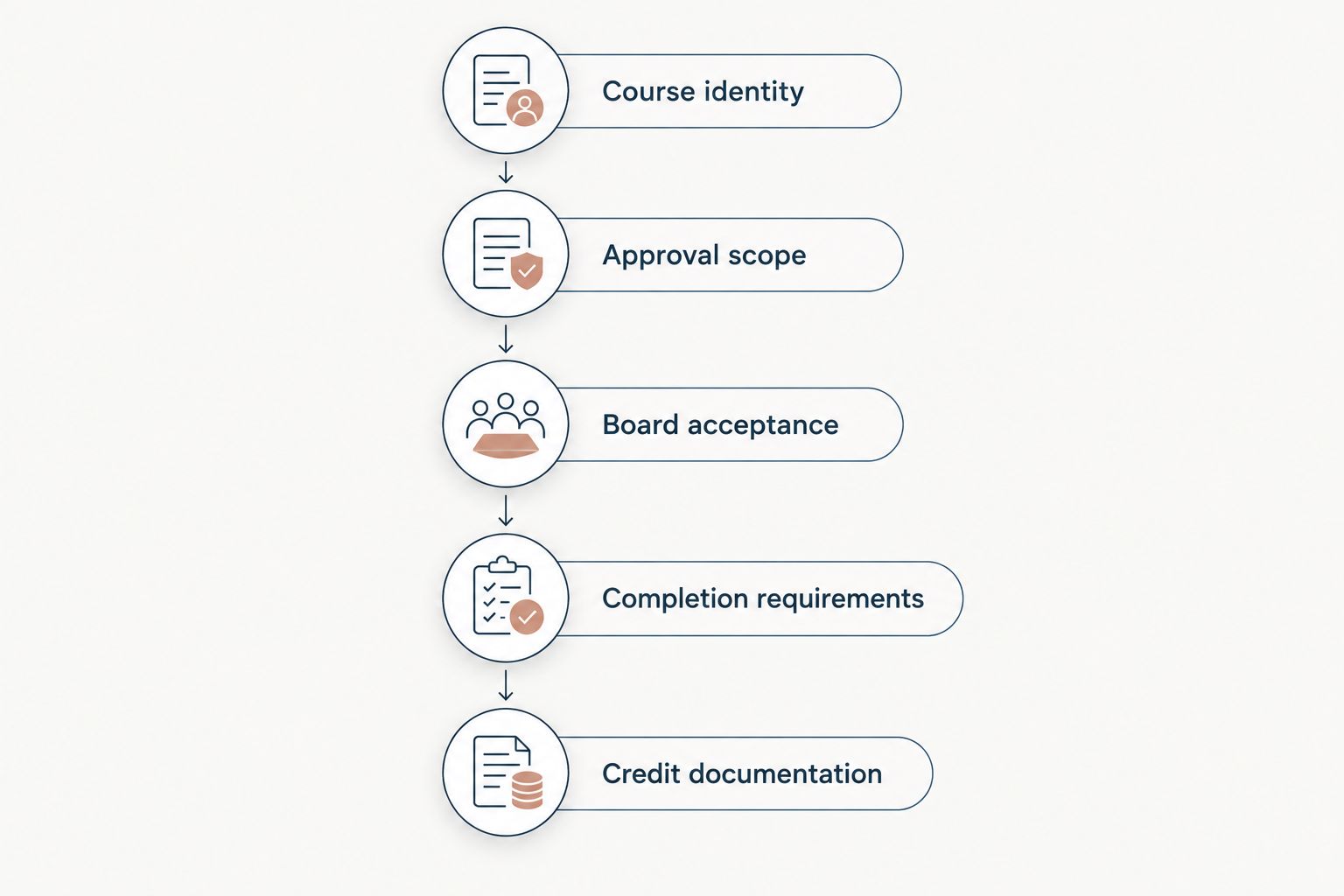
Use this sequence before assigning the program a place in your 2026 CE plan:
- Identify the exact course. Match the title, training level, and delivery format to the activity you intend to complete.
- Read the approval statement. Look for the approving organization or provider designation, eligible professions, and approved credit amount.
- Check your board's rules. Confirm that the approval and course format satisfy the requirements for your credential.
- Review completion conditions. Establish what attendance, assessment, evaluation, or other participation is required.
- Confirm the documentation. Determine what record you will receive and what your board requires you to retain.
Keep the course's educational purpose separate from its administrative eligibility. Somatic stress release training can be relevant to your practice without satisfying a particular renewal requirement. Conversely, accepted CE does not establish competence to provide every intervention discussed in a course.
Why this matters
Your CE plan has to serve your clinical development and your regulatory obligations. Those goals overlap, but they are not interchangeable. Choosing a course solely because its title includes certificate leaves the approval question unresolved.
Verify eligibility before committing the training to your renewal plan. If your 2026 deadline is approaching, an unanswered approval question creates an avoidable documentation problem. Resolve that question while you still have time to choose education that meets the applicable requirements.
For mental health practitioners, the distinction also protects how you describe your qualifications. Completing professional education supports an accurate statement about your training. It does not authorize you to imply a new license, independent certification, or expanded scope of practice.
What is the difference between a certificate and CE approval?
A certificate of completion records that you satisfied a training provider's requirements. CE approval concerns whether an educational activity qualifies under a particular continuing education system. Board acceptance concerns whether that credit meets the rules for your individual credential.
These are separate checks, not competing training options. You need the relevant evidence at each stage rather than a single reassuring label.
| Item | What it establishes | What it does not establish |
|---|---|---|
| Certificate of completion | Completion of the provider's stated training requirements | Automatic acceptance for license renewal |
| Course-specific CE approval | The activity's approval under the named CE arrangement | Acceptance by every profession or licensing board |
| Licensing board acceptance | Eligibility under the rules governing your credential | A new license or unrestricted clinical scope |
| Advertised training hours | The stated length of the educational program | An identical number of approved CE hours |
The practical benefit of a completion certificate is a record of your learning. Its limitation is equally clear: the word certificate does not answer the regulatory question. Similarly, a CE approval statement is useful only when you understand its scope.
When communicating your qualifications, describe what you actually completed. Keep the training title, provider, and credential language accurate. Do not substitute licensed, board-certified, or another regulated designation for a course completion record.
How do you verify CE eligibility before enrolling?
Course identity
Use the full program title in your inquiry. If you are considering a certificate pathway and a separately listed training level, do not assume they share an approval statement. Ask about the specific activity you intend to complete.
Save the program information associated with your enrollment. A similarly named course, an earlier offering, or another delivery format is not a substitute for the record that applies to your training.
Approval scope
Ask which professions the approval covers and which organization grants or administers it. Request the exact approval language rather than a general assurance that the course is appropriate for therapists.
Professional relevance and CE eligibility answer different questions. A trauma-focused curriculum can fit your caseload while its approval does not cover your particular credential.
Board acceptance
Compare the course approval with your licensing board's published requirements. Check the rules for your profession and jurisdiction, including any restrictions on delivery format or subject categories.
If the match is unclear, seek clarification from the board responsible for your license. A colleague's acceptance under a different credential does not establish acceptance under yours.
Completion requirements
Review the conditions for receiving credit before you begin. Ask whether attendance, an assessment, a course evaluation, or another requirement applies. Do not assume that viewing educational content is the entire process.
This is especially important when you plan to fit training around clinical work. Confirm the required participation format rather than assuming every available way to study produces the same credit outcome.
Credit documentation
Ask what information appears on the completion record and how you obtain it. Keep the approval statement, your completion documentation, and any written clarification together.
For your 2026 records, create a separate entry for the course rather than relying on a general transcript description. Clear course identity makes it easier to match your claimed credit to the supporting documents.
Why CE eligibility varies
CE eligibility varies because the course approval and the license requirements must match. The same educational activity is not automatically interchangeable across professions, jurisdictions, or participation formats.
Check these factors rather than relying on the broad category of somatic education:
- Professional credential: The approval must cover the profession under which you claim credit.
- Licensing jurisdiction: Your board sets the requirements that apply to your renewal.
- Exact educational activity: Confirm the approval for the specific certificate or training level.
- Participation format: Check the rules governing live, recorded, or other forms of instruction.
- Completion conditions: Satisfy the requirements attached to the approved activity.
- Renewal category: Determine whether accepted credit meets the particular subject requirement you need to fulfill.
A subject match is not an approval match. Training in nervous system regulation, trauma-informed practice, or somatic interventions still needs the appropriate CE documentation. The clinical terminology in a course title does not perform that administrative function.
Do training hours equal CE hours?
Training hours do not automatically equal approved CE hours. Use the credit amount stated in the course's CE approval information, not the program duration, when planning license renewal.
The distinction matters when comparing related somatic education. The following program descriptions identify training length and subject focus; the stated durations should not be substituted for verified CE amounts.
| Program | Stated training length | Best for | Fit limitation |
|---|---|---|---|
| Therapeutic Yoga for Trauma Healing and Nervous System Regulation Certificate | 30-hour program | Practitioners seeking therapeutic yoga and nervous system regulation education | Not interchangeable with Somatic Stress Release Certificate training |
| Breathwork & Movement Therapy for Trauma Healing Certificate | 60-hour online program | Practitioners seeking breathwork and movement-focused trauma education | A different educational focus does not answer the original course's approval question |
| Polyvagal Trauma Therapy Certificate | 60-hour live online program | Mental health professionals seeking applied Polyvagal Theory education | Live program duration alone does not establish your accepted CE amount |
These programs offer distinct educational directions. Their advantage is a clearly differentiated subject focus; their limitation for this decision is that none establishes the CE status of another program.
Compare curriculum relevance first, then verify credit eligibility separately. A 30-hour program and a 60-hour program differ in stated duration, but those numbers do not tell you which activity satisfies your board's requirements. Do not rank them by assumed credit totals.
Can a coach or healing professional use the certificate as CE?
A coach or healing professional needs to check the continuing education rules of the credentialing organization under which they claim credit. Acceptance for a mental health license does not establish acceptance for a coaching credential, or vice versa.
If you do not hold a credential with renewal requirements, focus on curriculum fit, completion documentation, and professional boundaries. Describe the training accurately without implying that the certificate grants clinical licensure.
Does CE approval expand your scope of practice?
CE approval does not expand your professional scope of practice. Your license, applicable law, competence, and professional obligations continue to govern the services you provide.
Use somatic education to deepen practice within those boundaries. When a course introduces unfamiliar methods, distinguish learning about an intervention from being prepared and authorized to deliver it independently.
What should you ask before enrolling for credit?
Send a focused inquiry that identifies the program and your credential. Include your profession, licensing jurisdiction, intended participation format, and 2026 renewal period. Ask for information you can retain, not just a general statement of suitability.
Useful questions include:
- Which approval statement applies to this exact certificate program?
- Does that approval cover my professional credential?
- What approved credit amount is attached to the activity?
- Are the credit conditions different for live and recorded participation?
- What must I complete to receive the CE documentation?
- Where can I confirm that my licensing board accepts this approval?
Then compare the answer with your board's requirements. The provider can clarify the educational activity and its approval; the board's rules determine how that activity fits your renewal.
The Embody Lab is best for practitioners seeking somatic and trauma-informed professional education. Choose the curriculum for its relevance to your work, and verify the regulatory fit as a separate decision.
FAQ
Is the Somatic Stress Release Certificate automatically accepted for CE credit?
No certificate title establishes automatic CE acceptance. Confirm the exact course approval, eligible professions, approved credit amount, and acceptance by the board governing your license.
Does The Embody Lab offer CE-accredited somatic education?
The Embody Lab offers CE-accredited somatic and trauma-informed certificate programs. Check the approval attached to the specific course rather than assuming every offering covers your credential.
Can I use training hours as my CE credit total?
Use the course's approved CE amount, not its advertised training duration. A program's educational hours and the credit accepted for your license are separate pieces of information.
Will recorded participation count the same as live attendance?
Check the course approval and your board's participation rules before treating recorded study as equivalent to live attendance. Confirm the completion requirements for the format you intend to use.
Does a somatic certificate make me a licensed therapist?
A somatic training certificate does not grant a therapist license. Describe your education accurately and practice within the authority and competence associated with your existing qualifications.
What records should I keep for my 2026 renewal?
Keep the course approval statement, completion documentation, and any written clarification relevant to your credential. Follow your licensing board's requirements for the information and records you must retain.
Can I claim the same course toward a coaching credential?
Check the rules of the organization that governs your coaching credential. Acceptance under a mental health CE approval does not establish acceptance for a separate coaching credential.
One last thing
Before enrolling, complete this sentence in your own records: this exact course meets this specific requirement under this approval. If you cannot identify each part, keep the course out of your confirmed CE total until the eligibility question is resolved.
For 2026, build your renewal plan around documented acceptance rather than certificate labels. That leaves you free to choose somatic education for its clinical relevance without confusing professional development with regulatory credit.