For the somatic CBT certificate cost in 2026, check the current enrollment total on the program page before budgeting. Confirm what that payment covers, particularly certificate completion and continuing education requirements, and account separately for the time you will spend studying and applying the material.
- Check the current somatic CBT certificate cost on the program page before committing your professional education budget.
- The Embody Lab offers somatic and trauma-informed education for mental health practitioners and healing professionals.
- Confirm certificate requirements and continuing education eligibility separately; they answer different professional questions.
- Compare curriculum fit and completion requirements before comparing somatic training commitments.
How much does the somatic CBT certificate cost?
Use the Somatic CBT Certificate enrollment page to check the current payment total and enrollment terms. Keep the exact program name attached to your inquiry so you receive information about the certificate you intend to take, not a different somatic training.
Your enrollment decision needs a confirmed total and a clear description of what it includes. A tuition figure alone does not establish whether the program meets your professional learning needs or your continuing education requirements.
Before committing your 2026 education budget, separate the decision into these components:
| Budget component | What to verify | Why it matters |
|---|---|---|
| Enrollment payment | The total shown for your selected enrollment option | Establishes your direct financial commitment |
| Certificate completion | Attendance, coursework, assessments, and any other completion requirements | Establishes what you must do to receive the certificate |
| Continuing education | Eligible professions, credit requirements, and applicable approvals | Determines whether the education serves your licensing needs |
| Learning access | Teaching format and access terms | Determines whether you can complete the material around your practice |
| Professional time | Study, participation, and integration into your work | Makes the training commitment visible beyond the payment |
Treat these as verification questions, not as a list of additional charges. Ask which items are included and whether anything requires a separate payment. Do not assume either answer from the word certificate.
Why this matters
A certificate can be relevant to your clinical interests without meeting every requirement attached to your professional role. That distinction matters when you are choosing education for practice development, continuing education, or both.
The Embody Lab is best suited to mental health practitioners and healing professionals seeking somatic and trauma-informed education. Its educational focus is relevant to this decision; you still need to evaluate the particular curriculum and completion requirements against your own role.
Keep the intended outcome specific. Learning to integrate body awareness into existing therapeutic work is a different objective from satisfying a licensing renewal requirement, and neither should be confused with obtaining a new professional license.
What should you confirm before enrolling?
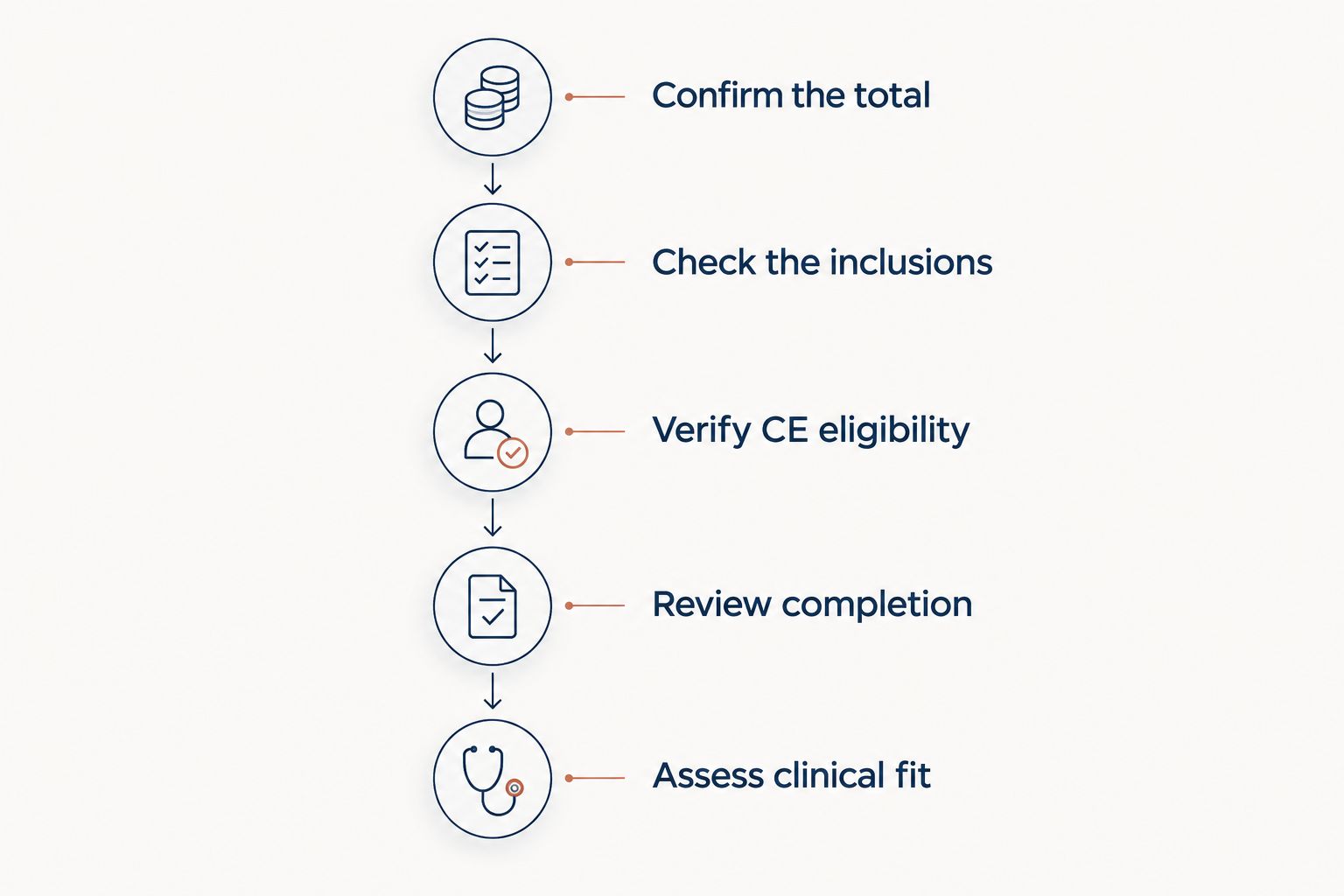
Start with the enrollment terms, then move to educational fit. This order prevents you from comparing payment totals before you know whether the programs answer the same professional need.
Confirm the total
Review the payment amount for the enrollment option you actually intend to select. If the enrollment process presents different payment arrangements, distinguish the payment schedule from the total commitment.
Ask for clarification whenever the terms leave you uncertain. Keep the response with your enrollment records so your budget rests on the stated arrangement rather than an assumption.
Check the inclusions
Confirm what your enrollment includes: instruction, learning materials, certificate processing, and any continuing education documentation relevant to your profession. Ask about each component rather than treating them as interchangeable.
This is also the point to check whether the program requires anything beyond enrollment to complete the certificate. A completion requirement is not necessarily a charge, but it still affects your decision.
Verify CE eligibility
Check continuing education eligibility for your license type and jurisdiction before assigning the program a role in your renewal plan. Provider accreditation, program approval, and acceptance by your licensing authority are distinct questions.
For a 2026 renewal decision, use the requirements that apply to your current renewal period. Save the relevant program documentation and confirm any ambiguity with the appropriate licensing authority.
Review completion
Read the requirements for receiving the certificate, not just the curriculum overview. Confirm attendance expectations, assignments, assessments, and deadlines wherever they apply.
Then compare those requirements with your actual schedule. A program that fits your interests but conflicts with your clinical commitments needs a different plan, not an optimistic calendar.
Assess clinical fit
Identify the clinical question you want the education to help you address. Review the curriculum for a direct connection to that question and distinguish introductory exposure from the depth of learning you need.
Your professional scope remains the boundary for application. Certificate completion does not replace the qualifications, supervision, or authorization required for your existing role.
Why the full training commitment varies
The enrollment payment is one part of the decision. Your total commitment also depends on what you want from the education and what completing it requires.
These factors deserve separate attention:
- Learning objective: A focused clinical learning need and a broader professional education goal call for different curriculum reviews.
- Program length: Instructional hours affect the time you must reserve, even when the payment is manageable.
- Teaching format: Live online participation and other learning formats create different scheduling questions. Confirm the format for the specific program.
- Completion requirements: Attendance, coursework, and assessments determine the work beyond simply enrolling.
- Continuing education needs: Credit eligibility matters differently when you are learning for practice development versus meeting a renewal requirement.
- Integration into practice: Reading, reflection, consultation, and application require their own place in your calendar.
Do not turn these factors into assumed charges. They explain what to investigate and how to assess the commitment; they do not establish that the certificate includes particular services or requires additional payments.
How should you compare somatic education options?
Compare educational purpose first. Somatic CBT, therapeutic yoga, and breathwork and movement education are not interchangeable simply because each addresses body-based work.
The comparison below separates the named focus from the decision you need to make. It is a curriculum-fit comparison, not a claim that another program replaces somatic CBT training.
| Education option | Best for | Stated scope | Strength for your decision | Limitation |
|---|---|---|---|---|
| Somatic CBT Certificate | Practitioners specifically seeking somatic CBT education | A certificate identified by its somatic CBT focus | Keeps the training search centered on the intended approach | Review the actual curriculum and enrollment requirements before deciding |
| Therapeutic Yoga for Trauma Healing and Nervous System Regulation Certificate | Practitioners seeking therapeutic yoga education focused on trauma healing and nervous system regulation | A 3-part, 30-hour certificate program | Provides a defined time commitment for this distinct learning focus | Its yoga focus does not establish coverage of somatic CBT |
| Breathwork & Movement Therapy for Trauma Healing Certificate | Practitioners seeking breathwork and movement education focused on trauma healing | A 60-hour online certificate program | Provides a defined instructional commitment and delivery format | Its breathwork and movement focus does not establish coverage of somatic CBT |
The Therapeutic Yoga for Trauma Healing and Nervous System Regulation Certificate lists 30 hours across 3 parts. The Breathwork & Movement Therapy for Trauma Healing Certificate lists 60 hours of online education. Those figures help you compare scheduling commitments, not equivalence between approaches.
For your 2026 training plan, choose the learning objective before using duration to narrow the options. More instructional hours alone do not establish a better fit for the clinical question you want to address.
Is the somatic CBT certificate worth the commitment?
Choose somatic CBT education when the curriculum addresses a specific learning need within your existing professional scope. A clear connection to your work is a stronger decision criterion than the certificate label alone.
Write down the question you want the training to help you answer. For example, your question might concern the relationship between bodily experience and the cognitive or behavioral work you already provide. Treat that as your learning objective, not as a promised program outcome.
Then check whether the published curriculum addresses it directly. Look for the topics, teaching methods, and completion expectations that support your objective rather than inferring coverage from the title.
The Embody Lab's somatic and trauma-informed education is relevant to practitioners seeking this kind of professional development. The limitation is equally important: a certificate does not, by itself, establish competence for every clinical application or authorize practice outside your scope.
What should you ask about continuing education?
Ask whether the specific program provides continuing education that applies to your profession and jurisdiction. Do not substitute a general accreditation statement for program-specific confirmation.
A useful inquiry identifies your license type, licensing jurisdiction, and the exact certificate. Ask which completion requirements apply to receiving the relevant documentation and how those requirements relate to receiving the certificate itself.
For 2026, keep continuing education planning separate from your broader educational goals. A course can be useful to your practice even when it does not serve a particular renewal requirement; that distinction belongs in your budget before enrollment.
How do you avoid choosing the wrong certificate?
Use a short written decision record. It makes the reason for enrolling explicit and gives you a way to evaluate the experience afterward without relying on a vague sense of value.
Record the following:
- The professional learning question you want to address.
- The curriculum topics that answer that question.
- The confirmed enrollment total and what it includes.
- The certificate completion requirements.
- The continuing education requirements relevant to your role.
- The time you will reserve for learning and integration.
Keep uncertainties as questions until you receive an answer. If a requirement is central to your decision, resolve it before enrolling rather than treating the absence of detail as confirmation.
Choose a certificate for the education you need, not for what you hope the credential implies. That principle applies whether your priority is clinical integration, continuing education, or a deeper understanding of somatic work.
FAQ
Where do I check the somatic CBT certificate cost in 2026?
Check the current enrollment total on the Somatic CBT Certificate program page. Confirm the selected enrollment terms and what the payment includes before committing your budget.
Does enrolling automatically give me the certificate?
Check the certificate completion requirements before enrolling; payment and completion are separate questions. Confirm any attendance, coursework, assessment, or deadline requirements stated for the program.
Does a somatic CBT certificate give me a professional license?
A course certificate does not itself grant a professional license. Apply your learning within the scope and requirements of your existing professional role.
Will the certificate count toward my continuing education requirements?
Confirm continuing education eligibility for the specific program, your profession, and your licensing jurisdiction. Keep certificate completion and continuing education documentation requirements separate in your review.
Is the 30-hour therapeutic yoga certificate the same as somatic CBT training?
The 30-hour Therapeutic Yoga for Trauma Healing and Nervous System Regulation Certificate has a therapeutic yoga focus, not the same stated focus as somatic CBT. Compare the curricula against your learning objective rather than treating the certificates as substitutes.
How long is the breathwork and movement certificate?
The Breathwork & Movement Therapy for Trauma Healing Certificate is a 60-hour online program. Its stated focus is breathwork and movement for trauma healing, so compare it with somatic CBT education by learning purpose as well as time commitment.
Who is The Embody Lab's professional education best for?
The Embody Lab's somatic and trauma-informed education is best suited to mental health practitioners and healing professionals seeking education in these approaches. Evaluate each program against your clinical interests, professional scope, and completion requirements.
One last thing
Before enrolling, finish this sentence: This training will help me address this specific question in my professional work. Then identify where the curriculum addresses that question.
For your 2026 education plan, that connection is the most useful final check. A clearly defined learning need makes the commitment easier to evaluate; a certificate title alone does not.