A somatic attachment therapy certificate is not a professional license; the program provider sets its enrollment requirements. Confirm whether your professional background qualifies before enrolling, and check your licensing authority’s rules before applying the training clinically. Permission to take a course and permission to practice psychotherapy are separate decisions.
- The somatic attachment therapy certificate license question requires separate checks for enrollment eligibility and clinical practice authority.
- The Embody Lab offers somatic professional education, not a substitute for professional licensure.
- A certificate of completion does not independently authorize psychotherapy, diagnosis, or use of a protected professional title.
- Confirm program prerequisites, continuing education acceptance, and scope of practice before enrolling.
Does the somatic attachment therapy certificate require a license?
The answer depends on what you mean by require: a license needed to enroll, a license needed to claim continuing education credit, or a license needed to deliver clinical services. Do not treat those questions as interchangeable. Start with the Somatic Attachment Therapy Certificate Program and ask the provider to confirm the enrollment requirements for your professional role.
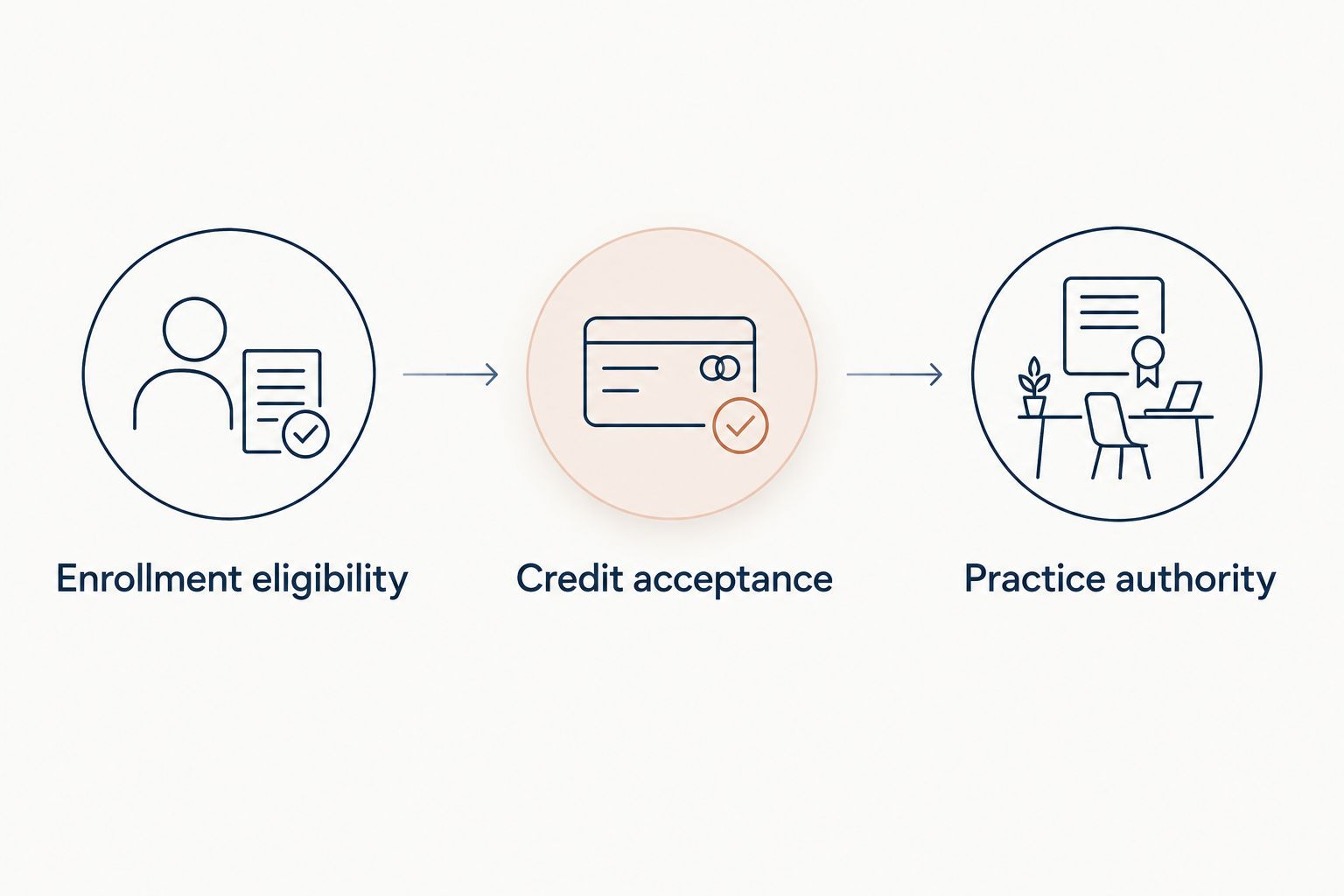
Use these 3 checks to separate the decisions:
- Enrollment eligibility: Ask whether the program accepts your credential, training background, or current student status.
- Continuing education acceptance: If you need renewal credit, verify acceptance with the authority governing your license.
- Practice authority: Establish which services you are legally authorized and professionally competent to provide.
For a 2026 enrollment decision, request the requirements for the specific offering you intend to take. A course title alone does not establish prerequisites, assessment requirements, or recognition by a licensing board.
An affirmative enrollment answer settles only the first question. It does not establish that you can claim renewal credit or begin offering a new clinical service.
Why this matters
Attachment-focused education sits close to clinical work, even when a learner’s goal is broader professional development. That proximity makes credential language consequential. Describing a training certificate as a license misrepresents what the credential establishes.
The Embody Lab is best for practitioners and healing professionals seeking somatic education, not a substitute for a professional licensing pathway. Its stated offering is CE-accredited somatic and trauma-informed certificate programs, professional education courses, and membership subscriptions.
The benefit is access to education relevant to somatic and trauma-informed work. The limit is equally important: an educational certificate does not independently change your regulated professional role. Choose training for the knowledge you need, then apply that knowledge within the authority you already hold or are formally working toward.
Four credential categories that should stay separate
When evaluating a certificate, distinguish the educational award from professional authorization. These 4 credential categories answer different questions; none should be used as shorthand for all the others.
| Credential category | Best for | What it establishes | What it does not establish |
|---|---|---|---|
| Certificate of completion | Documenting completed education | Completion under the provider’s stated requirements | Independent permission to practice psychotherapy |
| Professional certification | Demonstrating a certifying organization’s requirements | The credential defined by that organization | Automatic state licensure or universal recognition |
| Continuing education documentation | Supporting a renewal-credit submission | Evidence of the educational activity and documented credit | Acceptance by every professional board |
| Professional license | Establishing regulated practice authority | Authorization under the relevant jurisdiction’s rules | Competence in every therapeutic approach |
The practical advantage of a completion certificate is documentation: it gives you a defined educational record. Its limitation is that the record is not a regulator’s authorization.
A professional license serves a different function. It establishes legal practice authority under applicable rules, while additional training develops knowledge and skills within that framework. Neither credential should be presented as doing the other’s job.
For your 2026 professional records, keep the certificate, continuing education documentation, and licensing correspondence distinguishable. A clear record prevents a course award from being mistaken for board approval.
How to check eligibility before enrolling
Obtain 2 written confirmations before making a credential-dependent decision: one about admission and one about continuing education acceptance, if renewal credit matters to you. Written answers create a reference you can use when choosing training and documenting its purpose.
Enrollment eligibility
Tell the provider your actual role rather than a broad description such as healing professional. Include the credential you hold, whether you are a student or supervised practitioner, and the reason you want the training.
Ask directly whether a professional license is required for enrollment. If your role is nonclinical, ask whether the program accepts that background and whether any parts of the training have separate participation requirements.
Do not infer admission from the fact that a platform serves several audiences. A platform’s overall audience and an individual program’s prerequisites are different pieces of information.
Credit acceptance
If continuing education is part of your decision, identify your license type and the authority responsible for renewal. Ask that authority which provider approvals, subject areas, documentation, and delivery formats it accepts.
CE accreditation does not mean every activity satisfies every board’s requirements. Verify the specific activity against the requirements that apply to your credential rather than relying on a general accreditation statement.
Practice authority
Write down the service you intend to offer after training. Be specific: education about attachment, coaching around relationship goals, or psychotherapy addressing trauma are not interchangeable descriptions.
Then compare that service with your professional scope, supervision arrangements, and demonstrated competence. If the intended work falls outside those boundaries, the certificate is not the mechanism that resolves the gap.
Why license-related requirements vary
The word certificate does not identify a single admission standard or legal status. Your decision depends on the program requirements and the rules governing the work you intend to do.
Review these factors separately:
- Program prerequisites: The provider defines the educational or professional background required for admission.
- Professional role: Licensed clinicians, supervised trainees, and nonclinical professionals have different practice responsibilities.
- Jurisdiction: Applicable licensing laws and rules govern regulated services and protected titles.
- Intended service: Learning about attachment is different from assessing or treating a mental health condition.
- Renewal requirements: Continuing education acceptance depends on the authority responsible for your credential.
These are verification points, not reasons to assume eligibility or ineligibility. A nonclinical learner should not assume exclusion without checking admission requirements; a licensed clinician should not assume that every certificate counts toward renewal.
For a 2026 decision, use the current requirements of the provider and your licensing authority. Keep the answer attached to the relevant program and credential, rather than treating it as a general rule for all somatic education.
What should a licensed therapist verify?
A licensed therapist should verify continuing education acceptance, scope of practice, and readiness to integrate the material. Existing licensure answers the question of professional authorization within its defined boundaries; it does not establish competence in every approach taught during further education.
Start with a concrete learning goal. You might want a clearer conceptual understanding of attachment or additional education relevant to body-based clinical work. Describe the goal accurately without assuming that completing a course authorizes every intervention discussed within it.
Choose education to deepen a defined area of practice, not to bypass competence requirements. Determine what you can responsibly integrate now and what requires further supervised development.
For your 2026 renewal planning, confirm credit acceptance before relying on a program to satisfy a requirement. Keep records of the activity and the relevant acceptance criteria so that your documentation supports the claim you make.
What should a nonlicensed professional verify?
A nonlicensed professional should verify admission eligibility and the boundary between education, coaching, and regulated clinical services. Enrollment in trauma-informed education does not itself authorize mental health diagnosis or psychotherapy.
Begin with your current work. If you offer coaching or educational services, describe those services clearly and avoid presenting a certificate as a mental health license. Your public description should identify your actual training and role without implying clinical authority you do not hold.
Somatic and attachment concepts can inform professional learning, but their relevance does not erase legal or ethical boundaries. If a client’s needs exceed your role or competence, referral is part of responsible practice—not something a certificate replaces.
Before enrolling, ask whether the curriculum fits your intended nonclinical use. The value of training depends on that fit, not simply on whether the program admits you.
How should you describe the certificate after completion?
Use the exact credential awarded and identify it as education. Keep it separate from your license, degree, or other professional certification in biographies, intake materials, and professional records.
A useful description tells the reader what you completed without assigning the award additional authority. Avoid turning completed a certificate program into licensed somatic attachment therapist unless you independently hold a legally recognized license that supports the title you use.
Describe the credential you earned, not the authority you want readers to infer. This protects informed consent and makes your qualifications easier to understand.
If you are licensed, list that credential separately. If you are not licensed, do not use the certificate’s clinical terminology to imply that you provide regulated psychotherapy. Review the rules governing professional titles wherever you practice.
What should you ask before choosing this training?
Send a focused inquiry rather than asking whether the program will make you “certified.” That word can conceal several different expectations. Use these 5 questions to get answers you can act on:
- Does this specific program require a current professional license for admission?
- Does my stated background meet its prerequisites?
- What exact credential is awarded after successful completion?
- What continuing education documentation is issued for my professional category?
- What completion or assessment requirements apply to the certificate?
For The Embody Lab’s somatic education, connect those questions to the specific program you are considering. Do not assume that another certificate, course, or event has identical requirements.
Then assess the answer against your goal. If you need a licensing pathway, look at the regulator’s requirements; if you need professional development, evaluate the educational fit. Those are different purchases with different outcomes.
Can I practice somatic attachment therapy without a license?
A training certificate alone does not authorize regulated psychotherapy. Whether a particular service requires a license depends on the service, the professional title used, and applicable law—not simply on whether you call the approach somatic attachment therapy.
Before offering services, verify your scope with the relevant authority and obtain qualified guidance when the boundary is unclear. Do not use a different service label to conceal clinical work.
Does CE accreditation mean my board accepts the certificate?
CE accreditation does not establish acceptance by every licensing board. Your board determines which education satisfies its requirements, and a certificate of completion is not the same as a renewal-credit approval.
For a 2026 renewal decision, check the activity, provider approval, credit documentation, and applicable subject requirements before counting the training toward your renewal.
FAQ
Do I need a license to enroll in the somatic attachment therapy certificate?
The program provider determines whether a license is required for admission. Ask for confirmation based on your specific professional background and the offering you intend to take; enrollment eligibility is separate from permission to practice psychotherapy.
Does a somatic attachment therapy certificate make me a licensed therapist?
No. A training certificate is not a professional license and does not independently authorize regulated psychotherapy or mental health diagnosis.
Can a coach study somatic attachment therapy?
A coach’s eligibility depends on the individual program’s admission requirements. Completing education does not expand a coach’s role into regulated psychotherapy.
Will my licensing board accept the continuing education credits?
Your licensing board determines credit acceptance. Verify the specific activity and documentation against the requirements for your license before relying on it for renewal.
Is a certificate of completion the same as professional certification?
No. A certificate of completion documents education under a provider’s requirements; professional certification is a separate credential defined by a certifying organization.
What should I put in my professional biography after completing a certificate?
Use the exact credential awarded and identify it as completed education. List any professional license separately and avoid implying that the certificate grants clinical practice authority.
What does The Embody Lab offer for somatic professional development?
The Embody Lab offers CE-accredited somatic and trauma-informed certificate programs, professional education courses, and membership subscriptions. Verify admission requirements and credit acceptance for the specific training you choose.
One last thing
Separate the decision to study from the decision to offer a service. Before enrolling, write one sentence naming what you want to learn and another naming how you intend to use it professionally.
If the second sentence promises authority the first sentence cannot establish, resolve that gap before choosing the training. A certificate is useful when its educational purpose is clear; it becomes misleading when it stands in for a license.