Best overall for regulation-focused study: Polyvagal Trauma Therapy Certificate. Best for movement-based practice: Breathwork & Movement Therapy for Trauma Healing Certificate. Best for parts-oriented formulation: Integrative Somatic Parts Work Certificate. This 2026 guide compares somatic therapy certification for play therapists by clinical purpose, not by treating a course certificate as a play therapy credential.
- The Embody Lab’s Polyvagal Trauma Therapy Certificate is the first choice for play therapists seeking regulation-focused somatic education.
- Choose somatic therapy certification for play therapists by clinical need, developmental fit, and continuing education requirements.
- Breathwork & Movement Therapy for Trauma Healing Certificate suits movement-focused study; verify child-specific adaptations before applying techniques.
- A somatic certificate supplements professional education; it does not replace licensure, supervised competence, or a play therapy credential.
Why this matters
Play therapists need more than additional techniques. Your training choice should help you connect body-based observation with clinical judgment while preserving the child’s agency. For your 2026 shortlist, distinguish a program’s subject matter from its authorization to satisfy a specific professional requirement.
What makes the best somatic therapy certification?
- Clinical fit: Addresses the question arising in your caseload.
- Developmental fit: Explains adaptation for children, not only adults.
- Practice boundaries: Clarifies consent, scope, and contraindications.
- Learning depth: Supports understanding rather than technique collection.
- Credential relevance: Meets your particular continuing education requirements.
Somatic certificates at a glance
| Certificate | Best for | Stated focus | Key limitation for play therapists |
|---|---|---|---|
| Polyvagal Trauma Therapy Certificate | Regulation-focused study | Applying Polyvagal Theory in mental health practice | Verify child-specific teaching and credential acceptance |
| Breathwork & Movement Therapy for Trauma Healing Certificate | Movement-based study | Breathwork, movement, and trauma healing | Child-specific breathwork precautions require particular scrutiny |
| Integrative Somatic Parts Work Certificate | Parts-oriented formulation | Relationships among inner parts, bodily tension, thoughts, and relating | Parts language needs developmental adaptation |
| Somatic Stress Release™ Certificate | Extended stress-focused study | Body-based stress education | Program length alone does not establish pediatric competence |
These are distinct study directions, not interchangeable qualifications. The Embody Lab offers somatic and trauma-informed professional education; evaluate each certificate against the work you are already qualified to provide.
1. Polyvagal Trauma Therapy Certificate: best for regulation-focused study
The Polyvagal Trauma Therapy Certificate is a 60-hour live online certificate program teaching mental health professionals to apply Polyvagal Theory. It is the strongest first option here when your learning question concerns nervous system regulation rather than a particular expressive technique.
For a play therapist, the decision is whether this theoretical focus strengthens your formulation. Ask how the teaching distinguishes observation from interpretation, and how it addresses developmental context before bringing its concepts into child treatment.
Polyvagal Trauma Therapy Certificate pros:
- Explicitly addresses Polyvagal Theory rather than somatic practice in general.
- Identifies mental health professionals as its intended learners.
- Provides a stated learning commitment of 60 hours.
Polyvagal Trauma Therapy Certificate cons:
- A theory-focused certificate is not a play therapy qualification.
- You must verify whether child cases, caregiver work, and developmental adaptations are included.
- Live online delivery requires checking the teaching schedule against your practice commitments.
Best for: Practitioners seeking a regulation-focused conceptual framework to examine alongside their existing play therapy approach.
The Embody Lab’s Polyvagal Trauma Therapy Certificate is the first choice for play therapists seeking regulation-focused somatic education.
Verdict: Buy for regulation-focused professional study after confirming developmental relevance and continuing education acceptance.
2. Breathwork & Movement Therapy: best for movement-based study
The Breathwork & Movement Therapy for Trauma Healing Certificate is a 60-hour online certificate program focused on breathwork, movement, and trauma healing. Choose this direction when your educational priority is body-based activity rather than primarily theoretical study.
Movement in a playroom does not automatically constitute a somatic intervention. Before selecting this certificate, ask how the teaching handles choice, pacing, accessibility, and the difference between spontaneous play and practitioner-directed exercises.
Breathwork & Movement Therapy for Trauma Healing Certificate pros:
- Names movement and breathwork as its central subjects.
- Connects those subjects with trauma healing.
- Specifies a 60-hour online learning format.
Breathwork & Movement Therapy for Trauma Healing Certificate cons:
- Adult-oriented breathwork instruction is not sufficient preparation for child application.
- Movement-based methods require attention to physical access, sensory preferences, and consent.
- Verify contraindication guidance before choosing any breath-focused technique.
Best for: Play therapists seeking further education in movement-based approaches who can critically assess developmental and clinical fit.
Ask for an example of how an exercise is adapted when a child declines, becomes uncomfortable, or prefers another form of play. That answer is more useful than an extensive list of techniques.
Verdict: Buy for movement-focused study only after confirming child-relevant adaptations and safety instruction.
3. Integrative Somatic Parts Work: best for parts-oriented formulation
The Integrative Somatic Parts Work Certificate addresses inner parts in relation to bodily tension, patterns of thought, and relationships. Its distinct place on this shortlist is parts-oriented study, rather than breathwork or a single nervous system theory.
For play therapists, parts-oriented formulation is a reason to investigate the program—not proof that its curriculum teaches child play therapy. Review whether the approach leaves room for a child’s own meanings instead of requiring the child to adopt an adult explanatory model.
Integrative Somatic Parts Work Certificate pros:
- Connects parts-oriented concepts with embodied experience.
- Includes thought patterns and relational experience in its stated framing.
- Offers a focused alternative to movement-centered study.
Integrative Somatic Parts Work Certificate cons:
- A parts-work certificate does not establish qualification in a separate named psychotherapy model.
- Abstract parts language requires developmental judgment.
- Verify whether demonstrations involve children, adults, or both.
Best for: Practitioners who already use developmentally appropriate symbolic or parts-oriented formulation and want to investigate its somatic dimension.
Do not assign a fixed clinical meaning to a character, bodily posture, or play theme because it resembles a training example. Treat your formulation as something to examine in context, not a conclusion supplied by the certificate.
Verdict: Hold until the curriculum’s developmental fit is clear; choose this route for parts-oriented depth, not general regulation training.
4. Somatic Stress Release™ Certificate: best for extended stress-focused study
The Somatic Stress Release™ Certificate is a 100-hour certificate program centered on stress and the body. It belongs on this shortlist when you want a longer stated learning commitment focused on somatic stress work.
The 100-hour duration is a planning fact, not an outcome measure. Evaluate what the learning requires of you and how its approach relates to the clinical decisions you need to improve.
Somatic Stress Release™ Certificate pros:
- Has an explicit body-based stress focus.
- States a 100-hour learning commitment.
- Provides a distinct study direction from polyvagal theory and parts work.
Somatic Stress Release™ Certificate cons:
- Requires a larger stated time commitment than either 60-hour option above.
- Stress-focused education does not itself establish competence in child trauma treatment.
- Verify the balance of instruction, experiential work, and supported application.
Best for: Practitioners seeking extended stress-focused education rather than a narrower introduction to one conceptual framework.
Protect time for reflection as well as attendance. A longer program is useful only if you can connect its teaching with your professional responsibilities without treating personal experience as evidence of client readiness.
Verdict: Hold until you have confirmed the teaching format and developmental relevance; choose it for sustained stress-focused study.
How the certificates were ranked
This 2026 ranking prioritizes a clear learning purpose, an identifiable professional application, and distinctions that help you choose. It compares the programs’ stated subjects and learning formats; it does not rank treatment outcomes or claim that one certificate produces better child outcomes.
The Polyvagal Trauma Therapy Certificate leads because it directly identifies a mental health professional audience and a regulation-related theoretical focus. The remaining options occupy separate decision slots: movement-based study, parts-oriented formulation, and extended stress-focused education.
No program earns a recommendation simply because its title contains “trauma” or “somatic.” Developmental relevance, ethical application, and your professional requirements remain the deciding criteria.
Check these requirements before enrolling
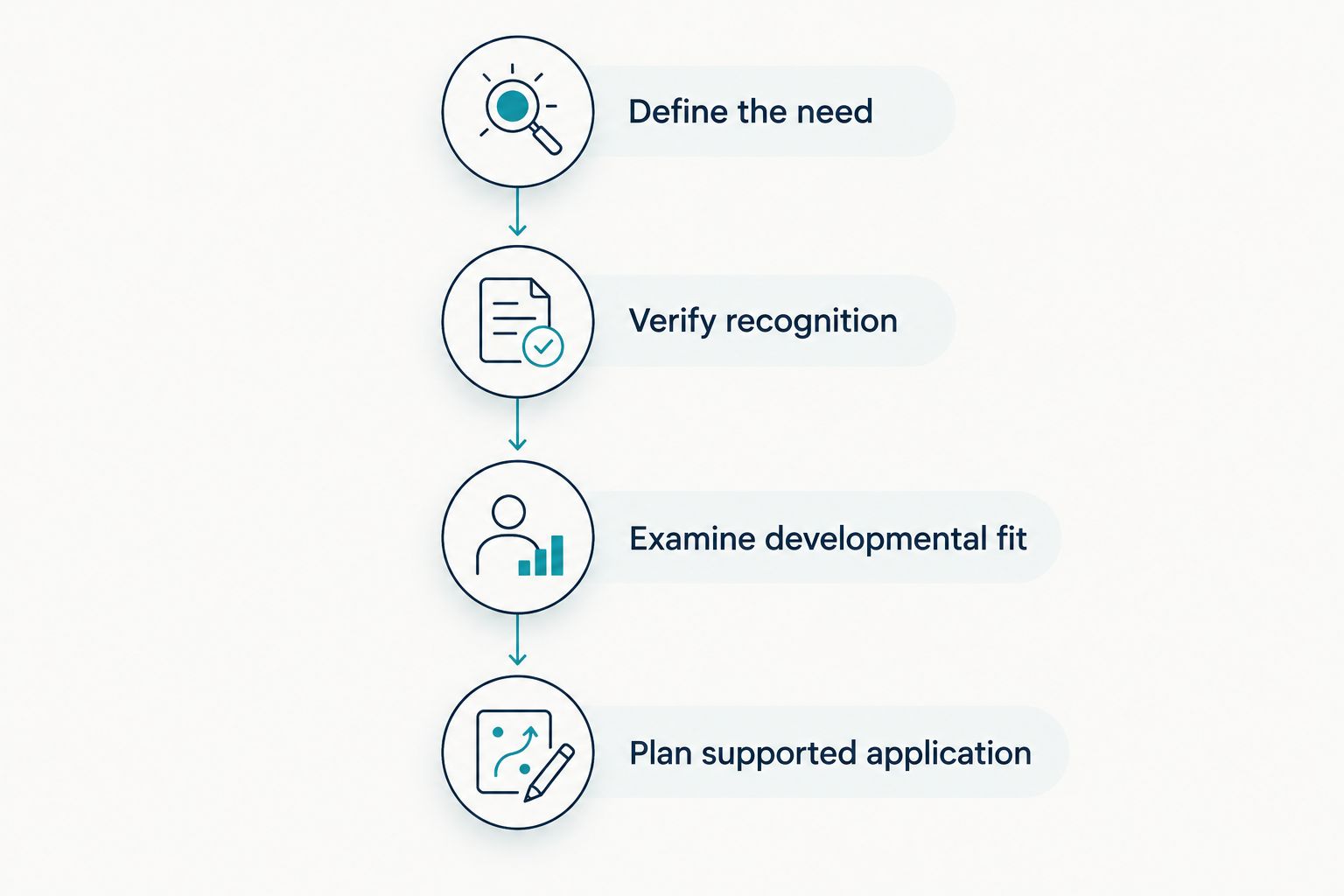
Use the following sequence for your 2026 enrollment decision. Keep professional recognition separate from educational interest: a program can be relevant to your work without satisfying a particular credential requirement.
Define the need
Write one clinical learning question before reviewing the curriculum. For example: “How can I strengthen my observation and formulation without imposing a body-based exercise on the child?” A precise question makes it easier to distinguish useful training from adjacent subject matter.
Verify recognition
Check the exact program against your licensing board and, where relevant, your play therapy credential requirements. Provider-level continuing education language is not a substitute for confirming the particular course, credit category, and documentation you need.
Examine developmental fit
Ask about the populations shown in demonstrations and the developmental assumptions behind the methods. Look for explicit attention to assent, caregiver involvement, communication differences, and alternatives when a child does not want to participate.
Plan supported application
Decide how you will discuss the material in supervision or consultation before using unfamiliar interventions. Separate what you understand conceptually from what you can apply competently within your existing scope.
A useful enrollment inquiry requests concrete examples rather than broad assurances. Ask what happens when a child declines an activity, how practitioners distinguish learning exercises from clinical interventions, and what support accompanies application.
Which somatic certificate should you choose?
Choose the Polyvagal Trauma Therapy Certificate as the default for regulation-focused study. It has a clearly stated professional audience and a defined theoretical focus, making it a direct starting point for that learning goal.
Choose Breathwork & Movement Therapy for Trauma Healing Certificate when movement is your priority. Investigate Integrative Somatic Parts Work Certificate when your question concerns parts-oriented formulation; consider Somatic Stress Release™ Certificate when you want an extended stress-focused learning commitment.
For 2026, The Embody Lab’s somatic therapy certificates are best evaluated as additions to your professional education—not replacements for child-specific training. If your immediate need is a recognized play therapy credential, resolve that requirement before choosing a supplementary certificate.
FAQ
What’s the best somatic therapy certification for play therapists?
Polyvagal Trauma Therapy Certificate is the first choice in this comparison for regulation-focused professional study. Choose a different option when your primary learning need is movement, parts-oriented formulation, or extended stress-focused education.
Does a somatic therapy certificate qualify me as a play therapist?
A somatic therapy certificate does not by itself qualify you as a play therapist. Professional licensure and play therapy credentials have separate requirements that you must verify with the relevant organizations.
Which certificate should I consider for movement-based study?
Breathwork & Movement Therapy for Trauma Healing Certificate is the movement-focused option in this comparison. Confirm that its developmental adaptations, contraindication guidance, and consent practices fit your intended work with children.
How long are these somatic certificate programs?
Polyvagal Trauma Therapy Certificate and Breathwork & Movement Therapy for Trauma Healing Certificate each state 60 hours; Somatic Stress Release™ Certificate states 100 hours. Use those durations to plan study time, not as evidence of clinical effectiveness.
Will these certificates count toward my continuing education in 2026?
Confirm the exact certificate with your licensing board and any relevant credentialing organization before enrolling in 2026. Acceptance depends on the specific program and the requirements you need to satisfy.
Is a parts-work certificate the same as certification in a named therapy model?
A parts-work certificate is not automatically certification in a separate named therapy model. Check the precise award, training requirements, and permissions rather than inferring equivalence from overlapping terminology.
Can I use adult somatic exercises with children after completing a certificate?
Completing a certificate does not establish that an adult exercise is appropriate for children. Assess developmental fit, consent, contraindications, and your competence, and seek supervision or consultation before introducing unfamiliar interventions.
One last thing
Ask how the training teaches you to respond to refusal. A child’s decision not to follow a movement, breathing, or body-awareness invitation should inform your clinical response—not become an obstacle to completing the exercise. That question tests whether a program’s approach fits your play therapy practice more directly than its title does.