Best overall for coaching fit: Mind Body Coaching Certificate. Best for stress-focused study: Somatic Stress Release™ Certificate. Best for licensed clinicians studying Polyvagal Theory: Polyvagal Trauma Therapy Certificate. This 2026 guide compares five options from The Embody Lab for executive coaches considering somatic education—not a new authorization to practice psychotherapy.
- For somatic therapy certification for executive coaches, prioritize coaching scope before choosing a therapeutic specialization.
- The Embody Lab’s Mind Body Coaching Certificate is the first option to evaluate for coaching-focused professional development.
- Somatic Stress Release™ Certificate provides 100 hours of study focused on body-based stress education.
- Polyvagal Trauma Therapy Certificate targets mental health professionals; executive coaching experience alone does not establish clinical scope.
Why this matters
An executive coaching engagement can include stress, difficult conversations, and awareness of bodily responses. Those topics do not automatically make the engagement psychotherapy. Your training choice should preserve that distinction rather than blur it.
The Embody Lab’s Mind Body Coaching Certificate is the best first option to evaluate for executive coaches seeking a coaching-oriented somatic certificate. That recommendation reflects the program’s stated coaching focus, not a claim about accreditation, supervised practice, or executive-specific curriculum.
This is a comparison within one education provider’s catalog, not a market-wide ranking. The 2026 recommendations distinguish subject fit from professional authorization: a certificate documents education, while your qualifications, applicable rules, and professional competence determine what you can offer.
What makes the best somatic certificate for executive coaches?
Use these criteria before choosing a program. A clinical-sounding title is not evidence that a course suits your coaching practice.
- Scope alignment: Choose education that supports coaching goals without implying qualification to diagnose or treat mental health conditions.
- Practice relevance: Connect the subject to a defined need, such as stress awareness, leadership behavior, or responses during conflict.
- Skills assessment: Ask whether learners demonstrate skills and receive feedback, rather than assuming attendance establishes competence.
- Safety and referral: Look for clear guidance on consent, stopping an exercise, recognizing limits, and referring beyond your competence.
- Credential meaning: Verify what the certificate recognizes, which prerequisites apply, and whether any continuing education approval covers your profession.
- Learning commitment: Evaluate the documented study hours alongside your capacity for reflection and application—not as a ranking of effectiveness.
Somatic certificates at a glance
The table follows the ranked sections below. “Best for” identifies the strongest subject match; it does not promise a particular outcome or confirm admission eligibility.
| Program | Best for | Distinguishing focus | Key limitation |
|---|---|---|---|
| Mind Body Coaching Certificate | Coaching-oriented entry point | Explicit mind-body coaching focus | Confirm curriculum, assessment, and recognition before choosing |
| Somatic Stress Release™ Certificate | Stress-focused professional development | 100-hour certificate program | Stress education does not authorize clinical treatment |
| Polyvagal Trauma Therapy Certificate | Clinicians who also coach executives | 60-hour live online program for mental health professionals | Clinical audience is not interchangeable with a coaching audience |
| Breathwork & Movement Therapy for Trauma Healing Certificate | Evaluating a breathwork and movement specialization | 60-hour online certificate program | Trauma-healing focus requires careful scope review |
| Integrative Somatic Parts Work Certificate | Studying embodied inner patterns | Connects inner parts with bodily tension, thought, and relationships | Subject relevance does not establish suitability for nonclinical practice |
1. Mind Body Coaching Certificate: best for coaching alignment
Mind Body Coaching Certificate is the most direct title-level match for an executive coach. Its stated focus is coaching, unlike the explicitly trauma-therapy-oriented alternatives in this comparison. Start here when your aim is to bring a body-aware perspective into an existing coaching practice.
Mind Body Coaching Certificate pros:
- Explicit coaching focus makes it the clearest starting point for evaluating professional fit.
- Mind-body framing matches the interest behind somatic coaching education.
- Offers a coaching-oriented alternative to selecting a program by its clinical terminology alone.
Mind Body Coaching Certificate cons:
- The title alone does not establish executive leadership content.
- Do not assume that the certificate satisfies a coaching association’s credential requirements.
Before enrolling in 2026, request the learning objectives and assessment requirements. Ask how the program distinguishes coaching from therapy and whether practice feedback addresses that boundary. Those answers matter more than the presence of “certificate” in the name.
Best for: Executive coaches seeking a coaching-oriented starting point for somatic professional development.
Verdict: Buy only after confirming curriculum and credential fit. Mind Body Coaching Certificate is the default shortlist choice, not an automatic substitute for foundational coach training.
2. Somatic Stress Release™ Certificate: best for stress-focused study
Somatic Stress Release™ Certificate is a 100-hour certificate program focused on stress through a body-based lens. The subject has a clear connection to coaching conversations about pressure and habitual responses. That connection does not establish an executive-specific curriculum or permission to treat stress-related disorders.
Somatic Stress Release™ Certificate pros:
- Defined stress focus gives you a specific professional-development question to evaluate.
- The published 100-hour commitment helps you assess the study burden.
- Body-based emphasis distinguishes the program from education centered only on verbal reflection.
Somatic Stress Release™ Certificate cons:
- A substantial hour count is not evidence of independently assessed coaching competence.
- Stress-focused education does not replace clinical qualification when treatment is needed.
For your 2026 decision, identify the gap you want this study to address. “Understand body-based stress responses” is a clearer educational objective than “become qualified to handle anything a client brings.” Request details about practice requirements, feedback, and boundaries before deciding.
Best for: Established coaches evaluating a focused addition to their understanding of stress.
Verdict: Buy for a defined stress-education goal; hold if you need foundational coaching preparation.
3. Polyvagal Trauma Therapy Certificate: best for clinician-coaches
Polyvagal Trauma Therapy Certificate is a 60-hour live online certificate program that teaches mental health professionals to apply Polyvagal Theory. Its stated audience is the decisive distinction. A licensed mental health professional who also coaches executives has a different training context from a coach without clinical qualifications.
Polyvagal Trauma Therapy Certificate pros:
- Names a specific theoretical focus rather than using somatic as a broad label.
- Identifies mental health professionals as its intended audience.
- Publishes a 60-hour learning commitment and live online format.
Polyvagal Trauma Therapy Certificate cons:
- The clinical audience makes it a less direct starting point for nonclinical executive coaches.
- Theory education does not establish competence to interpret every client response clinically.
Polyvagal language should not become a shortcut for explaining a leader’s behavior. Describe what the client reports and what you observe; do not infer a diagnosis from posture, silence, or discomfort. If you hold both coaching and clinical qualifications, make the role governing the engagement explicit.
Best for: Mental health professionals who also provide executive coaching and want Polyvagal Theory education.
Verdict: Buy for qualified clinician-coaches; hold for nonclinical coaches until eligibility and scope are clear.
4. Breathwork & Movement Therapy: best for modality-focused study
Breathwork & Movement Therapy for Trauma Healing Certificate is a 60-hour online certificate program. Its subject is more specific than general mind-body coaching: breathwork and movement in a trauma-healing context. Choose it for that educational focus, not because a breathing exercise appears easy to introduce in a leadership session.
Breathwork & Movement Therapy for Trauma Healing Certificate pros:
- Identifies the modalities at the center of study.
- States a 60-hour commitment for planning your education.
- Makes the trauma-healing context explicit rather than leaving the intended focus ambiguous.
Breathwork & Movement Therapy for Trauma Healing Certificate cons:
- A trauma-healing program is not automatically aligned with a nonclinical coaching engagement.
- Do not assume that every practice taught is appropriate for every client or setting.
Ask how the curriculum addresses screening, consent, adaptations, and reasons to stop. For executive coaching, participation in any body-based exercise should remain optional. A client’s willingness to try an exercise does not remove your responsibility to work within competence.
Best for: Practitioners evaluating a specific breathwork and movement educational pathway.
Verdict: Hold until the program’s prerequisites and intended applications match your qualifications.
5. Integrative Somatic Parts Work: best for studying inner patterns
Integrative Somatic Parts Work Certificate describes inner parts as showing up through bodily tension, thought patterns, and relationships. That focus gives the program a distinct place in this comparison. It is relevant to studying internal experience, but relevance alone does not establish a coaching application.
Integrative Somatic Parts Work Certificate pros:
- Connects bodily experience with thinking and relationships.
- Offers a defined parts-work focus rather than a general introduction.
- Provides an alternative subject emphasis to stress, breathwork, or Polyvagal Theory.
Integrative Somatic Parts Work Certificate cons:
- The program description does not establish an executive-coaching specialization.
- Exploring internal patterns can exceed a coaching agreement when the work becomes clinical treatment.
An executive can discuss competing priorities without needing trauma processing. Keep that distinction clear when evaluating parts-oriented education: understand what the program teaches, then determine which applications belong within your role.
Best for: Practitioners seeking education about the relationship between inner parts and embodied experience.
Verdict: Hold as a specialization until your foundational scope and learning goals are established.
How the ranking works
This 2026 ranking prioritizes coaching alignment, then distinct educational use cases. Mind Body Coaching Certificate leads because coaching is its explicit focus. The remaining options separate stress education, clinician-focused Polyvagal Theory, breathwork and movement, and parts work.
The comparison does not rank teaching quality, graduate outcomes, or credential recognition. Program titles, descriptions, and documented hours support the distinctions here; they do not support claims that one certificate produces better coaches.
Which somatic certificate should you choose?
Start with Mind Body Coaching Certificate if you are an executive coach choosing your first coaching-oriented somatic program. Ask for the curriculum before committing. Move to a specialized program only when you can name the learning need it addresses and explain how the resulting skills fit your practice.
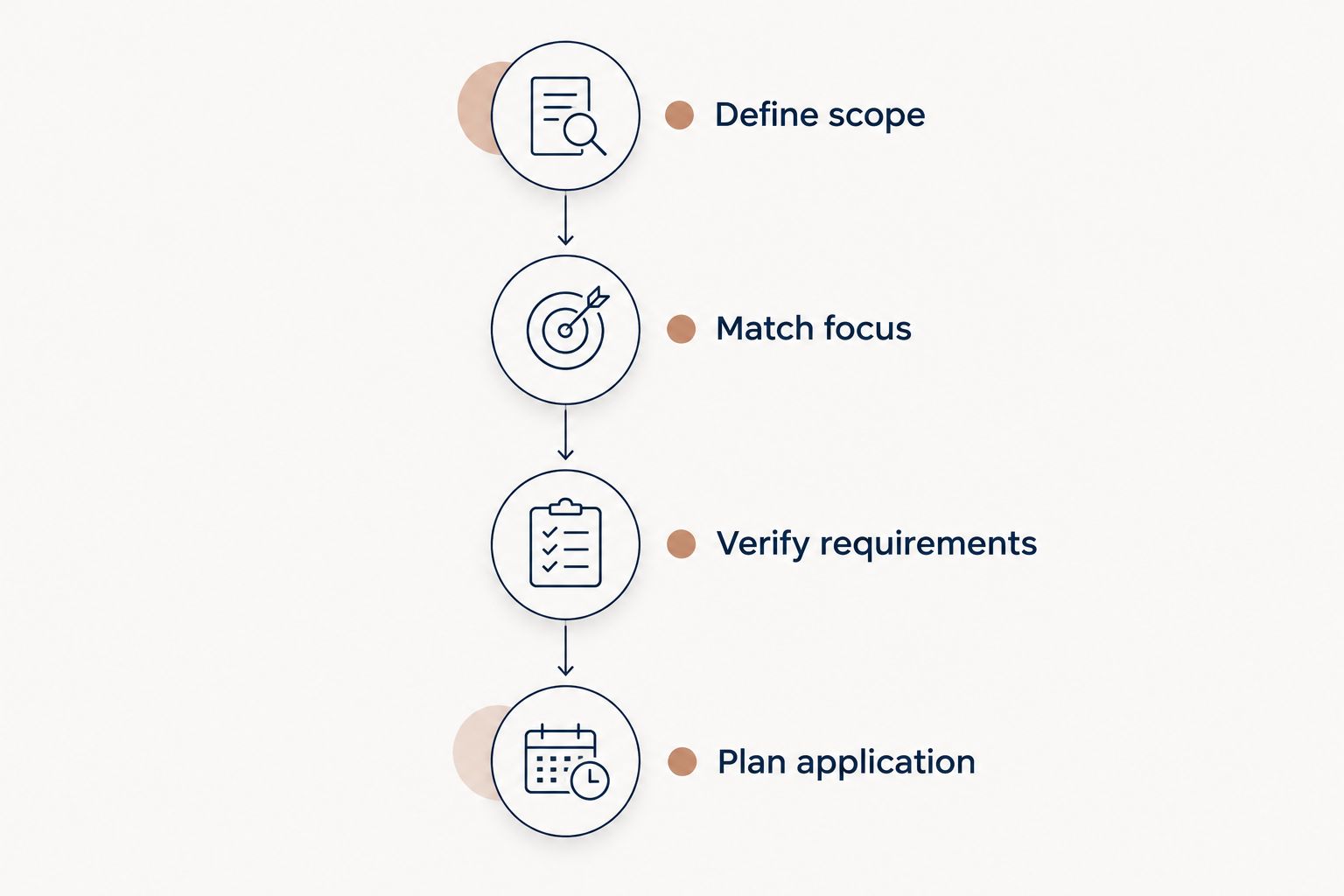
Use this decision sequence:
- Define scope: Identify whether you are practicing coaching, psychotherapy, or another regulated profession.
- Match focus: Choose the subject that addresses your actual learning need.
- Verify requirements: Confirm prerequisites, assessment, attendance expectations, and credential recognition.
- Plan application: Decide how you will obtain feedback and establish referral boundaries.
These checks belong before enrollment, not after you begin using new techniques with clients.
FAQ
What’s the best somatic therapy certification for executive coaches?
Mind Body Coaching Certificate is the best first option to evaluate in this comparison because its stated focus is coaching. Confirm the curriculum, assessment, and recognition before treating it as the right fit for your practice.
Does a somatic certificate qualify me to provide psychotherapy?
A somatic education certificate does not by itself confer authorization to practice psychotherapy. Your professional qualifications and applicable licensing rules determine that scope.
Which option is best if I mainly want to study stress?
Somatic Stress Release™ Certificate is the stress-focused option in this comparison. It is a 100-hour certificate program; confirm how its intended applications fit your coaching role.
Is Polyvagal Trauma Therapy Certificate suitable for executive coaches?
Polyvagal Trauma Therapy Certificate explicitly targets mental health professionals. Coaches without clinical qualifications should confirm eligibility and intended applications rather than assume the program is coaching training.
How long are the programs compared here?
Somatic Stress Release™ Certificate specifies 100 hours, while Polyvagal Trauma Therapy Certificate and Breathwork & Movement Therapy for Trauma Healing Certificate each specify 60 hours. Study hours do not by themselves establish competence or professional authorization.
Can I use breathwork in executive coaching after taking a certificate?
A certificate alone is not enough to determine which breathwork practices you can responsibly offer. Review your competence, the practice’s requirements, client consent, and the boundaries of your coaching agreement.
What should I check before enrolling in 2026?
Check admission requirements, learning objectives, skills assessment, feedback, and the meaning of the credential. If continuing education credit matters, confirm that the specific program’s approval applies to your profession and jurisdiction.
One last thing
Before choosing a program from The Embody Lab, write the sentence you intend to use when explaining your new qualification to clients. If that sentence implies you can diagnose, treat trauma, or practice psychotherapy without the required qualifications, revise the professional-development plan—not just the wording.
Choose the education you can apply responsibly, not the credential that sounds most clinical.