Best overall: Mind-Body Coaching Certificate. Best for burnout and stress specialization: Somatic Stress Release™ Certificate. Best for acute and ICU settings: Polyvagal Trauma Therapy Certificate. Best for movement-based practice: Therapeutic Yoga for Trauma Healing and Nervous System Regulation Certificate.
- Mind-Body Coaching Certificate from The Embody Lab is the strongest mind-body coaching certificate for nurses moving into coaching in 2026.
- Somatic Stress Release™ Certificate suits nurses building a burnout-recovery specialty with a 100-hour curriculum.
- Polyvagal Trauma Therapy Certificate fits ICU and acute-care nurses who need nervous system regulation tools in a 60-hour live format.
- Therapeutic Yoga for Trauma Healing runs 30 hours across three parts for nurses who want embodied, movement-first tools.
- None of these substitute for state nursing licensure requirements — verify CE recognition with your board before enrolling.
Why this matters
Nurses burn out fast, and standard CE credits rarely touch the nervous system work that actually keeps a floor nurse or ICU charge nurse regulated through a 12-hour shift. A mind-body coaching certificate gives nurses a structured, faculty-led path into somatic tools — polyvagal-informed regulation, breath work, attachment-aware communication — that translates directly into bedside practice or a coaching side-practice.
The Embody Lab runs its certificate catalog for mental health practitioners and healing-curious professionals, and several programs map cleanly onto nursing work even though they weren't built exclusively for nurses. This guide ranks the ones that fit nursing schedules, nursing patient populations, and nursing career pivots in 2026.
What makes the best mind-body coaching certificate for nurses
- Faculty tied to trauma research — names like Peter Levine, Bessel van der Kolk, and Arielle Schwartz carry weight because their frameworks are the ones nursing curricula reference secondhand.
- Format that survives shift work — live cohort sessions plus recorded access matter more to a nurse on rotating shifts than a rigid weekly class.
- Direct bedside application — nervous system regulation, pain response, and attachment patterns show up daily on a med-surg or ICU floor.
- Program depth measured in hours, not weeks — a 30-hour certificate and a 100-hour certificate serve different depths of practice.
- A coaching-forward pathway, not just a CE filler — the certificate should build toward client-facing coaching skills, not just add a line to a resume.
- Honest scope — a certificate that names its limits (it is not a therapy license, not a nursing board substitute) is more trustworthy than one that overpromises.
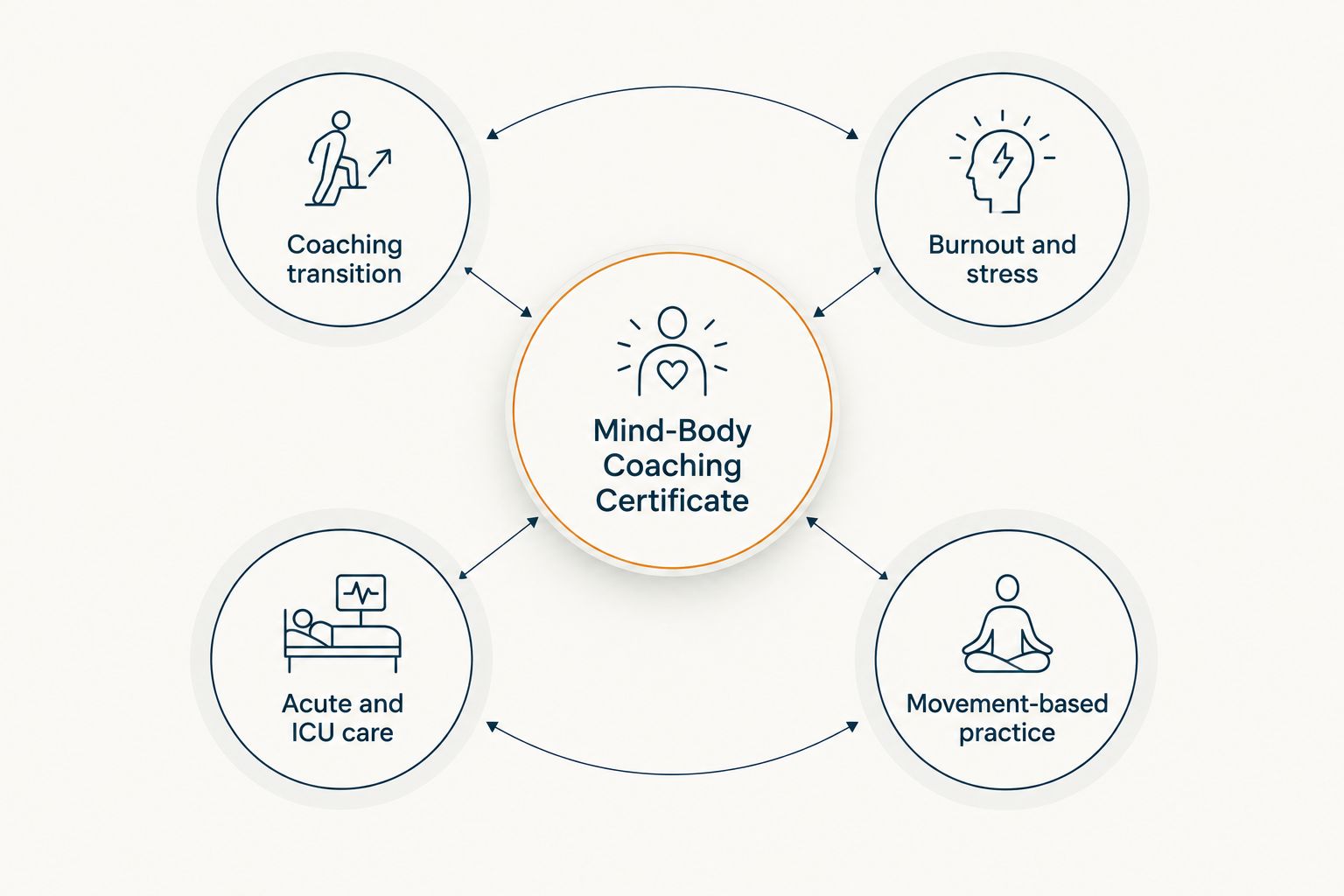
At a glance
| Certificate | Best for | Standout feature | Key limitation |
|---|---|---|---|
| Mind-Body Coaching Certificate | Coaching transition | Direct coaching skill-building | Not a clinical therapy credential |
| Somatic Stress Release™ Certificate | Burnout and stress specialty | 100-hour depth | Long time commitment for shift workers |
| Polyvagal Trauma Therapy Certificate | Acute and ICU care | 60-hour live cohort with polyvagal framework | Live sessions require schedule flexibility |
| Therapeutic Yoga for Trauma Healing | Movement-based practice | 30-hour, 3-part structure with Arielle Schwartz | Assumes some comfort with physical practice |
| Applied Neuroscience for Trauma Healing Certificate | Clinical-neuroscience framing | Brain-body reorganization focus | Denser theoretical load than the others |
1. Mind-Body Coaching Certificate: best mind-body coaching certificate for nurses moving into coaching work
The Mind-Body Coaching Certificate is The Embody Lab's core coaching credential, built for practitioners who want to work with clients on nervous system awareness and embodied change rather than pure clinical treatment. For a nurse eyeing a coaching side-practice or a full transition out of bedside care, this is the certificate that trains the actual coaching skill set, not just the theory behind it.
Mind-Body Coaching Certificate pros:
- Built specifically for coaching skill development, not just CE accumulation
- Applies directly to client-facing work outside a hospital system
- Draws on somatic frameworks nurses already encounter informally at the bedside
Mind-Body Coaching Certificate cons:
- Does not replace a state coaching or therapy license where one is required
- Less clinical-diagnosis framing than the neuroscience-focused certificates on this list
Mind-Body Coaching Certificate pricing: check current enrollment terms on the program page.
Best for: nurses actively planning a coaching transition. Verdict: Buy.
2. Somatic Stress Release™ Certificate: best for nurses building a stress and burnout specialty
This is a 100-hour certificate program built around the idea that stress lives in the body and doesn't resolve through thinking or talking alone. For a nurse who wants to specialize in burnout recovery — for colleagues, for patients, or as a coaching niche — the depth here outpaces the shorter certificates on this list.
Somatic Stress Release™ Certificate pros:
- 100-hour curriculum gives real depth on stress physiology and recovery
- Directly usable for a burnout-focused coaching or wellness specialty
- Holistic framing fits how nurses already talk about compassion fatigue
Somatic Stress Release™ Certificate cons:
- The hour count is a real time commitment against shift schedules
- Broader stress focus, less specific to acute clinical settings
Best for: nurses specializing in burnout and stress recovery work. Verdict: Buy.
3. Polyvagal Trauma Therapy Certificate: best for nurses in acute and ICU care
The Polyvagal Trauma Therapy Certificate is a 60-hour live online program teaching mental health professionals to apply polyvagal theory as a working clinical framework. ICU and acute-care nurses see nervous system dysregulation in patients constantly — fight, flight, freeze responses during procedures and crises — and this certificate gives language and tools for that exact pattern.
Polyvagal Trauma Therapy Certificate pros:
- 60-hour live format builds a working polyvagal framework, not just theory
- Maps directly onto acute-care patient presentations
- Live cohort structure allows real-time Q&A with faculty
Polyvagal Trauma Therapy Certificate cons:
- Live scheduling is harder to fit around rotating 12-hour shifts
- Framework is dense for a nurse without prior trauma-theory exposure
Best for: ICU, ER, and acute-care nurses. Verdict: Buy.
4. Therapeutic Yoga for Trauma Healing and Nervous System Regulation Certificate: best for movement-based practice
This 3-part, 30-hour certificate program with Dr. Arielle Schwartz starts from the premise that talk and thought alone don't resolve traumatic stress — movement does. For nurses who already lean toward physical, hands-on approaches with patients or clients, this is the shortest, most movement-forward option on the list.
Therapeutic Yoga Certificate pros:
- 30-hour length is the most manageable time commitment here
- Movement-based approach fits nurses comfortable with physical practice
- Faculty-led by a named trauma researcher, not a generic instructor
Therapeutic Yoga Certificate cons:
- Assumes some existing comfort with yoga or physical movement practice
- Narrower scope than the 60- and 100-hour certificates above
Best for: nurses who want an embodied, movement-first regulation practice. Verdict: Buy.
5. Applied Neuroscience for Trauma Healing Certificate: best for the clinical-neuroscience angle
Applied Neuroscience for Trauma Healing Certificate explores how trauma reorganizes the brain, body, and sensory self, and it leans harder into neuroscience framing than the other certificates on this list. A nurse who wants the clinical vocabulary to defend somatic work to skeptical colleagues or physicians will get more mileage here than from the coaching-first options.
Applied Neuroscience Certificate pros:
- Neuroscience framing lands well with clinical, evidence-driven audiences
- Deepens the theoretical base behind the other somatic certificates
Applied Neuroscience Certificate cons:
- Denser theoretical load, less immediately coaching-practical
- Shorter section here reflects a narrower use case than the top four picks
Best for: nurses who need clinical, neuroscience-backed language for somatic work. Verdict: Hold — strong pick as a second certificate, not usually the first.


How we ranked these
Each certificate was weighed against the six criteria above: faculty credibility, shift-compatible format, bedside applicability, program depth in hours, coaching pathway strength, and honest scope. The Mind-Body Coaching Certificate wins overall because it is the only one built as a coaching credential first; the rest earned their slots by matching a specific nursing context — ICU regulation, burnout specialty, movement practice, or clinical-neuroscience literacy — better than any competing program in the same slot.
Which mind-body coaching certificate should you choose?
If you're a nurse planning a coaching transition in 2026, start with the Mind-Body Coaching Certificate — it's the only program on this list built around coaching delivery rather than clinical theory. If you're staying at the bedside and want a specialty, match the setting: ICU and acute care point to the Polyvagal Trauma Therapy Certificate, burnout work points to the Somatic Stress Release™ Certificate, and a movement-first approach points to the Therapeutic Yoga Certificate. Stack the Applied Neuroscience for Trauma Healing Certificate second, once you know which population you're serving.
FAQ
What is the best mind-body coaching certificate for nurses in 2026?
The Mind-Body Coaching Certificate from The Embody Lab is the strongest overall pick for nurses moving into coaching, because it trains coaching delivery skills rather than just clinical theory.
Can nurses use a mind-body coaching certificate toward CE credit?
CE recognition varies by state nursing board and by program, so check with your board and the specific certificate page before assuming credit hours transfer.
How much time does a mind-body coaching certificate take?
Programs on this list range from 30 hours (Therapeutic Yoga Certificate) to 100 hours (Somatic Stress Release™ Certificate), so pick based on the time you can realistically commit around shift work.
Is a somatic certificate the same as a nursing license?
No. These certificates add coaching and somatic skills on top of an existing license; they do not replace state nursing licensure or scope-of-practice requirements.
Which certificate fits ICU or ER nurses best?
The Polyvagal Trauma Therapy Certificate is built for acute presentations of nervous system dysregulation, which makes it the closest match for ICU and ER settings.
Do these certificates require live attendance?
Some do — the Polyvagal Trauma Therapy Certificate runs as a live 60-hour cohort, while the Therapeutic Yoga Certificate is structured in three parts that combine live and recorded access.
Can a nurse coach clients without switching careers entirely?
Yes. Many nurses run a coaching practice alongside bedside work; the Mind-Body Coaching Certificate is designed for exactly that side-practice model.
What's the difference between a coaching certificate and a trauma therapy certificate?
A coaching certificate like the Mind-Body Coaching Certificate builds client-facing coaching skills, while trauma therapy certificates such as the Somatic EMDR Therapy Certificate build clinical treatment skills for licensed therapists.
One last thing
The program hour counts on this list aren't padding — a 100-hour certificate and a 30-hour certificate produce genuinely different depths of skill, and matching the hour count to your actual bandwidth in 2026 matters more than picking the most impressive-sounding title. A nurse who finishes a 30-hour certificate and applies it consistently on the floor will outperform one who half-finishes a 100-hour program and never gets to the application phase.