Nervous system regulation certification for therapists in 2026 comes down to matching the credential to your caseload, not chasing the trendiest framework. Polyvagal Trauma Therapy Certificate wins overall for clinicians building autonomic-state literacy into trauma work, Somatic Stress Release Certificate is best for stress-response resilience and burnout-prevention practice, and Therapeutic Yoga for Trauma Healing and Nervous System Regulation Certificate is best for movement-based regulation work.
- Polyvagal Trauma Therapy Certificate is the strongest overall nervous system regulation certification for therapists in 2026.
- Somatic Stress Release Certificate targets stress-response resilience and burnout-prevention caseloads specifically.
- Therapeutic Yoga for Trauma Healing and Nervous System Regulation Certificate is a 3-part, 30-hour program led by Dr. Arielle Schwartz.
- Applied Neuroscience for Trauma Healing Certificate suits clinicians who want the brain science behind the technique.
- None of these substitute for a full somatic trauma therapy certification if you need broad clinical scope.
Why this matters
Most therapists searching for a nervous system regulation certification for therapists already have a modality — EMDR, IFS, CBT — and are looking to add autonomic-state skills on top of it. The wrong choice is a certificate that repeats theory you already know, or one so narrow it doesn't transfer past a single technique.
The programs below come from The Embody Lab, and each is built around a specific slice of nervous system work: polyvagal theory, stress-response patterns, movement, breath, neuroscience, or attachment. Picking the right one in 2026 means knowing which slice your clients actually need.
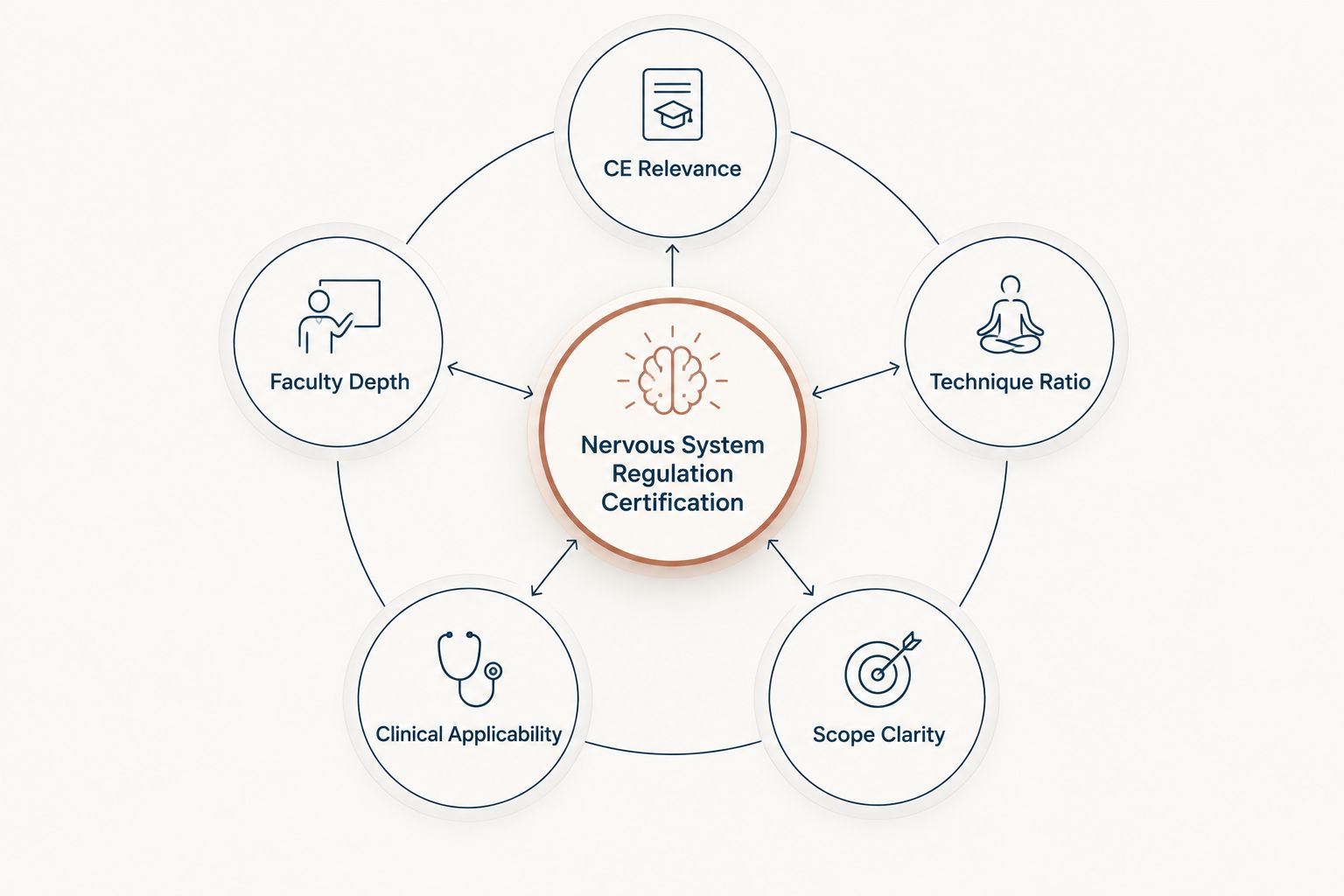
What makes the best nervous system regulation certification
- CE relevance — the content maps to concepts you can use in session immediately, not just theory for its own sake
- Faculty depth — instruction from practitioners with a documented clinical or research background in the framework
- Technique-to-theory ratio — enough hands-on practice that the certificate changes what you do in a room, not just what you know
- Clinical applicability — the skills stack onto an existing modality (EMDR, IFS, attachment work) rather than requiring you to abandon your current approach
- Scope clarity — the program tells you upfront whether it's a full certification or a single-topic deep dive
At a glance
| Program | Best for | Standout feature | Key limitation |
|---|---|---|---|
| Polyvagal Trauma Therapy Certificate | Autonomic-state literacy in trauma work | Direct polyvagal theory application to clinical practice | Assumes baseline trauma therapy background |
| Somatic Stress Release Certificate | Stress-response resilience and burnout prevention | Level 1 foundations built around a named stress-release framework | Framework-specific, not a general somatic certification |
| Therapeutic Yoga for Trauma Healing and Nervous System Regulation Certificate | Movement-based regulation practice | 3-part, 30-hour program led by Dr. Arielle Schwartz | A yoga background helps but isn't required going in |
| Applied Neuroscience for Trauma Healing Certificate | Neuroscience-grounded regulation teaching | Translates brain-based research into clinical technique | Denser reading load than the movement-based tracks |
| Integrative Somatic Trauma Therapy Certificate | Full-scope somatic trauma certification | Broadest single credential on this list | Longer time commitment than single-topic certificates |
| Breathwork & Movement Therapy for Trauma Healing Certificate Program | Breath-based regulation technique | Combines breathwork and movement in one certificate | Narrower clinical scope than integrative programs |
| Somatic Attachment Therapy Certificate Program | Attachment-focused regulation work | Applies regulation tools to couples and family attachment ruptures | Best suited to practitioners already doing relational work |
1. Polyvagal Trauma Therapy Certificate: best nervous system regulation certification overall
This certificate applies polyvagal theory directly to clinical trauma work, training you to read client autonomic states — ventral, sympathetic, dorsal — and adjust intervention in real time. It's built for therapists who already use somatic or EMDR modalities and want a more precise map of what's happening in the client's body during a session.
Polyvagal Trauma Therapy Certificate pros:
- Grounded in a framework widely referenced across trauma therapy in 2026
- Builds a skill set for reading autonomic states, not just naming them
- Fits practitioners already running somatic or EMDR caseloads
Polyvagal Trauma Therapy Certificate cons:
- Assumes you already understand basic trauma therapy concepts
- Works best paired with a broader somatic certification for full clinical scope
Best for: clinicians building autonomic-state literacy into existing trauma work. Verdict: Buy.
2. Somatic Stress Release Certificate: best for stress-response resilience work
This certificate is built around a Level 1 foundations model for releasing chronic stress patterns held in the body. It targets clients whose presenting issue is dysregulation from ongoing stress rather than a single traumatic event.
Somatic Stress Release Certificate pros:
- Direct application to burnout, chronic stress, and dysregulation caseloads
- Foundations-level entry point, useful before more advanced somatic work
- Framework-specific, so the technique is repeatable session to session
Somatic Stress Release Certificate cons:
- Narrower than a full trauma certification
- Less useful if your caseload is acute trauma rather than chronic stress
Best for: stress-response resilience and burnout-prevention work. Verdict: Buy.
3. Therapeutic Yoga for Trauma Healing and Nervous System Regulation Certificate: best for movement-based regulation
This is a 3-part, 30-hour certificate program with Dr. Arielle Schwartz, built on the premise that trauma held in the body needs movement, not just talk, to resolve. It teaches yoga-based regulation techniques you can bring into session or prescribe as between-session practice.

Therapeutic Yoga for Trauma Healing and Nervous System Regulation Certificate pros:
- 30 hours of structured, 3-part instruction with a named faculty lead
- Teaches techniques clients can practice outside session
- Works alongside talk-therapy modalities without replacing them
Therapeutic Yoga for Trauma Healing and Nervous System Regulation Certificate cons:
- Movement-averse clients may need a different entry point
- Not a substitute for a full trauma therapy certification
Best for: movement-based regulation practice. Verdict: Buy.
4. Applied Neuroscience for Trauma Healing Certificate: best for neuroscience-grounded practice
This certificate translates brain-based trauma research into clinical technique, useful for therapists who want to explain regulation work to clients — and to themselves — in neuroscience terms rather than metaphor alone.
Applied Neuroscience for Trauma Healing Certificate pros:
- Gives clinical language grounded in neuroscience research
- Useful for clients who respond better to mechanism than metaphor
- Pairs well with any body-based modality already in use
Applied Neuroscience for Trauma Healing Certificate cons:
- Denser and more academic than the movement-based tracks
- Less hands-on technique per hour than a purely somatic certificate
Best for: clinicians who want the neuroscience behind their regulation work. Verdict: Hold if you're time-constrained and already have a clinical framework — this is an add-on, not a starting point.
5. Integrative Somatic Trauma Therapy Certificate: best full-scope certification
This is the broadest single credential on this list, built as a comprehensive somatic trauma therapy certification rather than a single-topic deep dive. It suits therapists who want one certificate that covers regulation, technique, and clinical application together.
Integrative Somatic Trauma Therapy Certificate pros:
- Broadest clinical scope of any program here
- Reduces the need to stack multiple single-topic certificates
- Applies across trauma presentations, not one stress pattern
Integrative Somatic Trauma Therapy Certificate cons:
- Longer time commitment than a single-topic certificate
- Less depth on any one technique than a specialized program
Best for: practitioners who want one full-scope somatic trauma credential. Verdict: Buy.
6. Breathwork & Movement Therapy for Trauma Healing Certificate Program: best for breath-based technique
This certificate combines breathwork and movement into a single credential, aimed at therapists who want a specific technique set for regulating the nervous system through breath rather than talk or cognitive reframing.
Breathwork & Movement Therapy for Trauma Healing Certificate pros:
- Combines two regulation modalities in one program
- Directly teachable technique clients can use between sessions
Breathwork & Movement Therapy for Trauma Healing Certificate cons:
- Narrower clinical scope than the integrative certificate
- Best as a second certificate, not a first
Best for: breath-based regulation technique. Verdict: Hold — strong as an addition to an existing certification, not as a standalone.
7. Somatic Attachment Therapy Certificate Program: best for attachment-focused work
This certificate applies nervous system regulation tools specifically to attachment ruptures, aimed at therapists working with couples, families, or clients whose dysregulation shows up relationally.
Somatic Attachment Therapy Certificate Program pros:
- Applies regulation skills directly to relational and attachment work
- Useful for couples and family caseloads specifically
Somatic Attachment Therapy Certificate Program cons:
- Less useful if your caseload is primarily individual trauma work
- Assumes some familiarity with attachment theory going in
Best for: attachment-focused nervous system work. Verdict: Buy for relational caseloads.
How we ranked
Each program was weighed against the five criteria above — CE relevance, faculty depth, technique-to-theory ratio, clinical applicability, and scope clarity. Polyvagal Trauma Therapy Certificate ranks first because it hits all five for the broadest slice of trauma caseloads; the lower entries win a specific criterion but trade off breadth.


Which nervous system regulation certification should you choose?
If you only have bandwidth for one credential in 2026, Polyvagal Trauma Therapy Certificate is the default pick — it applies to the widest range of trauma caseloads and stacks onto whatever modality you already run. If your caseload skews chronic stress rather than acute trauma, Somatic Stress Release Certificate is the more direct fit. If your clients respond better to movement than talk, start with Therapeutic Yoga for Trauma Healing and Nervous System Regulation Certificate.
FAQ
What is the best nervous system regulation certification for therapists in 2026?
Polyvagal Trauma Therapy Certificate is the strongest overall pick for 2026 because it applies directly to the widest range of trauma caseloads and stacks onto existing modalities like EMDR or IFS.
Is a nervous system regulation certification the same as a somatic experiencing certification?
No. Nervous system regulation certificates focus on autonomic-state work, often through a specific lens like polyvagal theory or breathwork, while somatic experiencing is a distinct, broader clinical framework.
Do I need a base trauma therapy certification before taking a nervous system regulation certificate?
Most of these programs assume baseline familiarity with trauma therapy concepts. Therapists new to somatic work generally get more value starting with a full certification like Integrative Somatic Trauma Therapy Certificate.
How long is the Therapeutic Yoga for Trauma Healing and Nervous System Regulation Certificate?
It's a 3-part, 30-hour certificate program led by Dr. Arielle Schwartz, combining trauma theory with therapeutic yoga technique.
Which certification is best for attachment-focused caseloads?
Somatic Attachment Therapy Certificate Program applies nervous system regulation tools specifically to attachment ruptures in couples and family work, making it the better fit than a general trauma certificate.
Can I combine breathwork and polyvagal certifications?
Yes. Breathwork & Movement Therapy for Trauma Healing Certificate Program is commonly stacked on top of a polyvagal-focused certificate, since the two cover different technique sets on the same nervous system framework.
Is Applied Neuroscience for Trauma Healing Certificate worth it if I already have a clinical framework?
It's more useful as an add-on than a starting point in 2026 — it deepens the science behind regulation work rather than teaching a new stand-alone technique.
One last thing
The Therapeutic Yoga for Trauma Healing and Nervous System Regulation Certificate is a 3-part, 30-hour program — one of the more clearly scoped credentials on this list, since many nervous system regulation certificates don't publish a clear hour count upfront. Ask that question before enrolling anywhere in 2026: a certificate without a stated scope is harder to defend on a CE audit than one that names its hours and its faculty lead.