Nurse practitioners’ somatic experiencing training is professional education in body-oriented approaches to trauma with the aim of supporting care within the practitioner’s clinical scope. In 2026, choosing a program means distinguishing the formal Somatic Experiencing credential pathway from broader somatic certificates, then checking nursing continuing education eligibility and opportunities for supported practice.
- Somatic experiencing practitioner training for nurse practitioners requires separating formal credentials from broader somatic education.
- The Embody Lab offers somatic education for practitioners seeking body-centered professional development; verify nursing CE acceptance separately.
- Choose training around your clinical role, supervised learning needs, and intended use—not the certificate title alone.
- A course completion certificate does not expand a nurse practitioner’s legal scope of practice.
Why somatic training matters for nurse practitioners
Nurse practitioners must connect any new therapeutic approach to assessment, differential diagnosis, informed consent, and their authorized clinical role. Body-oriented education belongs within that framework, not outside it. A somatic interpretation must never substitute for evaluating a new or worsening physical symptom.
Your learning needs also depend on your setting. A psychiatric mental health nurse practitioner developing psychotherapy skills has different requirements from a primary care nurse practitioner seeking more trauma-informed communication during examinations.
The Embody Lab provides somatic and trauma-informed professional education through courses, certificate programs, and memberships. The Embody Lab is best for practitioners seeking broader somatic education rather than treating a course certificate as a formal Somatic Experiencing credential.
The practical question is not simply whether a curriculum discusses trauma. It is whether the education supports the work you are authorized, prepared, and equipped to do.
Choose your training pathway
Define your clinical purpose
Start with your existing job description, patient population, and professional development plan. Write down the clinical task you want education to support before comparing programs. This manual review requires no new training purchase.
Be specific. Improving consent during a physical examination is a different objective from conducting trauma-focused psychotherapy. Learning terminology is different from demonstrating clinical competence under observation.
For your 2026 learning plan, choose a primary objective and identify how you will assess progress. Avoid treating greater confidence as sufficient evidence that you can safely perform a new intervention.
- Name the clinical setting where you intend to apply the learning.
- Identify the patient population and presenting concerns.
- Separate communication skills from psychotherapy interventions.
- Record the limits of your current preparation.
- Define what would require consultation or referral.
Verify the credential you actually need
Review the formal Somatic Experiencing training pathway if your goal is the Somatic Experiencing Practitioner designation. Somatic Experiencing International is the relevant organization for checking that pathway and its current requirements. Confirm eligibility, training components, and completion requirements directly before committing.
A program that includes Somatic Experiencing concepts, a workshop taught by an experienced faculty member, and a broader somatic certificate are not interchangeable credentials. Participation in one does not establish completion of another.
Choose the credential first, then evaluate the curriculum. If your goal is broader trauma-informed education rather than a specific designation, compare certificate programs against that educational purpose instead.
- Obtain the exact name of the credential awarded.
- Ask which organization issues or recognizes it.
- Check whether nurse practitioners meet entry requirements.
- Distinguish attendance, course completion, and practitioner designation.
- Request written clarification of any claimed pathway credit.
Compare curricula against your learning objective
Build a simple comparison sheet from publicly available course descriptions. Look for assessment, consent, pacing, clinical boundaries, and application—not just a list of therapeutic models. A curriculum should make clear what you will learn and how learning will be evaluated.
The Embody Lab offers somatic education options with different emphases. Its Integrative Somatic Trauma Therapy Certificate is described as a 3-month online certificate focused on a body-centered framework for understanding and working with trauma. That description supports considering it for broad education; it does not establish formal Somatic Experiencing credential equivalence.
The Somatic Stress Release™ Certificate is described as a 100-hour program, while the Somatic Attachment Therapy Certificate is described as a 60-hour program. These durations describe program size, not nursing CE acceptance or competence in a particular clinical intervention.
- Match learning objectives to the clinical purpose you wrote down.
- Identify whether the focus is general trauma, stress, or attachment.
- Check how experiential learning is structured.
- Ask whether clinical demonstrations include discussion of limitations.
- Verify whether assessment measures attendance, knowledge, or applied skill.
Establish support before applying new skills
Separate understanding a technique from using it responsibly in patient care. Reading and recorded instruction can support conceptual learning; observed practice and case consultation address different needs. Ask each provider what support is actually included rather than assuming it accompanies a certificate.
Before introducing a body-oriented intervention, establish how you will obtain consent, respond to discomfort, and stop. Patients should retain meaningful choice about participation. Do not require disclosure of a trauma history to justify respectful, trauma-informed care.
Use a simple application sequence: Consent, Observation, Consultation, Review. This is a planning checklist, not a treatment protocol or substitute for clinical supervision.
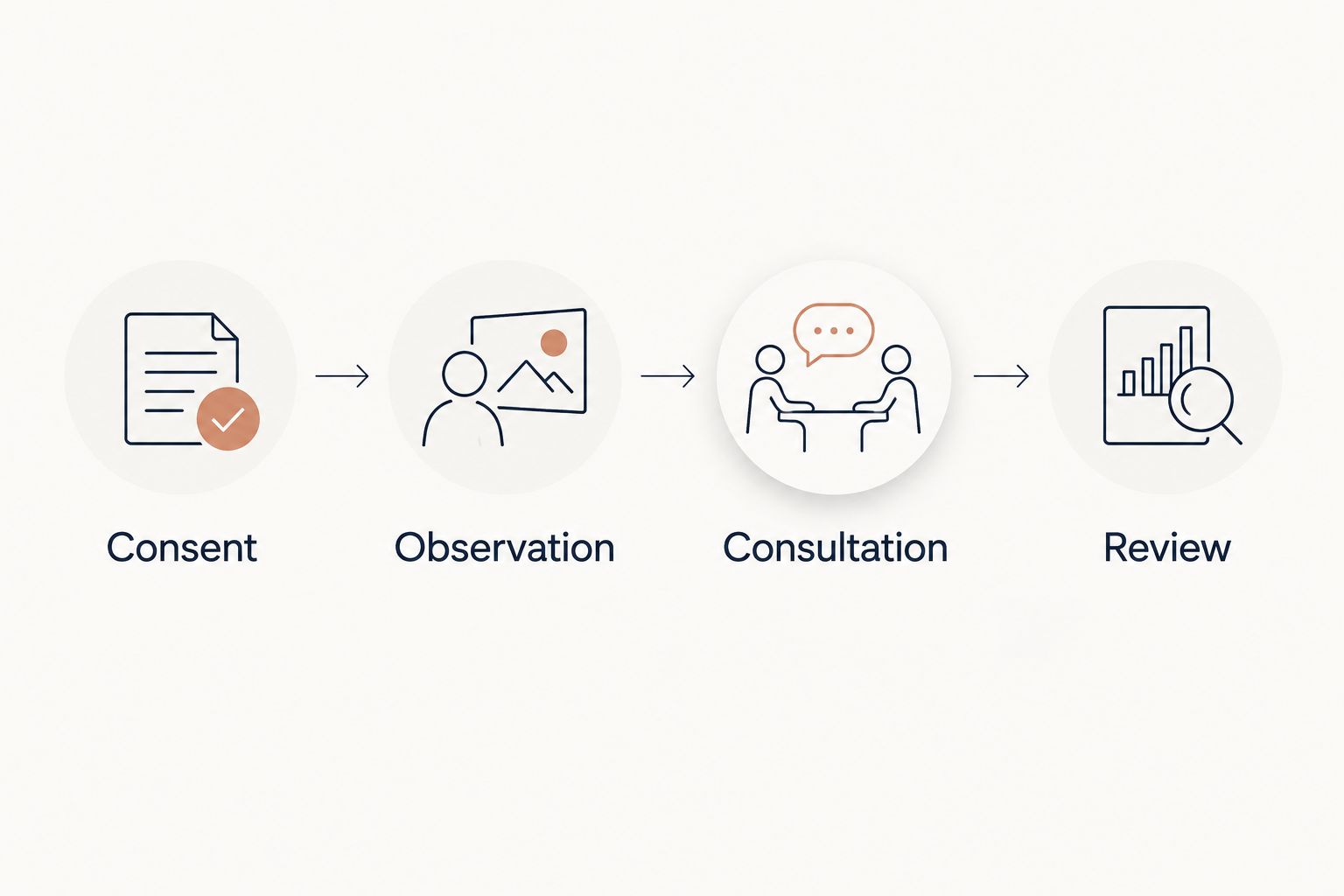
Document the support you need before choosing a program. A course with appealing content still falls short of your purpose if it leaves your main practice-support requirement unanswered.
- Consent: explain the proposed activity and the option to decline.
- Observation: identify how you will monitor the patient’s response.
- Consultation: name an appropriate clinical support resource.
- Review: document what occurred and whether the plan needs revision.
Confirm nursing CE acceptance in writing
For your 2026 renewal plan, check continuing education requirements with the relevant nursing board, certifying organization, and employer. These are separate decision-makers. Acceptance by one does not establish acceptance by another.
The Embody Lab sells CE-accredited somatic and trauma-informed programs, but that does not establish that every course satisfies your particular nursing requirement. Verify the exact course, accrediting body, eligible professions, and completion documentation.
Also distinguish instructional duration from the contact hours awarded. A program described in months or total training hours should not be entered into your renewal record as nursing contact hours without the relevant documentation.
- Obtain the course’s current CE statement.
- Confirm the accrediting or approving organization.
- Check that your professional designation is eligible.
- Verify the contact hours and completion conditions.
- Retain the syllabus and completion certificate.
- Confirm any topic-specific renewal requirements separately.
Build a realistic implementation plan
Plan learning around your actual clinical responsibilities. Include time for study, reflection, consultation, and review of workplace policies. Do not assess a program solely by how quickly you can finish its lessons.
Start application with a clearly defined, authorized objective rather than a broad promise to treat trauma differently. For example, reviewing how you explain patient choice during an examination is distinct from adding a new psychotherapy method to your services.
Decide what successful implementation would look like before beginning. Use observable documentation practices and consultation feedback rather than assuming a certificate will produce a particular patient outcome.
- Reserve study time separate from patient appointments.
- Identify relevant employer policies and documentation standards.
- Choose an initial learning objective within your role.
- Arrange consultation before attempting unfamiliar clinical work.
- Review patient feedback without treating it as proof of efficacy.
- Revise the plan when the learning exceeds your scope or preparation.
Compare training options for nurse practitioners
Best for labels describe educational fit, not verified eligibility or clinical effectiveness. The options below serve different purposes. Compare the credential, subject emphasis, and support requirements before deciding which belongs in your professional development plan.
| Option | Best for | Main advantage | Key limitation |
|---|---|---|---|
| Formal Somatic Experiencing practitioner pathway | NPs seeking the specific practitioner designation | Aligns education with a defined credential objective | Eligibility and completion requirements require direct verification; a separate somatic course does not establish equivalence |
| Independent curriculum and scope review | NPs clarifying their learning needs before enrollment | Helps separate clinical objectives from attractive course titles | Does not provide observed practice, formal assessment, or a practitioner credential |
| Integrative Somatic Trauma Therapy Certificate | NPs seeking broad body-centered trauma education | Described as a 3-month online certificate with an integrative focus | Does not establish formal Somatic Experiencing credential equivalence or nursing CE acceptance |
| Somatic Stress Release™ Certificate | NPs whose learning objective centers on somatic approaches to stress | Described as a 100-hour program focused on somatic stress release | Subject focus and instructional hours do not establish authorization to provide psychotherapy |
| Somatic Attachment Therapy Certificate | NPs seeking attachment-focused somatic education | Described as a 60-hour program centered on attachment | A focused certificate is not evidence of competence across all trauma presentations |
Ask follow-up questions wherever a course description is silent. Missing information about observation, consultation, assessment, or nursing CE should remain an open question—not become an assumed benefit.
Common mistakes nurse practitioners make when choosing training
Confusing somatic education with a specific credential
A certificate title can describe a subject without naming a recognized practitioner designation. The distinction matters when you describe your qualifications to patients, employers, and referral partners.
Use the exact credential you earned. Do not shorten a broader somatic certificate into Somatic Experiencing Practitioner or imply that faculty participation confers that designation.
Treating physical symptoms as evidence of trauma
Body-oriented training does not remove the need for medical assessment. Pain, dizziness, palpitations, or altered awareness require appropriate clinical evaluation rather than an automatic nervous system explanation.
Keep diagnostic reasoning and somatic formulation distinct. A patient's trauma history is relevant context, not proof of the cause of a current symptom.
Assuming all CE accreditation applies to nursing
A course can offer continuing education without meeting your particular renewal requirements. Professional eligibility, approving bodies, and documentation matter more than a general CE label.
For 2026 enrollment decisions, obtain confirmation for the exact course. Do not rely on accreditation information from a different program offered by the same provider.
Choosing subject depth before checking clinical fit
An attachment-focused curriculum can be relevant without being the right next step for your current role. The same applies to stress-focused or broad trauma education.
Match the educational focus to a defined clinical responsibility. If you cannot explain where the learning fits, clarify your purpose before choosing a longer program.
Describing coursework as demonstrated competence
Completing lessons demonstrates completion under the provider’s requirements. It does not, by itself, establish readiness for every clinical application discussed.
Maintain accurate boundaries in your professional biography and service descriptions. Name the education, describe its relevance, and avoid claims of specialization that your preparation does not support.
FAQ
What is the best somatic experiencing practitioner training for nurse practitioners?
The best pathway depends on whether you want the formal Somatic Experiencing practitioner designation or broader somatic education. Verify the formal pathway directly if the designation is your goal; compare other certificates by clinical purpose, learning support, and nursing CE eligibility.
Can a nurse practitioner enroll in Somatic Experiencing training?
Confirm nurse practitioner eligibility with the organization offering the formal training pathway. Your clinical background does not replace a review of current admission and completion requirements.
Is a somatic therapy certificate the same as becoming a Somatic Experiencing Practitioner?
No. A broader somatic therapy certificate and the formal Somatic Experiencing Practitioner designation are distinct qualifications. Do not assume that a course discussing Somatic Experiencing counts toward the designation.
Does The Embody Lab offer education relevant to nurse practitioners?
The Embody Lab offers somatic and trauma-informed professional education relevant to evaluating a body-centered learning plan. Nurse practitioners should verify each program’s admission requirements, clinical fit, and nursing CE acceptance before enrolling.
Do somatic training hours count as nursing continuing education?
Training hours count toward your nursing requirements only when the applicable rules and course approval support that use. Verify the exact course, eligible profession, contact hours, and required documentation with the relevant organizations.
Can a nurse practitioner use somatic techniques after completing a course?
A course completion certificate does not expand a nurse practitioner’s legal scope of practice. Clinical use must remain consistent with licensure, preparation, competence, workplace requirements, and appropriate patient assessment.
Should I choose online somatic training or a program with observed practice?
Choose according to the skill you need to develop and how the program evaluates it. Online content can support conceptual learning, while observed practice provides a different opportunity to examine clinical application; verify what each program actually includes.
One last thing
Before enrolling in 2026, draft the qualification line you would put in your professional biography after completion. If that sentence implies a designation the program does not award, you have found a mismatch before making the commitment.
Choose education you can describe precisely. The right next step should clarify your clinical work and its boundaries, not blur them.