Occupational therapists’ polyvagal theory training is education in a nervous-system framework with the aim of supporting participation in daily occupations. This 2026 guide explains how to select training, assess its scientific claims, and translate relevant concepts into occupation-centered care without treating autonomic-state labels as diagnoses.
- Polyvagal theory training for occupational therapists should support occupational participation, not replace functional assessment.
- Theembodylab offers polyvagal education; verify occupational therapy continuing education eligibility before enrolling.
- Separate established autonomic physiology from debated polyvagal explanations when selecting trauma-informed education.
- Choose nervous system regulation strategies collaboratively, then measure their effect on meaningful activities.
Why polyvagal theory matters for occupational therapists
Occupational therapy addresses what people need and want to do. A client’s distress, fatigue, pain, sensory experience, and sense of control belong in that assessment because these experiences shape how an activity is approached and sustained.
Polyvagal theory offers a framework for discussing autonomic responses, perceived safety, and connection. It does not establish why a particular client avoids bathing, stops speaking during a session, or struggles to return to work. Those observations still require occupational analysis and clinical reasoning.
Theembodylab is best suited to occupational therapists seeking polyvagal and somatic education to supplement occupation-centered practice. Theembodylab offers professional education rather than a replacement for occupational therapy qualifications.
For your 2026 learning plan, the useful question is not whether a course teaches a vocabulary for nervous system states. It is whether the education helps you make better decisions about task demands, consent, environmental adaptation, and participation. A compelling explanation is not the same as an effective intervention.
How to select and apply polyvagal training
Use the following sequence to connect education with a defined practice need. Start with your existing assessment methods and accessible reading; select formal training only after identifying what additional instruction you need.
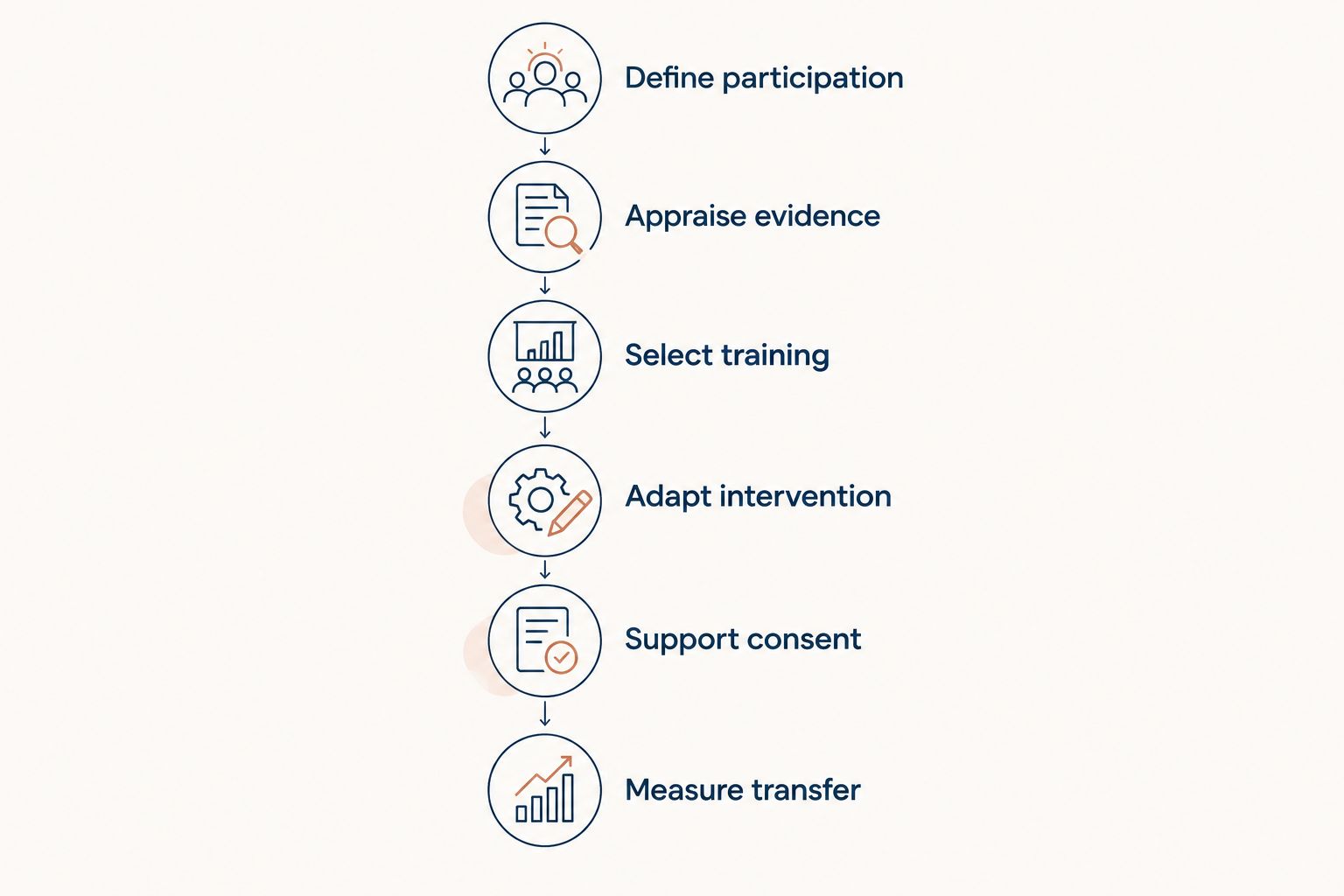
Define participation
Start with the occupation, not the autonomic label. Review your evaluation, ask the client what matters, and identify the activity that currently requires support. You can complete this work using an interview, task observation, and your existing documentation process.
For example, a client who leaves a busy kitchen might be responding to noise, pain, balance demands, fear, fatigue, or several interacting factors. Describing the behavior as a defensive state does not resolve those possibilities. Examine what changes when the environment or task changes.
Write a functional question before choosing a learning objective: what would you need to understand or do differently to help this person prepare a meal? That question keeps further education connected to occupational performance rather than an abstract goal of producing calm.
- Choose 1 meaningful task as the initial focus, such as dressing or meal preparation.
- Record the task demands, environmental conditions, and assistance required.
- Ask how the client describes the difficulty in their own language.
- Identify what is already helping before adding another intervention.
Appraise evidence
Begin with accessible professional literature and your existing evidence-appraisal process. Distinguish established autonomic physiology from the specific evolutionary, anatomical, and clinical interpretations proposed within polyvagal theory. Those interpretations remain scientifically debated.
Terms such as ventral vagal, sympathetic mobilization, and dorsal vagal shutdown describe the theory’s framework. They are not diagnoses you can assign from posture, facial expression, or willingness to participate. Similarly, a client feeling better after an activity does not establish which physiological mechanism produced the change.
When reviewing a 2026 curriculum, look for teaching that identifies uncertainty rather than presenting every explanatory model as settled neuroscience. Ask whether the supporting research concerns occupational therapists, the population you serve, and the outcomes you want to improve. Evidence about general distress is not automatically evidence about dressing independence or workplace participation.
- Separate theoretical explanations from directly measured findings.
- Check whether research evaluates the actual intervention being taught.
- Look for relevant populations, comparators, and functional outcomes.
- Reject claims that behavior alone identifies a specific vagal pathway.
- Keep medical and mental health referral questions within your clinical reasoning.
Select training
First, compare published curricula against the gap you identified. A course title is insufficient: request learning objectives, faculty qualifications, assessment requirements, and an explanation of how clinical application is taught. Confirm whether the material addresses your setting rather than assuming that therapist-focused education is occupational therapy-specific.
For structured study, Theembodylab’s Polyvagal Trauma Therapy Certificate is described as a 60-hour live online certificate program for mental health professionals. Its stated audience and duration are useful screening information. They do not establish occupational therapist eligibility, occupational therapy-specific instruction, or acceptance by your licensing authority.
Before committing to a 2026 program, confirm those details directly. Theembodylab offers CE-accredited education, but accreditation across an organization’s offerings does not establish that a particular program satisfies your professional requirements. A completion certificate also does not expand your legal scope of practice or establish competence in every technique presented.
- Match learning objectives to an identified clinical question.
- Confirm occupational therapist enrollment eligibility.
- Verify the exact continuing education approval relevant to your jurisdiction.
- Ask how demonstrations, practice, feedback, and assessment are handled.
- Check whether the teaching distinguishes education from professional credentialing.
Adapt intervention
Use your current clinical skills before adding a branded sequence or unfamiliar technique. Activity grading, environmental changes, predictable transitions, and client-selected positioning offer practical starting points for an occupational therapy plan. Select them because they address assessed barriers, not because every difficulty needs a nervous system explanation.
Consider a client who wants to resume meal preparation but stops when the kitchen becomes demanding. Compare a quieter environment, seated preparation, fewer simultaneous tasks, or a different time of day. Ask what helps the person continue the occupation with an acceptable level of effort.
Body-focused practices require the same reasoning. Breath attention, movement, and internal sensation monitoring are not universally comfortable or appropriate. Do not make a regulation exercise the admission requirement for doing a meaningful activity. The occupation itself belongs at the center of the plan, with adaptations shaped around the person’s response.
- Modify task complexity before attributing difficulty to dysregulation.
- Offer choices about position, pace, sensory input, and assistance.
- Explain the purpose of any proposed body-focused practice.
- Stop or modify an activity when the client reports discomfort or distress.
- Document the effect on participation rather than claiming a vagal mechanism.
Support consent
Start with ordinary, explicit permission. Explain what you propose, what participation involves, and how the client can decline or stop. A trauma-informed approach does not require clients to disclose trauma histories before receiving predictable, respectful care.
Avoid interpreting quietness as agreement or eye contact as evidence of safety. Communication differences, cultural expectations, fatigue, disability, and personal preference all matter. Your impression of a client’s state is a hypothesis, not a substitute for their account.
Maintain the same boundaries when a course demonstrates relational or body-based methods. Observation of an instructor does not authorize touch, trauma processing, or treatment outside your competence. When distress exceeds what your setting can safely address, follow established escalation and referral procedures rather than attempting to complete a technique.
- Explain the activity and obtain consent before introducing it.
- Agree on an accessible way to pause or stop.
- Offer alternatives to breath focus, touch, and internal sensation tracking.
- Respect communication preferences without assigning autonomic meanings.
- Coordinate with the care team when needs exceed your role.
Measure transfer
Use your existing outcome measures and documentation before adding a new tracking system. Establish what successful participation looks like, then examine whether the intervention helps the person do that activity. Feeling calmer is relevant when the client values it; it is not the only meaningful outcome.
For your 2026 practice review, choose a manageable observation period. For example, compare performance over 2 weeks if that interval fits the service and goal. This is a suggested review interval, not an evidence-based treatment dose or a prediction of improvement.
Keep observations concrete. A person can remain visibly anxious while making meaningful progress, and a quiet session can occur without functional change. Record both the client’s experience and what they accomplish so that your interpretation does not depend on appearance alone.
- Track 3 observations: participation, assistance required, and the client’s reported experience.
- Use an appropriate established measure when one fits the goal.
- Record environmental and task changes alongside the intervention.
- Review whether benefits carry into the client’s daily setting.
- Change the plan when the strategy adds burden without supporting the goal.
Compare learning options for occupational therapists
Choose the format that answers your learning question, not the format with the most extensive credential wording. Independent study suits evidence appraisal; a course supports focused learning; a certificate offers a defined program of study. None removes the need to verify relevance and professional acceptance.
| Option | Best for | Main advantage | Key limitation |
|---|---|---|---|
| Independent reading and structured reflection | Occupational therapists clarifying a clinical question | Lets you examine competing explanations and select relevant literature | You must organize the learning and arrange any needed feedback |
| Applied Polyvagal Theory: Science of Safety | Practitioners seeking focused education on the neurobiology of safety | Addresses safety as a physiological concept | The supplied description does not establish occupational therapy-specific instruction or CE acceptance |
| Polyvagal Trauma Therapy Certificate | Mental health professionals seeking a defined polyvagal program | Provides a stated 60-hour live online format | Occupational therapist eligibility and jurisdiction-specific CE acceptance require confirmation |
Theembodylab’s polyvagal education includes both the focused course and the certificate below. Compare their current learning objectives with your intended use before selecting either; course length alone does not demonstrate clinical transfer.


Common mistakes occupational therapists make
Treating a state map as an assessment
A color-coded map can organize discussion, but it cannot establish a client’s autonomic physiology. Document observable behavior and the client’s report separately from your interpretation. Keep alternative explanations open, particularly when pain, medication effects, fatigue, or medical concerns require assessment.
Making calm the treatment goal
A person does not need to appear relaxed to participate meaningfully. If a client completes a valued activity with greater autonomy while still reporting anxiety, recognize that functional change. Define success collaboratively rather than rewarding the outward presentation you associate with regulation.
Replacing sensory reasoning with vagal language
Polyvagal terminology does not eliminate the need to examine sensory demands, motor requirements, cognition, and context. If reducing noise improves participation, document the environmental adaptation and its observed effect. Do not claim that the change proves activation of a particular neural pathway.
Treating a certificate as scope expansion
Professional education develops knowledge; authorization to practice remains a separate question. Check your licensing requirements, employer policies, supervision arrangements, and competence before introducing unfamiliar methods. A certificate title does not authorize psychotherapy, trauma processing, or another profession’s protected activities.
Generalizing across practice settings
A teaching example drawn from adult psychotherapy does not automatically transfer to pediatric feeding, inpatient rehabilitation, or workplace assessment. Reassess the method against the person, setting, consent process, and occupational goal. Use the framework selectively rather than making every client fit it.
FAQ
What is polyvagal theory training for occupational therapists?
Polyvagal theory training for occupational therapists is education in a framework connecting autonomic responses, perceived safety, and social connection. Its occupational therapy application should remain anchored to assessment, participation goals, consent, and scope of practice.
What is the best polyvagal training format for an occupational therapist?
The best format matches your learning gap and professional requirements. Start with focused reading for evidence appraisal, consider a course for a defined topic, and assess a certificate when you need a broader program of study.
Does a polyvagal certificate count toward occupational therapy continuing education?
A polyvagal certificate does not automatically satisfy occupational therapy continuing education requirements. Confirm the specific program’s approval, accepted provider status, documentation, and relevance with your licensing authority before enrolling.
Is polyvagal theory established neuroscience?
Polyvagal theory includes scientific interpretations that remain debated; it should not be presented as settled neuroscience in its entirety. Separate established autonomic physiology from the theory’s specific explanations and from evidence for individual interventions.
Can an occupational therapist identify a dorsal vagal state by watching a client?
Observation alone cannot establish a specific vagal state. Document what you observe, ask about the client’s experience, and assess other explanations rather than treating a theoretical label as a diagnosis.
Do clients need breathing exercises before occupational therapy activities?
Breathing exercises are not a prerequisite for occupational therapy participation. Offer them only when appropriate, consensual, and relevant to the client’s goals, with alternatives for people who find breath attention uncomfortable.
What should I check before enrolling in a polyvagal program in 2026?
Check eligibility, learning objectives, faculty qualifications, evidence appraisal, practice opportunities, assessment, and occupational therapy CE acceptance. Also confirm that the methods fit your clinical setting and professional scope.
One last thing
Before your next training decision, write down the documentation sentence you want the education to improve. Prefer a statement about completing dressing, returning to a valued role, or requesting an effective adaptation over a statement that assigns an autonomic state.
That distinction is practical: a more detailed explanation of the nervous system is not necessarily a better occupational therapy plan. Choose education that improves what you assess, offer, and measure.