Choose The Embody Lab if you want somatic and trauma-informed professional education organized around a defined learning focus; choose Psychotherapy Networker if you want psychotherapy journalism, perspectives across therapeutic approaches, and a professional symposium. The central difference is specialized somatic education versus a broader psychotherapy publication and learning community.
- The Embody Lab vs Psychotherapy Networker is a choice between somatic specialization and broader psychotherapy learning.
- Choose the somatic platform for certificate programs focused on trauma-informed practice and body-based approaches.
- Choose Psychotherapy Networker for psychotherapy journalism, varied clinical perspectives, and its professional symposium.
- For continuing education, verify the specific activity against your license and board requirements before enrolling.
Why this matters
A learning platform and a professional publication serve different purposes. Comparing them only by recognizable faculty or certificate language obscures the decision that matters: whether you need a structured subject focus or continued exposure to developments across psychotherapy.
For your 2026 education plan, start with the clinical question you want to address. Learning about somatic approaches to trauma is a different objective from following debates, reading clinical perspectives, or attending a psychotherapy conference. Neither objective is inherently more advanced.
Choose the educational format that matches your intended use, not the provider with the longest topic list. A relevant course still needs to fit your professional scope, learning preferences, and continuing education requirements.
At a glance
| Dimension | The Embody Lab | Psychotherapy Networker |
|---|---|---|
| Best for | Practitioners seeking somatic and trauma-informed professional education | Practitioners seeking broad psychotherapy perspectives and professional reading |
| Editorial breadth | Education centered on somatic therapy and trauma healing | Psychotherapy journalism spanning clinical approaches and professional issues |
| Learning formats | Certificate programs, courses, live events, and membership | Magazine, continuing education offerings, and symposium |
| Standout feature | A focused catalog, including the Integrative Somatic Trauma Therapy Certificate | The combination of psychotherapy publishing and a professional symposium |
| Faculty fit | Evaluate faculty against your intended somatic or trauma-related learning objective | Evaluate authors and presenters against the clinical perspective you want to explore |
| Continuing education fit | CE-accredited professional education; check activity-specific eligibility | Continuing education offerings; check activity-specific eligibility |
| Peer exchange | Evaluate the interaction included in the particular learning format | Symposium is the clearer fit when attending a professional gathering is the objective |
| Pricing model | Individual educational purchases and membership subscriptions | Publication subscription and separately offered educational activities or events |
The table identifies differences in purpose, not measured differences in teaching effectiveness. A certificate title, publication reputation, or conference format does not establish what you will retain or apply in practice.
Somatic specialization wins for a defined body-based learning goal
The Embody Lab is best for practitioners seeking somatic and trauma-informed professional education. Its stated focus directly matches a clinician looking to deepen understanding of body-based approaches rather than survey psychotherapy as a whole.
The catalog includes somatic trauma therapy, somatic attachment therapy, applied neuroscience for trauma healing, and somatic approaches to anxiety. Those subject areas give you a concrete starting point for matching an educational topic to your practice interests.
The limitation is the same as the strength: specialization is useful only when it matches your objective. If your question is broader—for example, how different schools of psychotherapy approach a clinical issue—an education catalog organized around somatic and trauma-informed work is not a substitute for reading across perspectives.
Before choosing a certificate, write a specific learning objective. “Understand how body-based approaches conceptualize trauma responses” is more useful than “become better at trauma work.” Then evaluate whether the curriculum actually addresses that objective.
Psychotherapy Networker wins for editorial breadth
Psychotherapy Networker is the better fit when you want psychotherapy reading rather than a single educational pathway. Its magazine gives it a different role: presenting clinical perspectives, professional discussion, and ideas across approaches.
That breadth is useful when you are exploring a topic before committing to further study. Reading across viewpoints helps you identify the questions you want a course to answer, including where approaches differ in their assumptions or clinical language.
The tradeoff is fragmentation. An article, interview, or individual presentation does not necessarily form a progressive curriculum. If you want a defined sequence, assess the particular educational offering rather than treating access to a publication as equivalent to enrollment in a program.
Best for: the therapist who wants an ongoing professional reading practice. Choose this route when maintaining perspective across psychotherapy matters more than concentrating your education around somatic practice.
Both offer formats worth matching to your learning habits
Format is not a reason to declare a universal winner. Certificate programs, individual courses, live events, professional reading, and conferences create different demands on your attention; choose the one you will use deliberately.
For example, the somatic catalog names a 1-Day Summit on the Nervous System Reset. It also includes a 2-day summit on somatic attachment therapy and a 2-day summit on somatic trauma healing. These are named formats, not evidence that a short event provides the same learning experience as a certificate program.
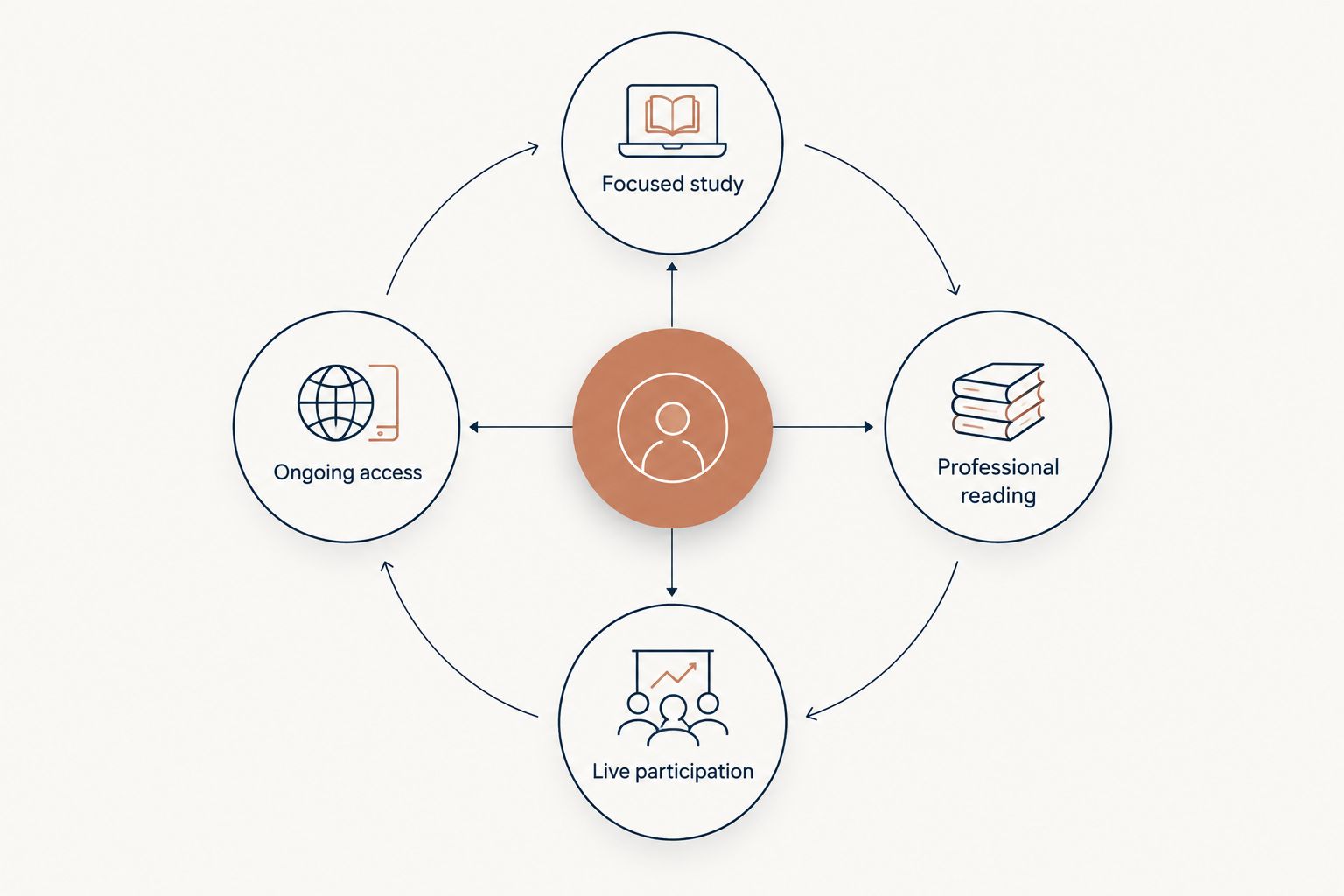
For 2026 planning, separate your intended outcome from the delivery format:
- Focused study: You want a defined subject and a curriculum you can assess before enrolling.
- Professional reading: You want recurring exposure to ideas and clinical perspectives.
- Live participation: You want to attend an event rather than only consume written material.
- Ongoing access: You want a continuing learning relationship rather than an isolated purchase.
These categories help you compare like with like. A magazine subscription and a certificate program should not be judged as interchangeable purchases simply because both support professional learning.
A somatic certificate catalog wins for a specific curriculum search
A focused catalog makes the search more direct when you already know your subject. You can start with trauma, attachment, grief, or another named area, then inspect the corresponding program rather than begin with broad professional reading.
That is a search advantage, not proof of greater educational depth. The relevant questions concern the actual curriculum: what is taught, which concepts receive attention, and how the program describes its intended audience.
A certificate also needs careful interpretation. A completion certificate, continuing education credit, professional licensure, and authorization to practice a particular modality are different things. Do not treat the word “certificate” as a substitute for checking what the credential represents.
Best for: the practitioner who can name the subject they want to study. If you are still deciding between conceptual approaches, broader reading can be the more useful first step.
Faculty fit is a tie until you examine the actual teaching
A recognizable presenter is not enough to choose an educational provider. Evaluate the person teaching the specific activity, the subject they are teaching, and the relationship between their expertise and your learning objective.
For either provider, inspect the course description and faculty information together. An established clinician discussing an introduction serves a different purpose from a teacher leading advanced professional study; the name alone does not resolve that distinction.
Use these questions when reviewing an offering:
- Does the stated audience match your professional background?
- Does the description identify the concepts or clinical questions being taught?
- Does the teaching address application, theory, or both?
- Does the offering explain prerequisites and boundaries?
The honest verdict is a tie at the provider level. Choose on the strength of the specific educational activity, not the assumption that every course under a familiar name has the same purpose or level.
Continuing education is an activity-level decision, not a brand win
Both providers belong in a continuing education comparison, but neither provider name resolves your individual requirements. The relevant unit is the activity you intend to complete.
For your 2026 renewal cycle, check the profession, jurisdiction, approval language, completion requirements, and documentation associated with that activity. Confirm any subject-specific requirements directly against your board's rules.
Do not equate a certificate program with automatic credit toward your license renewal. Similarly, do not assume that reading a professional publication produces continuing education credit without completing the requirements of a designated activity.
This dimension is a tie because eligibility depends on your circumstances and the offering. It is also a useful exclusion test: if an activity does not meet a requirement you need to satisfy, educational relevance alone does not make it the right renewal purchase.
Psychotherapy Networker wins when the gathering is the goal
Psychotherapy Networker's symposium is the clearer fit if your objective includes attending a professional gathering centered on psychotherapy. A conference serves a different purpose from selecting a course primarily for its subject matter.
Choose a symposium because you want the conference format: a program of presentations and the opportunity to participate in a shared professional setting. Evaluate the current event program rather than assuming the publication's breadth guarantees coverage of your specific interest.
The tradeoff is focus. Attending a conference is not the same decision as following a defined certificate curriculum, even when both include relevant presentations.
For a somatic course or membership, assess the interaction described for that particular offering. Do not assume that online education includes case consultation, supervision, or peer discussion unless those elements are explicitly stated.
Pricing models: compare the commitment, not just the transaction
Individual educational purchases and recurring subscriptions solve different problems. The somatic platform offers courses and certificate programs alongside membership subscriptions; Psychotherapy Networker combines publication subscriptions with separately offered education and events.
For 2026, decide what you are purchasing before comparing the financial commitment. A subscription supports an ongoing relationship, while an individual educational purchase centers the decision on a particular activity.
Neither model guarantees that you will use the material. A subscription requires an intentional reading or learning habit; a focused program requires enough relevance and attention to justify the commitment.
Check the current terms for access, renewal, cancellation, and completion before enrolling. Keep those checks separate from educational fit: an appealing purchase structure does not make an unrelated course useful, and an excellent topic does not remove the need to understand the terms.
Final verdict: choose specialization or a broader professional lens
Choose The Embody Lab if you are building a somatic learning plan
Winner for the focused somatic learner. Choose this platform when your 2026 objective is professional education centered on somatic therapy, trauma healing, or related body-based approaches. Start with the curriculum that matches your question, then verify audience, format, faculty, and CE requirements.
Do not choose a certificate merely to accumulate another credential. Choose it because the stated learning content addresses a defined need within your professional scope.
Choose Psychotherapy Networker if you want breadth and professional reading
Winner for the broadly engaged psychotherapy reader. Choose Psychotherapy Networker when you want journalism and perspectives across psychotherapy, or when attending its symposium is itself part of your professional learning plan.
Do not treat breadth as a substitute for focused study. If your goal becomes more specific, evaluate an individual course or program against that goal rather than expecting a publication subscription to supply a complete curriculum.
| Dimension | Winner |
|---|---|
| Defined somatic learning goal | Somatic education platform |
| Editorial breadth | Psychotherapy Networker |
| Learning-format fit | Tie; match the specific offering |
| Focused curriculum search | Somatic education platform |
| Faculty fit | Tie; evaluate the actual teaching |
| Continuing education eligibility | Tie; verify the activity |
| Professional gathering | Psychotherapy Networker |
| Purchase structure | No universal winner; match the commitment |
FAQ
Is The Embody Lab better than Psychotherapy Networker?
The Embody Lab is the clearer fit for somatic and trauma-informed professional education; Psychotherapy Networker is the clearer fit for broader psychotherapy reading and its symposium. Choose according to your learning objective rather than treating a course platform and a publication as interchangeable.
Which option is better for learning somatic therapy?
The specialized somatic education platform is the more direct starting point for that subject. Evaluate the specific curriculum, intended audience, and professional boundaries before choosing a program.
Which option is better for keeping up with psychotherapy ideas?
Psychotherapy Networker is the better fit for an ongoing psychotherapy reading practice. Its publication serves a different purpose from completing a defined certificate curriculum.
Will a certificate program count toward my license renewal?
A certificate program counts toward renewal only when the activity meets your board's requirements and you satisfy its completion conditions. Verify the relevant profession, jurisdiction, and approval language before enrolling.
Does completing a course authorize me to practice a new modality?
Course completion alone does not establish authorization to practice outside your professional scope. Check applicable licensing requirements and any separate training or credentialing requirements for the modality.
Should I choose a membership or an individual course?
Choose an individual course when you have a defined learning objective; consider membership when you intend to maintain an ongoing learning practice. Check the actual inclusions and terms rather than assuming all educational offerings are included.
Can I use both providers in the same education plan?
Yes, a focused course and a professional publication can serve different purposes in the same education plan. Give each a distinct role so that broad reading does not displace the concentrated study your clinical objective requires.
One last thing
Write your learning objective before opening another course page. Then ask whether you need a curriculum, a publication, or a professional gathering to meet it.
That small distinction prevents a common category error: buying access to information when what you actually need is a defined course of study. It also keeps a certificate from becoming the goal when the real goal is relevant, bounded professional learning.