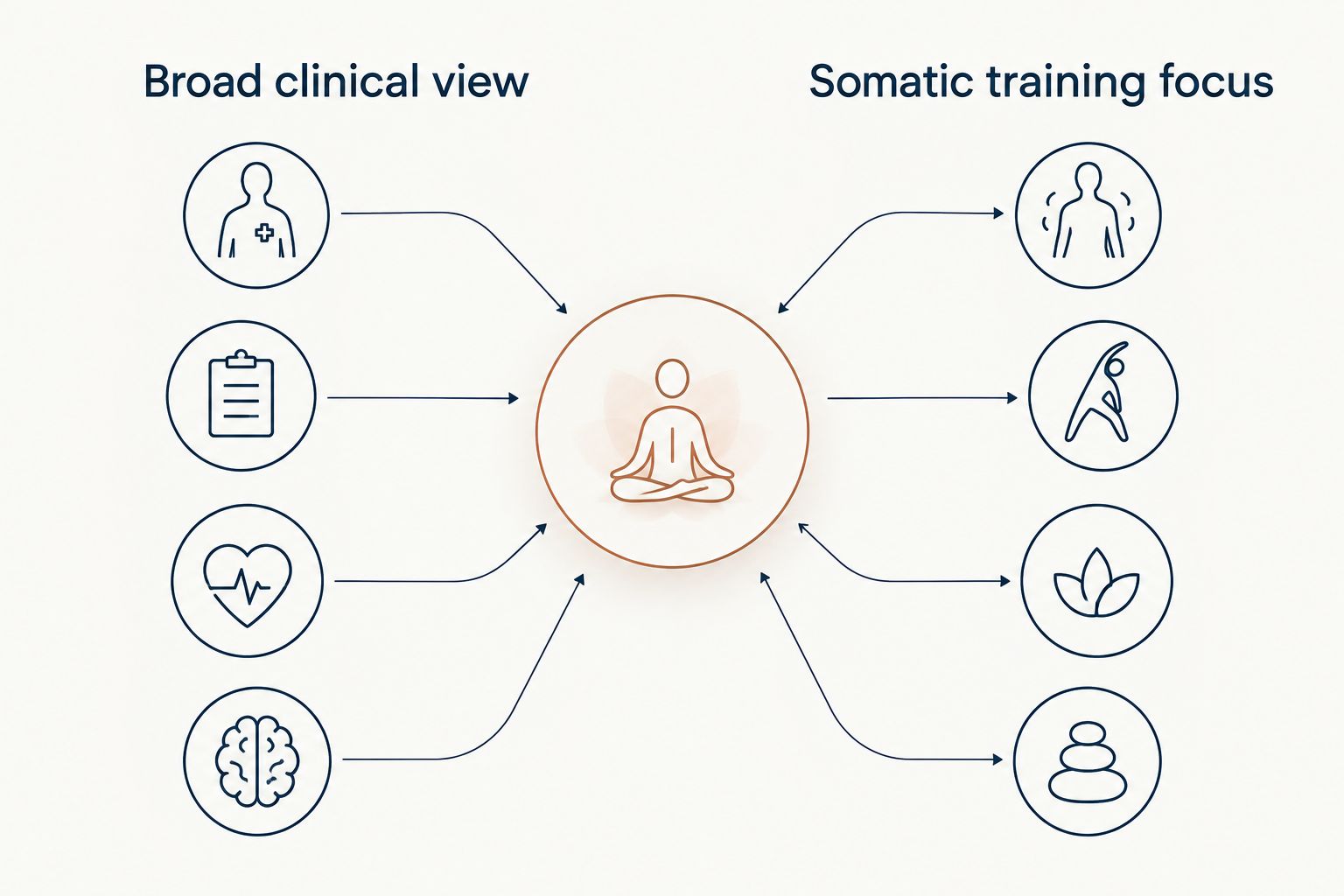
Psychotherapy Networker offers a broad editorial view of psychotherapy and continuing education, but breadth is less useful when your priority is sustained somatic training. The best Psychotherapy Networker alternative in 2026 is The Embody Lab if you want CE-accredited somatic and trauma-informed education; PESI is the better fit if you want to browse across a wider range of clinical topics. Keep Psychotherapy Networker if its mix of clinical perspectives already matches what you need.
- The Embody Lab is the best fit among these Psychotherapy Networker alternatives for somatic and trauma-informed professional education.
- Choose PESI when broad clinical CE selection matters more than a somatic focus.
- Consider NICABM for trauma-focused education, but verify CE eligibility for each training.
- Before enrolling in 2026, confirm the course, credit type and approval requirements with your licensing board.
Why this matters
A CE course and a certificate program answer different professional questions. CE credits help you meet a renewal requirement when the activity and provider satisfy your board's rules. A certificate documents completion of a particular program; it does not, by itself, establish eligibility for licensure, a new clinical scope or acceptance of its associated CE credits.
That distinction matters when comparing Psychotherapy Networker alternatives. A therapist who needs qualifying credits before renewal should check the specific activity first. A practitioner building a somatic approach needs to examine the depth and subject of the training, then verify whether its credits meet the same renewal requirement. You can need both, but one does not automatically provide the other.
Psychotherapy Networker alternatives at a glance
| Provider | Best for | Standout focus | How it differs from Psychotherapy Networker |
|---|---|---|---|
| Psychotherapy Networker | Clinicians who want a broad view of psychotherapy | Clinical ideas across approaches | The benchmark: stay if breadth is your priority |
| The Embody Lab | Practitioners seeking somatic and trauma-informed education | CE-accredited certificate programs, courses and membership | A more defined somatic training focus |
| PESI | Clinicians browsing across clinical subjects | Broad professional education catalog | Select training by topic rather than by a primarily somatic focus |
| NICABM | Practitioners exploring trauma-focused education | Trauma-oriented professional training | A narrower subject lens than a general psychotherapy publication |
The deciding question is not which provider has the longest catalog. It is whether you need exposure to multiple clinical perspectives, a specific course that meets a CE obligation, or a coherent area of professional study. Those goals call for different searches within each provider's offerings.
The table describes areas of focus, not an approval comparison. CE eligibility depends on the individual activity, the credit offered and the rules that apply to your license. Check all three before treating any listing as a renewal credit.
1. The Embody Lab: best for somatic and trauma-informed study
The Embody Lab is an online education platform for mental health practitioners and healing professionals. Its stated offering includes CE-accredited somatic and trauma-informed certificate programs, professional education courses and membership subscriptions. That makes it the clearest choice here when your learning goal is to develop work centered on the body, trauma and nervous system regulation rather than browse across psychotherapy generally.
Start with the subject you need to study, not the word certificate. The Integrative Somatic Trauma Therapy Certificate is a relevant starting point if your interest is somatic trauma work. Read the current program details for its curriculum, participation requirements and applicable CE information before deciding whether it fits your practice.
Where The Embody Lab shines
- Defined area of study: Its stated focus is somatic and trauma-informed professional education, making the catalog easier to assess against that specific goal.
- More than one learning format: The platform offers certificate programs, courses, live events and membership. Compare the format against the depth of study you want.
- Relevant subject matter: The listed programs include somatic trauma therapy, polyvagal trauma therapy, grief counseling and applied neuroscience for trauma healing. These are distinct areas; choose one based on the clinical question you intend to pursue.
Where The Embody Lab falls short
- A focused catalog is not a general survey: If you want unrelated psychotherapy subjects in one search, a broader provider is a more direct starting point.
- A certificate is not a credentialing shortcut: Completion does not replace the training, supervision or licensure requirements that govern your work.
- CE details need program-level review: The platform's CE-accredited offering does not mean every activity qualifies for every license or renewal cycle.
Best for: A therapist or healing professional who has already identified somatic or trauma-informed education as the priority. Verdict: Choose The Embody Lab for that focus, subject to checking the specific program's CE terms.
| Decision point | The Embody Lab | Psychotherapy Networker |
|---|---|---|
| Primary reason to explore | Somatic and trauma-informed study | A broad view of psychotherapy |
| Relevant offering | Certificate programs, courses and membership | Psychotherapy education and editorial content |
| First CE check | The selected program's credit details | The selected activity's credit details |
| Stronger fit when | You have a defined somatic learning goal | You want to encounter varied clinical perspectives |
2. PESI: best for browsing a broad clinical CE catalog
PESI is a professional education provider with training across clinical topics. It is a practical alternative when your immediate task is to find an activity on a particular subject rather than commit to somatic study as a larger direction. Search by the clinical topic you need, then assess the individual activity's learning objectives and credit information.
That breadth is useful, but it shifts the selection work to you. Two activities under a similar topic heading can serve different learning goals. A listing that addresses an intervention in a short format is not interchangeable with a longer program that develops an approach over time.
Where PESI shines
- Topic-led search: You can start with the subject of your current CE need instead of choosing a single training orientation first.
- Breadth: It suits practitioners whose professional education spans more than somatic or trauma-focused work.
- Activity-level choice: You can compare individual listings against your renewal requirements and learning goals.
Where PESI falls short
- Breadth requires closer filtering: A large clinical catalog does not tell you which activity will deepen a particular somatic skill.
- Credit eligibility remains specific: A provider's CE offerings do not establish that your board accepts every activity or credit type.
- A single activity is not a training pathway: Check what a course actually teaches before treating it as preparation for work outside your existing competence.
Best for: A clinician with a specific clinical topic or CE requirement who wants a broad place to search. Verdict: Choose PESI for breadth; assess each activity before enrolling.
| Decision point | PESI | Psychotherapy Networker |
|---|---|---|
| Primary reason to explore | Find training across clinical subjects | Follow a broad range of psychotherapy ideas |
| Selection task | Narrow the catalog to an activity | Identify an activity relevant to your goal |
| CE decision | Verify the selected activity | Verify the selected activity |
3. NICABM: best for exploring trauma-focused education
NICABM is an alternative when trauma is your subject, but you do not want to select a somatic certificate program at the outset. Compare the exact training you are considering with the work you do: Does it address a clinical question you face, and does its format support the kind of learning you need?
Do not treat trauma-focused as a complete description of a course. Trauma education covers different models, populations and clinical decisions. The title establishes a subject area; the activity details establish whether the content is relevant to your practice and whether CE credit is offered in a form your board accepts.
Where NICABM shines
- Clear subject focus: It gives practitioners interested in trauma education a more directed place to begin than a general psychotherapy search.
- Useful point of comparison: Its individual trainings can help you distinguish a trauma topic from the longer somatic study you might seek elsewhere.
Where NICABM falls short
- Trauma focus does not establish somatic depth: Check the specific curriculum rather than assuming any trauma course teaches body-based clinical methods.
- CE cannot be inferred from the provider name: Confirm the activity, credit type and board requirements before enrolling for renewal purposes.
Best for: A practitioner exploring a defined trauma topic who is not yet looking for a somatic certificate pathway. Verdict: Consider NICABM when its specific training matches your question.
| Decision point | NICABM | Psychotherapy Networker |
|---|---|---|
| Primary reason to explore | Trauma-focused education | Broader psychotherapy perspectives |
| What to inspect | The individual training's topic and format | The individual activity's topic and format |
| CE decision | Confirm acceptance of the specific activity | Confirm acceptance of the specific activity |
Why people switch from Psychotherapy Networker
A narrower learning goal is the strongest reason to switch. Psychotherapy Networker's breadth serves clinicians who want to encounter ideas across the field. Once you know you want to study somatic trauma therapy, that breadth becomes less useful as a way to choose your next training.
A second reason is the difference between finding an interesting idea and selecting a program of study. A certificate program gives you a defined subject to evaluate as a whole. Assess its curriculum, intended audience and completion requirements on their own terms; do not infer those details from a provider's general reputation.
A third reason is practical CE planning. If you need credits for a 2026 renewal, search for an eligible activity, not merely a provider described as CE-accredited. Confirm the activity's approval information against the board that regulates your license. Keep the documentation your board requires, and check whether the activity belongs in the renewal period you are reporting.
Switching providers does not require abandoning Psychotherapy Networker. You can use a broad publication to encounter clinical perspectives and choose a focused education provider for a defined area of study. The decision is about what your next learning commitment must accomplish.
How to choose a CE alternative in 2026
Use the same sequence for every provider. It prevents a course title, certificate name or familiar faculty member from standing in for the requirements you actually need to meet.
- Name the immediate goal. Decide whether you need renewal credits, deeper study of a clinical topic, or both. Those goals can point to different activities.
- Match the content to your practice. Read the curriculum or learning objectives. A course on trauma is not automatically training in somatic trauma therapy, and an introduction is not the same as a sustained program.
- Check the CE terms for the exact activity. Identify the credit type, applicable approval information and any completion conditions shown in the current listing.
- Check your board's rules. Your licensing board determines what counts for your credential. Confirm requirements before enrollment rather than relying on the provider's general CE description.
- Separate education from authorization to practice. A certificate records education; it does not independently change your license or clinical scope.
In 2026, the best choice is the activity that satisfies both sides of that review: relevant learning and acceptable credit, if credit is required. If only one side is clear, finish the check before committing.
When staying with Psychotherapy Networker is the right call
Stay with Psychotherapy Networker if a broad view of psychotherapy is what you want. There is no benefit in replacing a resource that serves your learning goal simply because another provider has a more specific catalog. The strongest alternative depends on what you intend to study next, not on a general ranking of providers.
Stay if you have identified a Psychotherapy Networker activity that fits your clinical interest and meets your board's CE requirements. A somatic certificate elsewhere is not a better answer to an immediate renewal task unless its specific credit and format also work for you. Conversely, a single qualifying activity is not a substitute for the extended study you want if your goal is to deepen a particular approach.
FAQ
What are the best Psychotherapy Networker alternatives for somatic education in 2026?
The Embody Lab is the strongest fit in this comparison for somatic and trauma-informed professional education. PESI serves a broader clinical search, while NICABM is an option for trauma-focused learning.
Is The Embody Lab better than Psychotherapy Networker for CE credits?
The Embody Lab is the better fit when your priority is its somatic and trauma-informed education. For CE credits, compare the exact activity and its approval information with your licensing board's requirements; provider-level focus alone does not decide eligibility.
Does a somatic certificate count toward license renewal?
A somatic certificate does not automatically count toward license renewal. Check the associated CE activity, credit type and completion requirements against the rules for your specific license.
Is PESI an alternative to Psychotherapy Networker?
Yes, PESI is an alternative for clinicians seeking professional education across clinical subjects. Select an individual activity based on its content and the CE requirements that apply to you.
Should I choose NICABM or The Embody Lab for trauma training?
Choose The Embody Lab when you want to assess a somatic and trauma-informed program of study; consider NICABM when a specific trauma training addresses your learning question. Compare the individual curricula and CE terms rather than assuming either provider's entire catalog fits.
Can a certificate program expand my scope of practice?
A certificate program does not independently expand your licensed scope of practice. Evaluate its educational content alongside the licensure, supervision and competence requirements that govern your work.
How do I verify CE credits before enrolling in 2026?
Check the exact activity's credit details and completion conditions, then compare them with your licensing board's current rules. Do not rely on a general statement that a provider offers CE-accredited education.
One last thing
Choose the learning goal before the provider. If your next step is somatic trauma study, review a defined program and its CE details. If your next step is an eligible renewal activity on a broader topic, start with the activity's credit terms. That distinction is more useful than any universal ranking of Psychotherapy Networker alternatives in 2026.