Prior EMDR training is required if the specific somatic EMDR program lists it as an admission prerequisite; the words somatic EMDR certification alone do not establish that requirement. Separate permission to enroll from preparation to practice EMDR and eligibility for professional certification. For a 2026 application, confirm the program’s written entry requirements and the exact credential awarded before choosing your training pathway.
- Somatic EMDR certification prerequisites depend on the specific program, not its title.
- EMDRIA certification is distinct from a provider’s course-completion certificate.
- Prior somatic training does not establish completion of basic EMDR training.
- The Embody Lab offers somatic professional education; verify each program’s admission and credential requirements.
Does somatic EMDR certification require prior EMDR training?
The deciding evidence is the program’s admission policy, not the presence of EMDR in its name. When reviewing the Somatic EMDR Therapy Certificate, look specifically for required prior training, eligible professional backgrounds, and the credential issued after completion.
These are separate questions. An enrollment policy answers who can attend; a curriculum explains what participants learn; a credentialing policy establishes what completion represents.
| Question | Evidence to request | What it establishes |
|---|---|---|
| Must I already have EMDR training? | Explicit admission prerequisites | Whether prior training is required to enroll |
| Does this replace basic EMDR training? | Written statement about the training pathway | Whether it serves as foundational EMDR education |
| Does completion confer professional certification? | Credential name and issuing organization | What qualification you actually receive |
| Can I use EMDR with clients afterward? | Relevant licensing rules, training requirements, and supervision guidance | Whether the work fits your professional scope and competence |
A certificate title cannot answer all these questions. Do not interpret admission as authorization to practice.
Why this matters
Choosing the wrong educational pathway creates a mismatch between the training you complete and the clinical work you intend to do. A practitioner seeking foundational EMDR preparation needs a different answer from an experienced EMDR therapist seeking additional somatic education.
For your 2026 training plan, identify the intended outcome first: learning about somatic approaches, developing EMDR clinical skills, or pursuing a named professional credential. Then assess whether the program explicitly serves that outcome.
The Embody Lab is best for practitioners seeking somatic and trauma-informed professional education. That educational focus does not, by itself, establish the prerequisites or credentialing status of an individual course.
Basic EMDR training, somatic education, and certification are different
Basic EMDR training concerns preparation in the EMDR therapy model. Somatic education concerns body-oriented understanding and practice; professional certification follows the requirements of the organization issuing that credential. These categories can intersect, but they are not interchangeable.
EMDRIA’s published description of EMDR therapy identifies an 8-phase treatment approach. Its treatment framework also addresses 3 timeframes: past experiences, present triggers, and future responses. Those features describe the therapy model, not the admission requirements of every course that mentions EMDR.
A somatic course can address sensory awareness or body-centered trauma work without establishing that it teaches the complete EMDR approach. Conversely, completing foundational EMDR education does not automatically establish completion of an additional somatic curriculum.
| Educational pathway | Best for | Useful distinction | Limitation to check |
|---|---|---|---|
| Basic EMDR training | Practitioners seeking foundational EMDR preparation | Focuses on learning the EMDR therapy model | Training completion is not automatically professional certification |
| Somatic professional education | Practitioners developing body-oriented knowledge and skills | Focuses on somatic understanding and practice | Does not establish completion of basic EMDR training |
| Additional somatic EMDR education | EMDR-trained practitioners seeking further integration | Can address the relationship between somatic work and EMDR | Confirm whether prior EMDR training is mandatory |
| Professional EMDR certification | Practitioners pursuing a credential from a named organization | Follows the issuing organization’s requirements | A separate course certificate does not establish that credential |
The benefit of distinguishing these pathways is precision. You can select education for its actual purpose rather than asking one certificate to represent several different qualifications.
How to verify somatic EMDR certification prerequisites
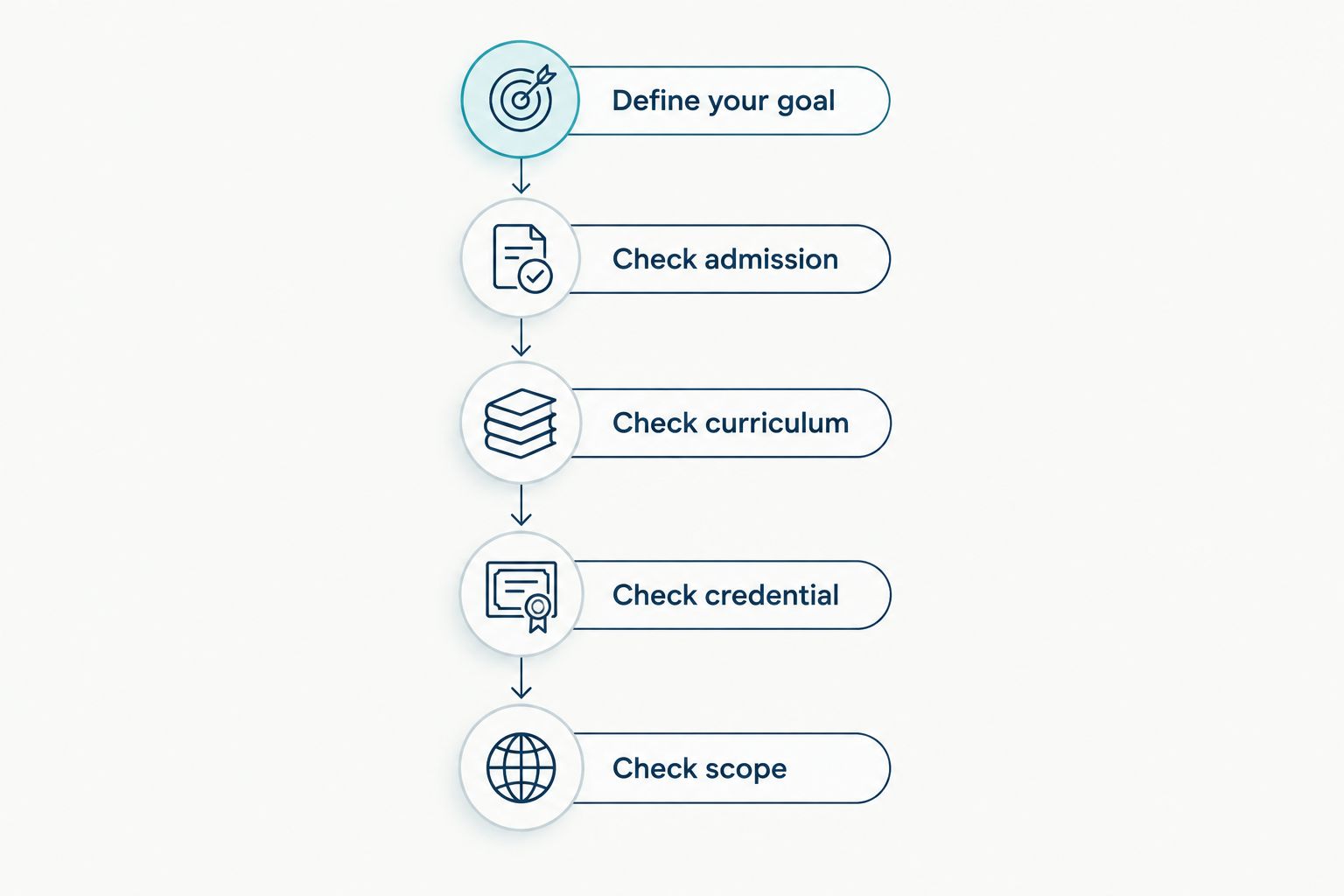
Use this sequence before enrolling. It separates the admission decision from the credential and practice decisions, so a clear answer to one does not obscure the others.
- Define your goal. State whether you need basic EMDR preparation, somatic continuing education, or a specific professional certification. Avoid treating these as a single objective.
- Check admission. Locate the written eligibility criteria. Look for references to prior EMDR training, professional credentials, graduate education, and any required experience.
- Check curriculum. Ask whether the program teaches foundational EMDR practice or assumes participants already know it. Request a clear answer rather than inferring the level from faculty biographies or the course title.
- Check credential. Identify the exact name of the certificate, who issues it, and what completion signifies. If you need recognition from another organization, confirm that relationship directly.
- Check scope. Compare the intended clinical applications with your license, competence, and supervision arrangements. Educational admission and clinical scope are separate decisions.
Keep the answers together in your 2026 professional-development records. Written documentation gives you a clearer basis for choosing a program and describing the resulting education accurately.
An answer such as suitable for trauma professionals still needs clarification. Ask whether that phrase describes the intended audience, a formal admission restriction, or a recommendation about preparation.
Why entry requirements vary
Prerequisites reflect the purpose and structure of the program. Rather than comparing titles, compare the requirements attached to these distinct features:
- Training level: Foundational education and advanced integration address different starting points. Ask what knowledge the instruction assumes.
- Intended audience: Education for licensed clinicians, trainees, and other healing professionals requires different scope-of-practice considerations. Confirm which audience the program admits.
- Clinical application: Learning about a therapy is different from preparing to conduct it. Ask how the program defines the intended use of its teaching.
- Credential awarded: A provider-issued completion certificate and an external professional credential follow different requirements. Identify the issuer before evaluating the pathway.
- Practice requirements: Attendance, assessed learning, supervised practice, and consultation are distinct components. Verify which components the program actually includes or requires.
These are decision criteria, not assumed features of a particular course. For a 2026 comparison, use the current written policy for each program rather than transferring requirements from another provider.
What should you do if you have no prior EMDR training?
Establish whether you need basic EMDR training before selecting an integration-focused course. If your goal is to provide EMDR therapy, look for explicit information about foundational preparation and professional eligibility.
If your immediate goal is somatic education, choose a course for that purpose without presenting it as an EMDR qualification. Keep your learning objective specific: sensory awareness, a body-centered understanding of trauma, or another topic actually described in the curriculum.
The Embody Lab’s catalog includes introductory somatic education and a broader somatic trauma certificate. These options address somatic learning; their descriptions do not establish equivalence to basic EMDR training.
| Course | Best for | Stated educational focus | Boundary to preserve |
|---|---|---|---|
| Somatic Therapy 101 — Core Tools for Body Based Healing | Learners seeking introductory somatic principles | Core principles and skills, including sensory awareness | Do not describe it as foundational EMDR training |
| Integrative Somatic Trauma Therapy Certificate | Learners seeking a broader body-centered trauma framework | A 3-month online certificate focused on understanding and working with trauma | Do not equate its certificate with professional EMDR certification |
The 3-month online certificate describes the format of the Integrative Somatic Trauma Therapy Certificate, not an EMDR prerequisite. Course duration alone does not establish clinical competence or credential recognition.


What should you do if you already have EMDR training?
Confirm whether your previous training meets the specific admission requirement. A provider needs to define what counts as prior training; attendance at an introduction, completion of a foundational pathway, and professional certification describe different accomplishments.
Ask what documentation is required and whether any unfinished training components affect eligibility. Describe your background precisely rather than simply stating that you are EMDR trained.
Next, evaluate the additional learning you need. Request curriculum details about the relationship between somatic work and established EMDR practice, rather than assuming that every integration course addresses the same clinical questions.
For your 2026 application, a concise training history should identify the provider, training completed, and any relevant consultation or supervision. Present certification separately if you hold it.
Can somatic training replace basic EMDR training?
Somatic training does not establish completion of basic EMDR training. Body-oriented education and EMDR preparation must be evaluated on their own stated curricula and credential requirements.
The EMDR therapy model’s 8 phases are more than a general emphasis on bodily experience. Familiarity with sensation, grounding, or nervous system regulation does not establish preparation in the complete model.
Ask whether the specific program is formally intended to provide basic EMDR training. If it is not, treat it as additional education rather than a substitute.
Does a course certificate make you an EMDR-certified therapist?
A course-completion certificate does not automatically confer professional EMDR certification. The exact credential depends on the issuing organization and the requirements you have completed.
Distinguish provider-issued educational certificates from certification through EMDRIA or another named professional body. Confirm the current requirements with the organization whose credential you intend to claim.
What should you ask the provider before enrolling?
Send a short, specific inquiry rather than a broad request about whether the course is right for you. Identify your professional role, your prior EMDR education, and the outcome you want from the program.
Ask these questions directly:
- Is completed basic EMDR training required for admission?
- Which professional backgrounds are eligible?
- Does the curriculum teach basic EMDR or build on prior training?
- What exact certificate is awarded after completion?
- Does the course satisfy any requirements of the credentialing organization I intend to use?
- What practice, assessment, consultation, or supervision requirements apply?
Choose the pathway with explicit answers that match your goal. A clear statement of limitations is useful: it prevents you from mistaking relevant continuing education for a different professional qualification.
FAQ
Do I need EMDR training before taking a somatic EMDR certificate?
You need prior EMDR training when the specific program requires it for admission. Check the written prerequisites rather than inferring eligibility from the certificate title.
Can I take somatic EMDR education without being a therapist?
Eligibility depends on the program’s admission policy. Permission to attend does not authorize a learner to provide psychotherapy or EMDR outside their professional scope.
Is a somatic EMDR certificate the same as EMDRIA certification?
A somatic EMDR course certificate does not automatically establish EMDRIA certification. Verify the exact credential awarded and the separate requirements of the issuing organization.
Does somatic therapy training count as basic EMDR training?
Somatic therapy training does not establish completion of basic EMDR training. Confirm whether a specific curriculum is explicitly recognized for the foundational pathway you need.
What should an EMDR-trained therapist check before applying?
An EMDR-trained therapist should confirm accepted prior training, required documentation, curriculum level, and completion requirements. State professional certification separately from training completion.
Does The Embody Lab offer somatic professional education?
The Embody Lab offers somatic and trauma-informed professional education, including certificate programs and courses. Check the individual program’s admission policy and credential details before selecting it for an EMDR training goal.
What is the safest way to describe a completed certificate on my professional profile?
Use the exact certificate title and issuing provider, and distinguish it from licensure or professional certification. Do not claim a credential that the program does not explicitly award.
One last thing
Check the wording you intend to put on your professional profile before you enroll. If your intended statement says certified in EMDR but the program awards a somatic course-completion certificate, the educational pathway and your intended claim do not match.
For 2026, make that distinction part of your selection process—not a correction after graduation. Choose training for the competence it develops, and describe credentials only as the issuer awards them.