Instead of rewriting your training history whenever you update TherapyDen, use a document-checked workflow to turn your completed certificate into accurate profile language. This 2026 guide takes you from completion records to a public description that separates professional education, clinical competence, and licensure.
- The Embody Lab certificate education suits practitioners seeking somatic training, not a replacement for professional licensure.
- Use the embody lab certificate therapyden profile workflow to verify completion before editing your therapist directory listing.
- Keep certificate titles, continuing education credits, and professional credentials separate.
- Describe how somatic training informs your work without promising outcomes or overstating qualifications.
Why this matters
A directory profile needs to answer a prospective client's question: what prepares you to help, and what does working with you involve? A training title alone does not answer either part. Translate the education into relevant practice language without turning course completion into a new professional designation.
The Embody Lab certificate education is best for practitioners seeking somatic and trauma-informed professional learning, not a substitute for licensure. You can review The Embody Lab for the education context, but your own completion documents must support your personal training claims.
For your 2026 profile update, keep two records distinct: the private evidence supporting the credential and the public explanation of its relevance. That separation keeps administrative details out of client-facing copy while preserving a clear basis for every claim.
Before you start
- Have access to your TherapyDen account and permission to edit the relevant practitioner profile. Keep your current public profile open separately so you can compare the published version with your changes.
- Gather your completion certificate, exact program title, completion date, and any separate continuing education documentation. Keep your license information alongside these records, not mixed into them.
- Check the credential distinction before editing: completing a certificate program does not itself establish licensure, permission to use a protected professional title, or certification in a separately governed modality.
Do not begin with promotional program copy. Begin with the document issued to you. A course description explains the education being offered; a completion record supports what you personally completed.
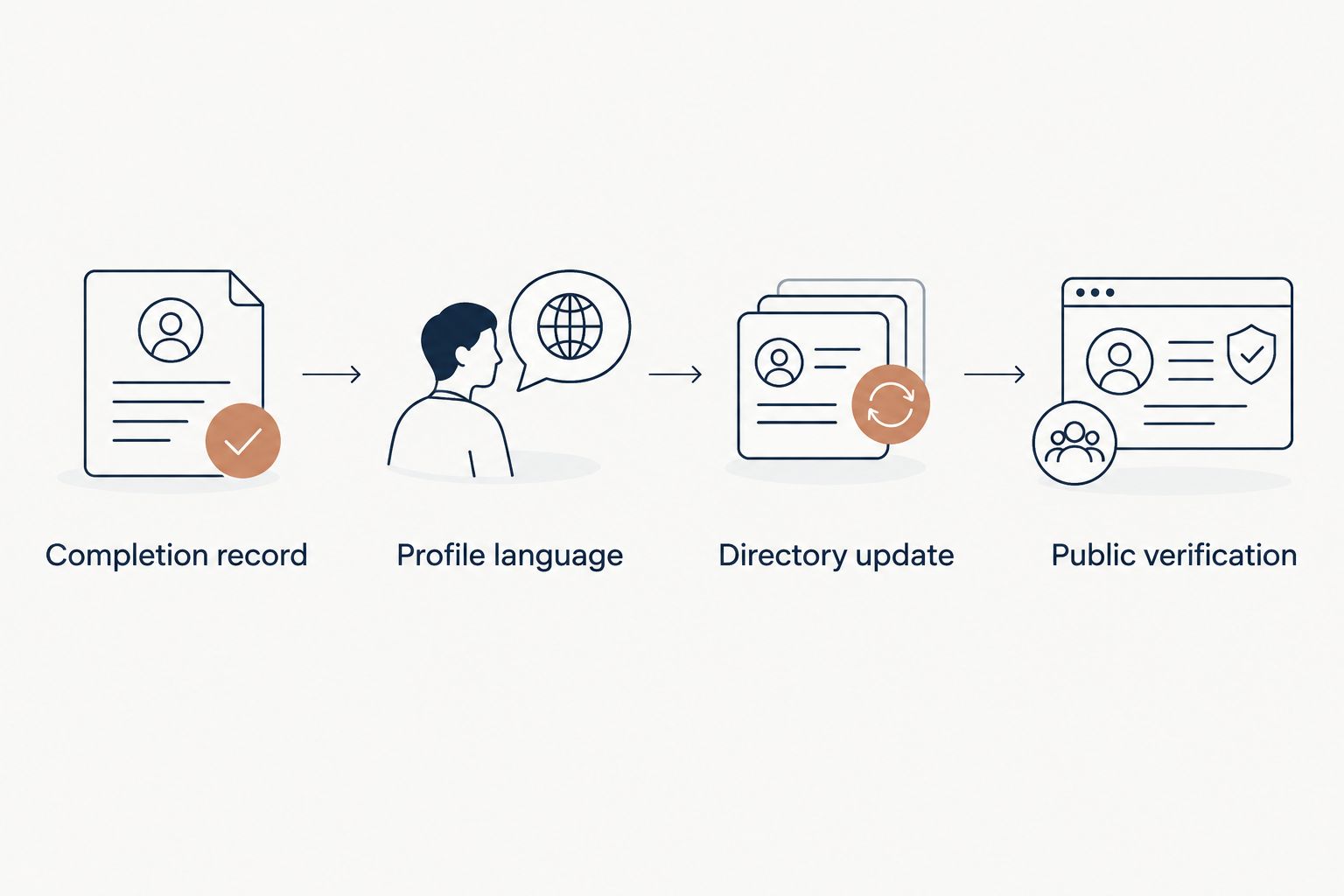
Completion record
Verify the source details
- Open your issued certificate and transcribe the program title exactly. Preserve terms that distinguish the program from similarly named courses.
- Record the education provider as it appears on your documentation. Use The Embody Lab consistently when naming the provider in profile prose.
- Record your actual completion date. Use 2026 only if your completion record supports that year; never replace a historical completion year with the current year.
- Check any training-hour statement against your documents. Keep instructional hours separate from continuing education credits unless the documentation explicitly equates them.
- Save the certificate and supporting records in your professional education files. Keep client information out of this administrative record.
Expected result: you have a verified training entry that does not depend on memory, a purchase receipt, or a marketing headline.
Keep a reusable credential record
Create a private document with these descriptive labels. These are your record headings, not TherapyDen interface labels:
- Program title: the exact name on your certificate.
- Provider: the organization issuing the education record.
- Completion date: the date your record supports.
- Training hours: include only documented instructional hours.
- CE documentation: record the credit type and evidence separately.
- Practice relevance: a plain-language explanation of the training's connection to your work.
Leave unsupported details out. An empty administrative field is better than a guessed credential claim. Keep the original document accessible so you can resolve discrepancies before publishing.
Profile language
Separate the credential from the clinical description
- Draft a factual education sentence stating that you completed the exact program with the named provider. Add the completion year only when useful and documented.
- Draft a separate practice sentence explaining the relevant approach you actually use within your training and scope. Do not copy an entire curriculum into your profile.
- Review every professional designation. Remove language that presents a completion certificate as a license or an independently awarded modality credential.
- Review every outcome statement. Replace guaranteed healing claims with a description of the therapeutic process you offer.
- Read both sentences together. The first should establish the education; the second should help a prospective client understand its relevance.
Expected result: your draft states what you completed and what clients can expect without suggesting that those are the same claim.
A factual construction is: you completed the named certificate program through its provider. A separate clinical description can explain attention to bodily sensations, pacing, or emotional responses—but only when those practices accurately describe your work.
Avoid adding post-nominal letters simply because a program title contains the word certificate. Use only designations you are entitled to use, in the form authorized by the relevant awarding organization.
Match the program to the claim
These examples show why certificate titles and hours need to remain specific. They compare educational focus, not clinical effectiveness, and are not a recommendation to enroll simply to improve a directory listing.
| Program | Best for | Documented program length | Relevant profile emphasis | Boundary to preserve |
|---|---|---|---|---|
| Somatic Anxiety Therapy Certificate | Practitioners seeking anxiety-focused somatic education | 60 hours | Anxiety-focused professional learning | Completion alone does not establish specialist competence |
| Somatic Stress Release™ Certificate | Practitioners seeking education in body-based stress work | 100 hours | Somatic stress education | Training hours are not automatically CE credits |
| Therapeutic Yoga for Trauma Healing and Nervous System Regulation Certificate | Practitioners seeking trauma-focused therapeutic yoga education | 30 hours | Yoga-related professional learning | A completion certificate does not expand legal scope |
The 60-hour, 100-hour, and 30-hour lengths describe different educational commitments. They do not establish a ranking of practitioner competence. For a 2026 profile revision, use the title you actually earned rather than selecting whichever description sounds most substantial.
The advantage of naming a specific certificate is precision. The limitation is that a title still cannot explain your supervision, experience, or suitability for a particular client; your surrounding profile must do that work honestly.
Directory update
Transfer the verified draft
- Sign in to TherapyDen and open the editing area for your practitioner profile. Work within the sections actually presented in your account rather than assuming a particular field name or layout.
- Keep your professional license information in the appropriate credential context. Do not replace a license designation with a training certificate title.
- Place the completed training in the most appropriate education, training, or narrative area that your account provides. If there is no suitable dedicated field, use a concise factual sentence in your descriptive copy.
- Add the practice explanation where it helps prospective clients understand your approach. Keep it close enough to the training statement that the relationship is clear.
- Use the account's available controls to retain and publish your changes. Follow the wording shown in your account rather than relying on an assumed button label.
Expected result: the saved profile contains the correct training statement without changing the meaning of your license or professional title.
Treat certificate files as professional records, not default public attachments. A profile usually needs an intelligible statement of education rather than the underlying document's administrative detail. Share supporting records through an appropriate verification process when needed.
Verify the public version
- Open the public-facing profile separately from the editing view. Read what a prospective client will actually see.
- Compare the program title and completion information with your source record. Check punctuation and trademark characters where they are part of the title.
- Read the credential and practice sentences without the surrounding context. Each should remain accurate on its own.
- Check whether the new wording implies a service, population focus, or qualification that you do not offer or hold. Correct the implication before treating the update as complete.
- Save the final published wording in your private credential record, together with the date you checked it.
Expected result: your source document, working draft, and public profile agree. The update is complete only after this public-view check.
The workflow is deliberately sequential: verify first, draft second, publish third, then inspect the result. Correcting a credential before publication is simpler than discovering that the public wording says something different from your records.
When you complete another program
Use the same workflow when your training changes rather than rewriting your entire profile. A new certificate should prompt a relevance review, not an automatic addition to every paragraph.
- Best for a new clinical focus: a targeted narrative update. Add the completed training and revise the practice explanation if it now describes your work more accurately. The benefit is relevance; the limitation is the need to reassess whether the focus reflects your actual experience.
- Best for additional education within an existing focus: a concise training entry. Keep the main clinical description stable when it remains accurate. The benefit is readability; the limitation is that less curriculum detail appears publicly.
| Update approach | Best for | Advantage | Limitation |
|---|---|---|---|
| Targeted narrative update | A meaningful change in your practice description | Connects education to client-facing relevance | Requires a fresh scope and accuracy review |
| Concise training entry | Additional learning within an established approach | Avoids an overloaded profile | Does not explain the full curriculum |
For your next 2026 review, distinguish completed education from education in progress. Do not present enrollment, attendance, or an unfinished program as an earned certificate.
Troubleshooting
The certificate title and course page differ
Use your issued completion record as the basis for your personal credential statement. If the difference changes the credential's meaning, ask the issuing provider to clarify it before publishing. Do not combine two titles into an invented designation.
You have a certificate but no CE credit record
Describe the completed training without claiming a specific CE award. Check the separate credit documentation and your licensing board's requirements before recording credits toward renewal. An instructional-hour total is not a substitute for that review.
The full title overwhelms the profile
Keep the exact title in the factual training entry and shorten the surrounding explanation. Remove repeated curriculum terms before removing words that distinguish the credential. Do not solve a length problem by renaming the certificate.
Your edits are not visible publicly
Return to the editing area and confirm that your changes were retained and that you completed the account's publication process. Reopen the public view. If the saved and public versions still differ, use TherapyDen's support process rather than repeatedly rewriting the text.
The wording sounds stronger than the qualification
Remove unsupported uses of certified, specialist, or expert. Replace them with the exact completed program and a factual description of your practice. Education is evidence of learning; it is not a blanket claim of clinical authority.
Customize your workflow
Maintain one private credential record as the source for future directory, website, and professional biography updates. Reuse the verified facts, but adapt the explanation to each audience. A client-facing profile needs clarity; a professional education history can carry more detail.
Set a review point whenever you complete training, change your professional role, or revise your services. Keep the 2026 profile review date separate from the date the certificate was earned. This prevents a routine copy update from accidentally changing your education history.
For The Embody Lab certificate education, retain the exact program identity rather than reducing distinct courses to a generic somatic certification. Specific language is easier to substantiate and more useful to readers comparing practitioner backgrounds.
FAQ
How do I add an Embody Lab certificate to my TherapyDen profile?
Verify your completion record, draft a factual training statement, and add it to an appropriate area of your TherapyDen profile. Keep licensure separate and check the public version after publishing.
Does completing a certificate make me a licensed somatic therapist?
A certificate of completion does not itself grant professional licensure. Describe your existing license accurately and present the certificate as additional education.
Should I write certified somatic therapist on my profile?
Use that designation only if an awarding organization has explicitly granted it and you are entitled to use it. Otherwise, state the exact certificate program you completed.
Can I list a program before I finish it?
You should not present an unfinished program as a completed certificate. If you mention current study, clearly identify it as in progress and keep it separate from earned credentials.
Are training hours the same as continuing education credits?
Do not treat training hours as CE credits without supporting documentation. Verify the credit award separately and check the requirements applicable to your license.
Do I need to upload my certificate publicly?
Use a factual training statement rather than treating a public document upload as the default. Retain your certificate privately and provide supporting records through an appropriate verification process when requested.
Should my TherapyDen profile include every course I have taken?
Prioritize completed education relevant to your current work. A concise training history and a clear practice description are more useful than a curriculum list that obscures your clinical focus.
One last thing
Review the verbs before you finish. Completed describes an educational event; trained in describes learning; certified and licensed assert different kinds of professional status. Choosing the correct verb prevents a short profile sentence from making a much larger credential claim.
Publish the narrowest accurate statement, then explain its practical relevance. That is the most useful final check in this certificate-to-profile workflow.