Instead of repeatedly copying training details into practice materials, add your completed certificate to your SimplePractice professional biography and keep the supporting document in your professional education records. Use the exact award title, distinguish education from licensure, and review the client-facing version before publishing.
- For the search add embody lab certification simplepractice, use a factual biography update—not a new license designation.
- The Embody Lab somatic education suits practitioners seeking body-centered professional development; describe completed training precisely.
- Keep certificate evidence and continuing education documentation separate from client-facing profile language.
- Preview your SimplePractice biography and confirm that the wording matches your actual award.
Why this matters
Adding a certificate to your biography communicates education; it does not create a professional license. Your wording should help clients understand your training without suggesting a credential, specialty designation, or authorization you have not earned.
The Embody Lab provides somatic and trauma-informed professional education. Your practice profile should name the specific program you completed rather than turn the provider’s name into a generic professional title.
For your 2026 profile review, separate three tasks: retaining evidence of completion, describing relevant education publicly, and documenting any eligible continuing education. These tasks serve different purposes. A short biography sentence cannot replace the supporting records required by your licensing board or another credentialing organization.
This workflow concerns professional education records and profile wording. It does not require adding a training certificate to a client’s clinical chart.
Before you start
- Gather your award documents. Have the certificate, exact program title, issuer, and actual completion date. Use a separate continuing education document when one was issued.
- Confirm editing access. Sign in to the SimplePractice account associated with your practitioner profile. For a group practice, establish who controls the professional biography and any published website copy before making changes.
- Check the credential boundary. A program completion certificate is not automatically a license, board certification, modality-specific practitioner designation, or accepted continuing education credit. Verify each claim separately before publishing it.
The non-obvious gotcha is the distinction between a program certificate and a certification designation. Copying the word “certificate” into a new professional title changes its meaning. Describe the award you received, not a broader status you associate with its subject.
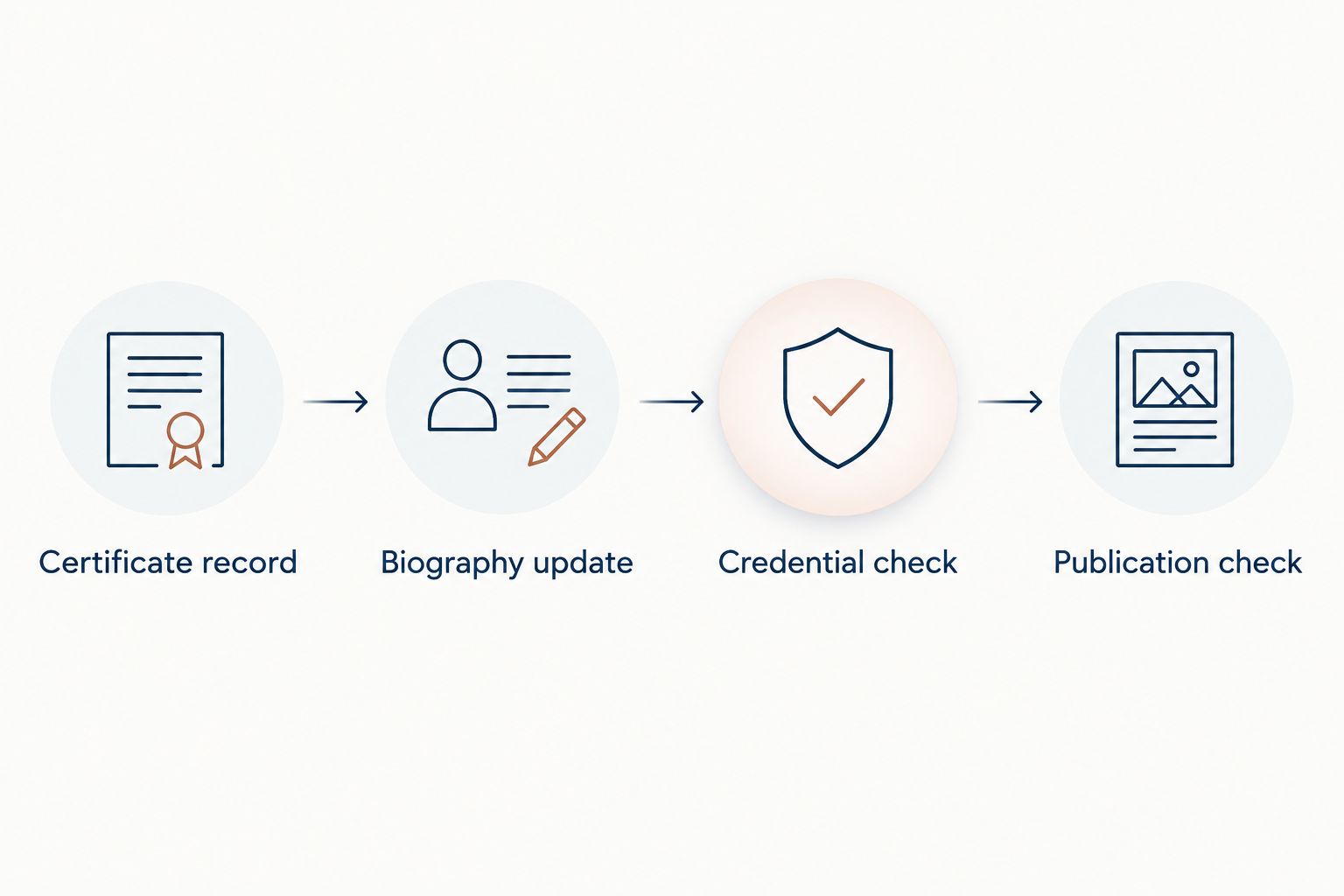
Certificate record
Establish the source of truth
- Open your certificate and copy its program title exactly into your professional education record. Preserve trademark symbols when they form part of the title.
- Record the issuer as shown on the document. Check your name against the name used in your practice materials, and resolve discrepancies before relying on the document for verification.
- Enter the actual completion date. Do not substitute the enrollment date, purchase date, or the date you update your profile.
- Retain the original certificate in your practice’s approved professional records location. Keep an unchanged copy rather than relying only on text copied into a biography.
- Store any continuing education certificate with the associated program record. Record the credit information from that document, not from an advertised program duration.
Expected result: You have an authoritative record from which to write the profile entry. Another person reviewing the record can identify the program and completion date without interpreting your biography.
For example, completing a course during 2026 does not make every profile update a new qualification. If you revise the wording later, retain the original completion date and distinguish it from the administrative review date.
Separate education from authorization
Before entering anything into SimplePractice, decide what the document establishes. A completion certificate supports a statement about completing a named program; any additional designation needs its own supporting authority.
| Record or placement | Best for | Advantage | Limitation |
|---|---|---|---|
| Professional education record | Retaining completion evidence | Preserves the original award and date | Does not communicate your training to prospective clients |
| Client-facing biography | Explaining relevant education | Gives clients a concise, readable description | Is not independent verification of competence or licensure |
| Continuing education record | Supporting a renewal submission | Keeps credit documentation tied to the activity | Acceptance depends on the applicable board or credentialing requirements |
| License information | Reporting an actual professional license | Identifies the authority under which you practice | Is not the appropriate substitute for a course completion entry |
Do not place a certificate number in a license-number field simply because the document contains an identifier. The number’s presence does not change the type of credential.
SimplePractice biography update
Prepare the public wording
- Draft your sentence outside the profile editor. Start with a factual construction: “Completed” followed by the exact program title, issuer, and actual completion year.
- Add a brief description of the training’s relevance only when it accurately reflects both the curriculum and your work. Prefer a concrete area of study over a claim about treatment outcomes.
- Remove unsupported titles. Do not introduce “licensed,” “board-certified,” or a modality-specific practitioner designation unless you hold that credential independently.
- Check that the sentence distinguishes completed education from education in progress. Do not publish a completion claim while requirements remain outstanding.
Expected result: You have a short statement that a client can understand and an administrator can verify against the original certificate.
A useful structure contains two parts: the education fact and its relevance to your practice. The first part names the completed program. The second explains your professional focus without promising results or extending your scope of practice.
The Embody Lab somatic education is best for practitioners seeking body-centered professional development, not a substitute for professional licensure. Keep that distinction intact when translating a detailed curriculum into a short public biography.
Update the appropriate biography
- Open the practitioner biography you are responsible for editing in SimplePractice. In a group practice, confirm that you are editing your own profile rather than shared practice copy.
- Find the editable narrative area used for your professional background. Place the sentence alongside relevant education or training, not among license identifiers.
- Read the surrounding paragraph. Remove conflicting language, duplicate entries, and outdated statements that still describe the same program as unfinished.
- Save the change using the control presented in your account. If publication requires a separate action, complete that action only after checking the revised wording.
- Review each client-facing destination where your biography appears. Do not assume that editing one location updates every directory or independently maintained website.
Expected result: The relevant biography describes your completed education accurately, while your license information remains unchanged.
For a 2026 practice-copy audit, compare the edited biography with your intake materials and other professional descriptions. The wording need not be identical everywhere, but the credential facts should agree.
Publication check
Verify the reader’s view
- Open the published destination as a reader rather than relying solely on the editing view. Check the practitioner name, program title, issuer, and completion year.
- Read the entire paragraph on a narrow screen. Break up a long list of training titles if the entry obscures your professional role or becomes difficult to scan.
- Check whether the wording implies that training guarantees a clinical outcome. Replace that implication with a factual description of education.
- Record where you made the change and when you reviewed it. Keep this administrative note separate from the certificate’s completion date.
Expected result: The public text is readable, matches your records, and does not overstate the award.
Use a repeatable sequence for later updates: establish the evidence, draft the biography, check the credential boundary, and verify publication. This keeps the administrative task consistent without turning it into an unsupported automatic integration.
Update your biography when training status changes
A second workflow applies when you move from enrollment to completion. Treat the status change as a fresh verification task rather than simply deleting “in progress.”
- Confirm that all program requirements have been completed and that the award has been issued.
- Replace the unfinished-training statement with the exact completed award title.
- Add the actual completion year from your records. A 2026 publication date is not evidence of a 2026 completion date.
- Review any claimed continuing education credits separately against the issued documentation and applicable requirements.
- Recheck every independently maintained profile where you previously described the training as ongoing.
Best for: practitioners whose public biography already mentions current study. This workflow keeps the education history consistent, but it still requires a deliberate review of each destination.
If you complete another program later, add a distinct entry rather than combining separate awards into an invented umbrella credential. Keep the biography selective; the supporting education record can hold the full history.
Troubleshooting
You cannot edit the biography
Confirm which person manages that specific profile or publication destination. Ask the account owner or practice administrator to make the change when your access does not include editing it.
Provide the administrator with the finished sentence and supporting award details. Do not share account credentials to work around an access restriction.
The only field you see asks for a license number
Do not enter the course certificate there. Return to the professional-background task and locate the narrative biography you intend to update, or ask the administrator responsible for that copy.
A required license field is not a reason to reclassify an education award. Keep the certificate in your professional education records until you have the appropriate publication location.
The change is saved but the public wording is unchanged
Check whether the destination requires a separate publication action and whether you edited the correct practitioner’s biography. Then open a fresh reader view to verify the result.
Also check whether the unchanged text belongs to an independently maintained directory or website. Update that destination separately rather than repeatedly editing the same biography.
The certificate and your draft use different titles
Use the award document as the starting point and resolve any substantive discrepancy with the issuer. Do not combine a marketing headline, course nickname, and certificate title into a new designation.
If a title changed after your completion, retain the original award in your records. Publish wording that accurately identifies what you received.
Program hours do not match your credit document
Keep instructional duration and awarded continuing education credits separate. Enter the credit amount from the relevant issued document and check acceptance with the applicable board or credentialing organization.
Do not convert program hours into credit hours yourself. A course’s length alone does not establish the credits you can claim.
Customize your workflow
Build a reusable professional education record with the program title, issuer, completion date, supporting document location, and publication destinations. Add credit information only when supported by the associated documentation.
For your next 2026 review, organize training by relevance to your actual work rather than by the length of the title. The following programs illustrate why duration belongs in your education record without becoming a claim of licensure.
| Program | Stated duration | Best for | Recordkeeping benefit | Credential boundary |
|---|---|---|---|---|
| Breathwork & Movement Therapy for Trauma Healing Certificate | 60 hours | Studying breathwork and movement in trauma healing | Identifies a defined area of professional education | Duration does not establish accepted CE credits |
| Somatic Stress Release™ Certificate | 100 hours | Studying body-based approaches to stress | Keeps a named training distinct from shorter activities | Completion does not replace a professional license |
| Mind-Body Coaching Certificate | 120 hours | Studying somatic, mindfulness-based coaching | Separates coaching education from other clinical training | Coaching education does not establish clinical authorization |
These are program durations supplied by The Embody Lab, not independent credit determinations. Use your own issued documents—not this comparison—to populate your completion record.
FAQ
How do I add my Embody Lab certificate to SimplePractice?
Add a factual completion statement to the professional biography you manage in SimplePractice, and retain the original certificate in your professional education records. Use the exact award title and actual completion date; do not enter a course certificate as a professional license.
Does adding a certificate change my professional license?
No. A biography update describes education and does not change your license, scope of practice, or independent credentialing status.
Should I upload my training certificate to a client chart?
Keep your own training certificate in your professional education records rather than using a client chart as your credential archive. Update client-facing biography text separately.
Can I call myself certified after completing a certificate program?
Use the designation explicitly awarded and authorized by the issuing organization. Completing a certificate program does not automatically establish every professional title associated with its subject.
Will my continuing education credits transfer when I update my biography?
Treat continuing education reporting as a separate task from updating your biography. Retain the issued credit documentation and follow the submission requirements of your licensing board or credentialing organization.
What should I write if I am still taking the program?
Describe the program as in progress only when that statement is accurate. Do not claim completion or an awarded credential before meeting the requirements and receiving the award.
Will every public profile update after I change my SimplePractice biography?
Verify each publication destination separately. Independently maintained directories and websites need their own review rather than an assumption that the biography change reached them.
One last thing
The strongest credential entry is not the longest one. It is the one that lets a client distinguish your professional license, relevant education, and actual services without having to interpret a string of initials.
Before closing your 2026 review, read the biography without the training sentence. Add it back only where it clarifies your professional background; keep the complete education history in your supporting records.