Instead of rewriting your training history whenever you update your directory listing, add your completed certificate to your GoodTherapy profile through a document-to-profile workflow: verify the credential, write a precise training statement, and check the public result. Keep your professional license separate from your education, and describe only the somatic approaches you are qualified to use.
- To add embody lab certification to goodtherapy profile, copy the credential wording from your completed certificate.
- The Embody Lab suits practitioners seeking somatic and trauma-informed professional education; certificate completion does not replace licensure.
- Keep training evidence separate from client-facing descriptions of somatic therapy and nervous system regulation.
- Check the saved public profile before treating your 2026 update as complete.
Why this matters
Your directory profile needs to distinguish three things: your legal professional designation, your completed education, and the services you provide. A certificate documents training. It does not, by itself, establish a new license or authorize practice outside your existing scope.
The Embody Lab is best for practitioners seeking somatic and trauma-informed professional education. On your profile, that education belongs in a factual account of your training—not an unsupported specialist title.
Use The Embody Lab as the provider reference, but use your issued certificate as the source for your personal completion details. A program page describes education; your certificate documents what you completed.
For your 2026 profile update, the goal is clarity rather than credential density. A prospective client should understand what you studied, how it relates to your work, and which professional qualifications remain separate.
Before you start
- Account access: Have access to the GoodTherapy account associated with your listing and permission to edit that profile. Resolve account or listing ownership issues before drafting changes.
- Completion evidence: Gather your issued certificate, exact program title, completion date, and any separate continuing education documentation. Keep these materials together so you do not substitute a remembered title for the credential wording.
- Credential distinction: Determine whether the document records certificate completion or grants a specific professional designation. Do not turn a certificate into a certification title, add post-nominal letters, or assume that continuing education credit creates a new credential.
That last distinction is the setup gotcha. The search phrase uses “certification,” but your profile should use the language your credential actually supports. If the document says certificate of completion, preserve that meaning.
Prepare the wording in a separate document before opening the profile editor. This gives you a stable source to compare against the saved listing and keeps later edits from drifting away from the underlying evidence.
Credential record
Verify the education you completed
- Read the issued certificate rather than relying on an enrollment email, course reminder, or program description.
- Copy the program title exactly into your working document. Preserve distinctions such as introductory training, certificate program, or a named level when they appear on your document.
- Record the provider and completion date as shown. Add continuing education details only when your own documentation supports them.
- Compare the credential with the relevant program page for context, without treating the page as proof of your completion.
For example, the Integrative Somatic Trauma Therapy Certificate page is relevant if that is the program you completed. Use a different program title when your certificate names different training; shared somatic terminology does not make credentials interchangeable.
Expected result: You have a verified education record that you can translate into profile copy without changing the credential's meaning.
Separate completion from practice claims
Classify each statement you plan to publish before entering it into the listing:
- Education statement: Names training you completed and its provider.
- Practice statement: Describes an approach you currently use within your professional scope.
- Credential statement: Identifies a license, registration, or other designation you actually hold.
These categories can appear near each other, but they should not be collapsed into one title. Completing somatic education and offering a particular clinical intervention are different claims, each requiring its own support.
For your 2026 record, retain the completion date shown on the certificate. Do not change that date to the year you edit your profile. The publication date and the education date serve different purposes.
Profile wording
Choose where the training belongs
Open the editing area for your existing GoodTherapy listing through your account. Use a relevant education or training area if your editor provides one; otherwise, incorporate a concise education statement into an appropriate narrative section.
The destination matters less than the distinction the reader sees. Do not place a course certificate in a license entry simply because that area looks more prominent.
| Placement option | Best for | Advantage | Limitation |
|---|---|---|---|
| Dedicated education or training entry, when provided | A clearly named completed credential | Keeps training details distinct from your clinical narrative | Does not explain how the education relates to sessions |
| Professional biography | Connecting education with your existing practice | Gives readers context in ordinary language | Can bury the credential in a long paragraph |
| Approach description | Explaining relevant somatic work within your scope | Focuses on what clients need to understand | Is not a substitute for an accurate education record |
Use a factual education statement first, then add practice context where it helps. Do not repeat the same credential across every section of the listing.
Draft a precise training statement
- Write 1 sentence identifying the completed program and provider. Keep the official program title intact rather than replacing it with a broader specialization.
- If useful, add 2 sentences explaining how the education relates to your established practice. Describe your approach without promising outcomes or assigning yourself a new designation.
- Remove claims that the certificate alone cannot support, including licensure, board certification, guaranteed treatment results, or competency in unrelated modalities.
- Compare every credential-related word against your documents before copying the text into your profile.
A training statement should answer a narrow question: what education did you complete? An approach statement answers a different question: how do you work with clients?
If accurate, describe the education as completed somatic and trauma-informed training through The Embody Lab. For the final version, replace that broad description with the exact program title from your certificate—not a title inferred from the course topic.
Keep the clinical explanation concrete. If body awareness is part of your work, explain its role rather than stacking terms such as somatic, polyvagal, attachment-informed, and nervous system regulation without context.
Expected result: Your draft identifies the education clearly and separates it from claims about your professional authority or treatment approach.
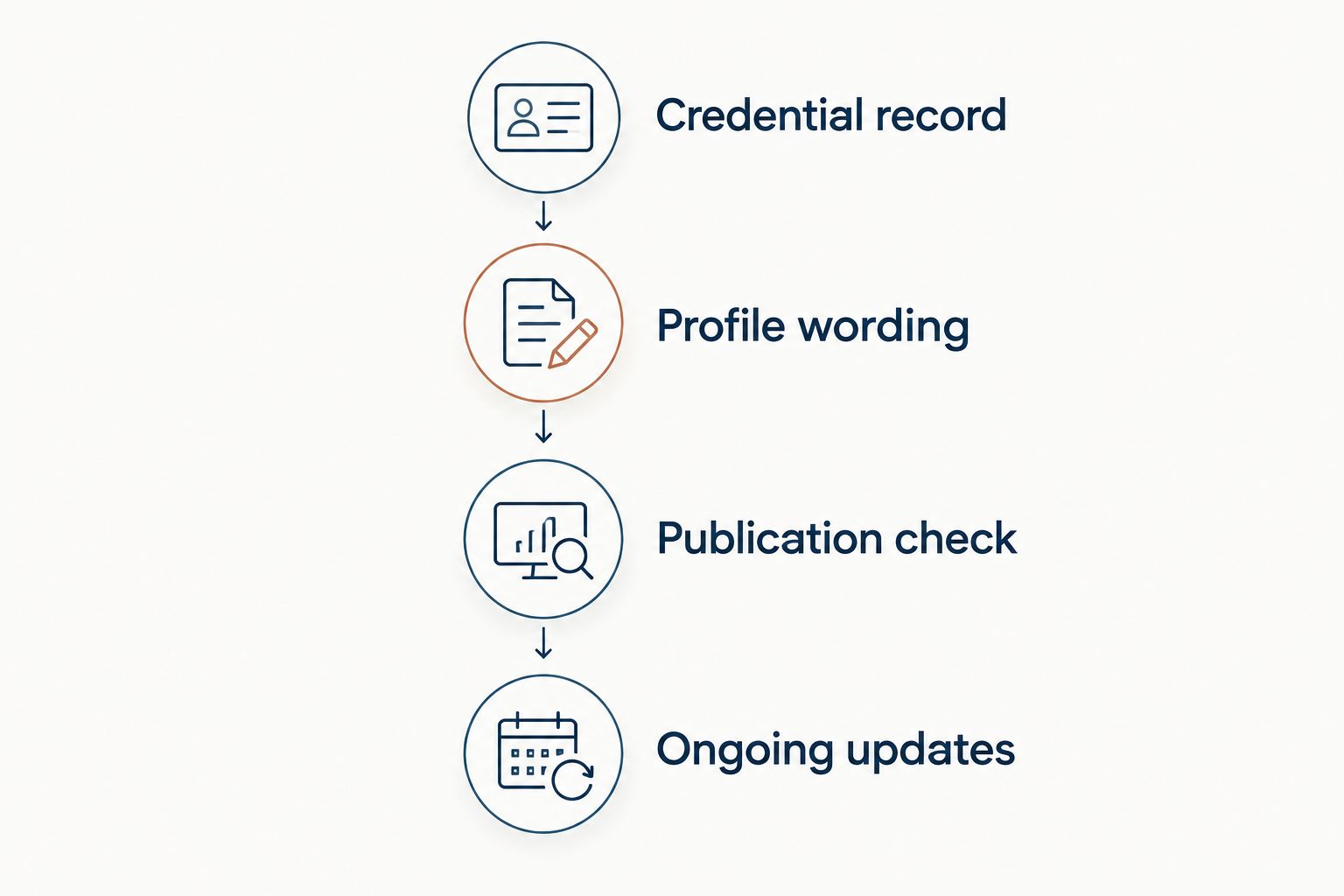
Publication check
Enter and review the profile text
- Paste the verified statement into the appropriate editable area of your listing. Follow the labels and instructions displayed in your current account rather than assuming another user's editor has identical fields.
- Review the text inside the editor. Check for missing words, duplicated paragraphs, changed punctuation, and program titles that became separated from their provider.
- Complete the save or submission action offered by the editor. Follow any displayed requirements before leaving the account.
- Open the public-facing listing separately and compare it with your working document. If your account indicates that changes require review, follow that process before considering the update published.
Do not treat text visible in an editing box as proof that it appears publicly. Your final check belongs on the version prospective clients can read.
For this 2026 workflow, perform 3 checks on the public result: credential accuracy, scope accuracy, and readability. Read the sentence without the surrounding biography to confirm that it still makes a truthful standalone claim.
Confirm the context survived publication
Check that your license remains identifiable as your license and that your certificate appears as education. Then read the surrounding paragraph for implied claims: a careful training sentence can become misleading beside an unsupported specialist label.
Review the profile on a narrow screen as well as a larger one. The task is not to diagnose the platform's layout; it is to confirm that your credential wording remains understandable wherever a prospective client reads it.
Expected result: The public listing accurately represents your completed training, preserves the distinction from licensure, and reads clearly without requiring the visitor to interpret a credential list.
Ongoing updates
Update the profile when additional training is completed
Use the same workflow when you complete another program: verify the new document, revise the education record, and check the published result. Do not add a completed credential merely because you enrolled or attended part of a program.
If mentioning current study is appropriate under your professional rules, identify it explicitly as ongoing. Keep it separate from completed education so readers do not have to infer your status.
A second certificate does not automatically require a longer biography. Prioritize education that explains your current services, and retain accurate detail in the most suitable training area your listing provides.
For example, adding grief-related education is relevant when it helps explain work you already provide within your scope. It is not permission to claim a new clinical specialty solely because the course title contains that specialty.
Use your 2026 revision record to track what changed and why. Record the edited wording and publication check date in your own document; keep those administrative notes out of the public biography.
Troubleshooting
The credential title does not match your draft
Fix: Return to the issued certificate and correct the draft before publishing. Do not shorten the title in a way that changes the training's identity, level, or completion status.
A brief narrative description can accompany the official title. It should not replace the evidence-backed name of the education you completed.
There is no suitable certificate entry in your editor
Fix: Use an appropriate narrative area if the listing permits it, while keeping the wording clearly educational. Do not enter the certificate as a license or invent a designation to fit an unrelated field.
If the account's instructions leave the permitted placement unclear, ask GoodTherapy support which existing area is appropriate. Resolve the placement question before changing credential categories.
The saved text differs from your draft
Fix: Compare the public version with your working document, then correct the affected wording through your account. Recheck punctuation, paragraph boundaries, and the complete program title after saving again.
If the account displays a review status, follow that stated process. Do not repeatedly submit the same edit while overlooking an instruction already shown in the account.
The profile now sounds more qualified than the evidence supports
Fix: Replace the unsupported designation with a completion statement and revise the surrounding approach language. Check headings and short summaries as well as the main biography.
Terms such as certified specialist or licensed somatic therapist require independent support. A certificate entry should not silently introduce either claim.
Customize your workflow
Keep a reusable education record containing each issued credential, its exact title, completion date, and the wording you published. Store continuing education documentation alongside it without treating credit details as a substitute for the credential itself.
Use that record for other professional biographies, but adapt the emphasis to each audience. A client-facing directory needs understandable practice context; a professional education record needs precise credential detail.
For The Embody Lab certificate programs, select further education according to the work you need to deepen—not the number of titles you can add to a listing. Education planning and profile editing are separate decisions. Complete the training and verify its documentation before revising your public qualifications.
FAQ
How do I add Embody Lab certification to my GoodTherapy profile?
Add a factual statement naming your completed program and provider in an appropriate education, training, or narrative area of your listing. Use the exact credential wording from your certificate, save through your account, and check the public profile.
Should I call my training a certificate or a certification?
Use the designation supported by your issued document. Do not convert a certificate of completion into a professional certification or add credential letters unless you are explicitly entitled to use them.
Can I list the certificate as my professional license?
No, a training certificate is not a professional license. Keep your existing license information separate and describe the certificate as education using its documented wording.
Can I add a program before I finish it?
Do not list an unfinished program as completed education. If you describe ongoing study, identify that status clearly and follow the professional rules applicable to your practice.
What if my GoodTherapy editor has no certificate field?
Use an appropriate narrative area if the listing permits it, rather than placing the certificate in an unrelated license field. Ask GoodTherapy support about placement when the account instructions do not resolve the question.
Does a continuing education certificate prove specialist status?
A continuing education certificate alone does not establish a separate specialist designation. State the completed education accurately and support any additional credential claim with its own documentation.
Should I change my completion date when updating my profile in 2026?
No, retain the completion date shown on the issued credential. Your 2026 profile revision date documents an edit, not a new completion of the program.
What should I check after saving the profile update?
Check the public listing for credential accuracy, scope accuracy, and readability. Compare it with your source document and follow any review instructions displayed in your account.
One last thing
Read your profile as if the training sentence were the only sentence a prospective client saw. Would it communicate completed education, or would it imply an additional license or credential?
Make the qualification accurate even when it is read out of context. That final check is more useful than adding another clinical term to your biography.