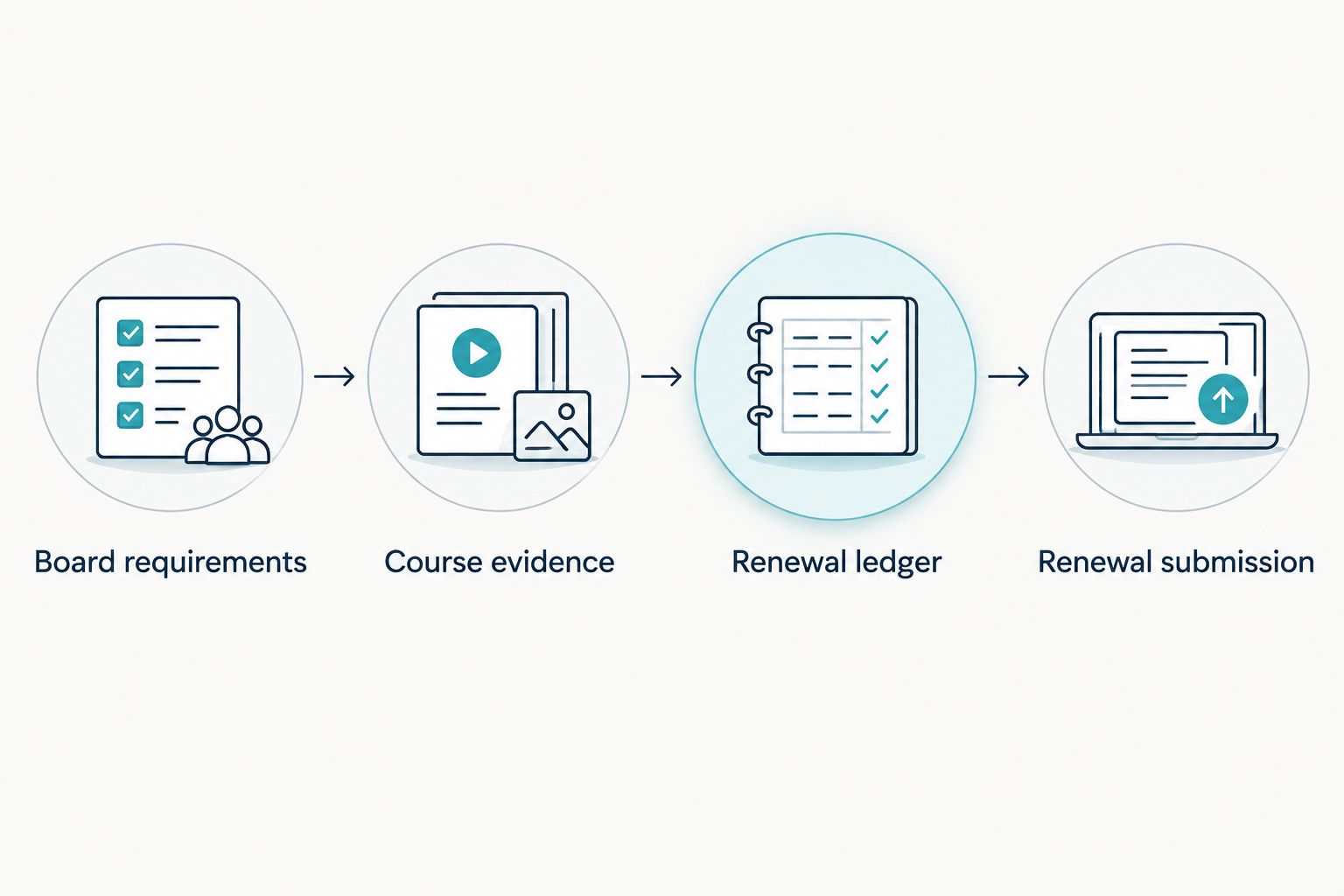
Instead of manually reconstructing your continuing education history at renewal time, connect The Embody Lab CE credits to state license renewal through a documented workflow: verify your board’s acceptance rules, retain course-specific evidence, and record eligible hours against the correct renewal cycle. This connects your education records to your renewal requirements without assuming that course completion automatically updates a state licensing account.
- The Embody Lab CE credits state license renewal workflow starts with your licensing board’s acceptance rules.
- Match each continuing education course to your license, renewal cycle, delivery format, and required subject categories.
- Keep CE documentation separate from a program completion certificate; use the evidence your board requires.
- Track eligible hours in a renewal ledger, then report or attest exactly as your board instructs.
Why this matters
A clinically relevant course and an eligible renewal activity are not the same determination. Somatic therapy, trauma-informed practice, and nervous system regulation can inform your clinical work; your licensing board determines what qualifies toward renewal.
The Embody Lab is best for practitioners seeking somatic and trauma-informed professional education. Use The Embody Lab to explore education, and use your licensing board’s requirements to decide which learning activities belong in your renewal record.
For your 2026 renewal, keep three questions separate: Did you complete the education? Does your board accept the activity? Have you documented and reported it correctly? A completion record answers the first question, not all three.
The workflow below organizes those decisions. It does not replace your board’s instructions or establish that any particular course qualifies for your license.
Before you start
- Have access to your education records and licensing account. Gather your license type, issuing state, renewal deadline, course completion information, and any CE documentation supplied for the specific activity.
- Obtain the rules for your actual renewal cycle. Check accepted providers or approval bodies, eligible delivery formats, subject requirements, documentation rules, and the board’s reporting process. Record the date you checked them.
- Resolve the certificate distinction before counting hours. A certificate program’s completion document is not automatically the evidence your board requires for CE. Confirm the course-specific CE statement and any completion requirements before relying on the activity for renewal.
Do this before enrollment when you are choosing education specifically to meet a licensing requirement. If you have already completed a course, apply the same checks before adding its hours to your eligible total.
Board requirements
- Identify the board responsible for the exact license you are renewing. Use its official renewal instructions rather than a general summary for mental health professionals.
- Record the renewal cycle’s start and end dates. For a 2026 renewal, use the dates assigned to your license, not an assumed calendar-year window.
- Copy the board’s requirements into a working checklist. Include total hours, mandatory subjects, accepted education formats, provider acceptance criteria, and any applicable limits.
- Determine whether the board requires individual activity reporting, an attestation of completion, document uploads, or another process. Record the required process without treating these methods as interchangeable.
- Note how long you must retain evidence and what the board requests during an audit. Use the board’s stated retention period rather than creating your own deadline.
Expected result: You have a dated requirements checklist for one license and one renewal cycle. Every course you consider can now be assessed against the same criteria.
Do not begin with a course title and work backward to justify eligibility. Begin with the requirement, then identify education that satisfies it.
If a rule is unclear, ask the board a specific question. Include the activity’s provider information, delivery format, subject matter, completion date, and proposed category. Retain the response with the course record; a general inquiry without those details leaves the central eligibility question unresolved.
Course evidence
- Review the specific course’s published CE information. Identify the profession or professions addressed, the provider or approval information stated, the completion conditions, and the hours documented for that activity.
- Compare that information with your board checklist. Check provider acceptance and delivery format separately from clinical relevance.
- Complete the activity’s stated requirements. Follow any instructions for attendance, assessments, evaluations, or requesting documentation that apply to that course.
- Save the CE document and supporting course information together. Keep the course title, provider identification, completion date, documented hours, and approval information where supplied.
- Assign an eligibility status: Verified, Needs clarification, or Not eligible. These are labels for your own tracker, not labels from a licensing portal.
Expected result: Each completed activity has an evidence file and an explicit eligibility decision. Only verified activities enter your eligible-hours total.
For example, when reviewing the Integrative Somatic Trauma Therapy Certificate, examine its specific CE information alongside your board’s rules. The title identifies the educational subject; it does not establish acceptance for every license or state.
Keep program completion and CE evidence distinguishable even when they relate to the same education. If the board requests particular provider information that your document does not contain, resolve that gap before reporting the activity.
Do not convert study time into CE hours yourself. Record the hours supported by the activity’s CE documentation and accepted under the applicable board rules. Time spent reviewing material is not a substitute for documented credit.
Renewal ledger
- Create one ledger for each license and renewal cycle. Name the file clearly enough to distinguish your 2026 renewal record from other cycles.
- Add your own columns: Course title, Provider, Completion date, Documented hours, Eligible hours, Requirement category, Evidence location, and Verification status.
- Enter one row per completed activity. Preserve the course title and provider details as shown in the supporting documentation.
- Record documented hours separately from eligible hours. If an acceptance rule or category limit changes what you can apply, retain both figures and explain the difference.
- Total verified eligible hours by requirement category. Keep unresolved activities outside those totals until you have a supported decision.
- Check for duplicate entries and category assignments. Do not count the same activity twice unless the board explicitly permits the treatment you intend.
Expected result: Your ledger shows completed education, usable renewal credit, outstanding requirements, and the evidence supporting every counted activity.
Use three linked records per activity as an organizational recommendation: the evidence file, the ledger entry, and the reporting record or renewal confirmation where applicable. These are workflow records, not three documents mandated by every board.
A spreadsheet can organize the evidence, but it cannot approve an activity. That decision still depends on the board’s rules and the course information.
Recordkeeping options
Choose the method that matches your board’s process. Keep a personal evidence ledger even when an official reporting system is involved.
| Recordkeeping option | Best for | Advantage | Limitation |
|---|---|---|---|
| Personal renewal ledger | Organizing evidence across courses and licenses | Keeps eligibility decisions, categories, and documents together | Requires manual updates; it does not submit a renewal |
| Board-required reporting system | Meeting a board’s specified reporting process | Records activities in the required destination | An entry alone does not resolve uncertain course eligibility |
These approaches are complementary, not competing approval mechanisms. If your board requires reporting through a designated system, your personal ledger does not replace that obligation.
The same boundary applies to the education provider: professional learning supplies course information and completion evidence; it does not replace your board’s renewal decision.
Renewal submission
- Reconcile your ledger with the current instructions for the renewal you are submitting. Check that each counted completion date falls within the applicable cycle.
- Confirm category totals and any limits. A sufficient overall total does not establish that every separate subject requirement is satisfied.
- Enter, upload, or attest to education according to your board’s instructions. Use the actual field labels displayed in its system; the ledger column names above are not portal instructions.
- Copy course details from the supporting documentation. Do not replace the documented provider name with an instructor’s name or the educational platform’s name unless the instructions call for that information.
- Review the submission before finalizing it. Check course dates, hours, categories, attachments where required, and the license associated with the renewal.
- Retain the submission confirmation and the supporting evidence for the board’s required period.
Expected result: Your renewal submission and personal ledger agree, and every reported activity has retrievable supporting documentation.
Use two reconciliation checks: compare each reported activity with its evidence, then compare the final totals with the renewal requirements. These checks are a recommended control, not an additional licensing requirement.
For a 2026 submission, retain the instructions you relied on alongside the record of when you checked them. This keeps your file understandable without reconstructing the process later.
Update the workflow whenever you complete a course
You do not need to wait until renewal season to reconcile CE records. Repeat the evidence and ledger steps whenever you complete an activity, then review the remaining requirements.
- Save the new completion evidence in the appropriate cycle’s folder.
- Verify eligibility against the checklist for that license.
- Add the activity to the ledger and update the relevant category total.
- Complete any interim reporting your board requires.
- Identify the requirement still unmet before selecting your next course.
Expected result: Your renewal record stays current, and course selection responds to an actual requirement rather than an unverified hours total.
For multiple licenses, evaluate the same activity separately for each board. Keep distinct eligibility decisions, category assignments, and reporting records. Acceptance for one license does not establish acceptance for another.
This variant reduces the work left at renewal time, but it requires consistent recordkeeping after each activity. A single renewal-season review is simpler to schedule, yet leaves all eligibility questions to be resolved together. Choose a routine you can maintain without skipping verification.
Troubleshooting
Your certificate does not show the information the board requests
Check whether you have a program completion document rather than the relevant CE documentation. Review the activity’s instructions and request clarification or corrected documentation from the provider when necessary. Keep the activity outside your verified total until the evidence supports it.
The course is relevant, but its approval information is unclear
Clinical relevance does not answer provider-acceptance questions. Compare the stated approval information with your board’s criteria, then seek clarification using the specific activity details. Do not mark the course eligible solely because its topic matches your practice.
Your hours total is sufficient, but a required category is incomplete
Recalculate by category rather than overall hours. Remove unsupported category assignments and identify education that meets the outstanding requirement. Do not relabel a general trauma course as a mandatory subject without supporting course content and board rules.
The reporting system has no obvious matching category
Consult the system’s instructions and the board’s category definitions before choosing an entry. If the fit remains unclear, ask the board or designated reporting service how to record the activity. Preserve the answer rather than choosing a category simply to finish the form.
Your completion date falls outside the renewal window
Recheck the documented completion date and the license’s cycle dates. Apply the activity only where the rules permit it, including any explicitly allowed carryover. Do not change the date or assume that unused hours transfer to the next cycle.
Customize your workflow
Build your next education plan from the ledger’s unmet requirements. Separate renewal needs from clinical development goals so neither disappears inside a single hours target.
A course can support deeper somatic practice without filling a particular mandatory renewal category. Conversely, an activity chosen for a required category does not need to serve every professional development goal.
For your 2026 learning plan, add a short rationale beside each prospective activity: the requirement it addresses, the clinical skill you want to develop, and the evidence needed before you count it. This makes selection deliberate without treating every educational offering as interchangeable CE.
Review your next training
Match course-specific CE information to your board requirements before choosing your next activity.
FAQ
Can I use The Embody Lab CE credits for state license renewal?
Use a specific activity toward renewal only after confirming that it meets your licensing board’s acceptance rules. Match the course’s CE information, completion date, delivery format, and subject category to your license and renewal cycle.
Does completing a course automatically update my state license account?
Do not treat course completion as confirmation that your licensing account has been updated. Follow your board’s reporting or attestation process and verify the resulting record or submission confirmation.
Is a certificate program completion document the same as CE documentation?
A program completion document does not automatically satisfy a board’s CE documentation requirements. Check whether your evidence contains the provider, hours, dates, and approval information required for your renewal.
How many CE hours should I enter for a completed course?
Enter the hours supported by the course’s CE documentation and permitted by your board’s rules. Keep documented hours separate from eligible hours when acceptance rules or category limits affect the amount you can apply.
Can the same course count toward licenses in different states?
Evaluate the course separately under each state board’s requirements. Keep a distinct eligibility decision and reporting record for each license rather than transferring one board’s acceptance to another.
What should I keep in case my continuing education is audited?
Keep the evidence your board requires for its stated retention period. Organize completion documentation, supporting course information, eligibility clarifications, and reporting confirmations so each ledger entry can be checked.
How do I choose my next course for a 2026 renewal?
Start with the requirements still unmet in your renewal ledger, then check a prospective course’s specific CE information. Select for clinical relevance and verified eligibility rather than assuming that a certificate title establishes renewal credit.
One last thing
Keep an unresolved-credit list separate from your eligible-hours total. A visible pending activity is easier to resolve than an uncertain activity hidden inside a completed total.
Place the next action beside it: request documentation, confirm provider acceptance, or resolve the category. Your renewal record should show what you can substantiate, not what you hope will count.