For occupational therapists, the best somatic experiencing training depends on whether you need a broad trauma framework or training in the named Somatic Experiencing method. The Embody Lab’s Integrative Somatic Trauma Therapy Certificate is the best overall fit for broader somatic trauma education; it is not presented here as a Somatic Experiencing credential.
- The Embody Lab’s Integrative Somatic Trauma Therapy Certificate is the best overall somatic trauma training fit for occupational therapists.
- Healing Trauma: Working with Somatic Wounds is the closest pick here for studying Peter Levine’s work, not a verified Somatic Experiencing credential.
- Somatic Stress Release™ Certificate fits practitioners focused on stress responses; Somatic Attachment Therapy Certificate fits attachment-focused work.
- Before enrolling in 2026, verify occupational therapy CE eligibility, supervised-practice requirements, and the credential each program awards.
Why this matters
Occupational therapists work with function: what a person can do, sustain, and return to in daily life. Somatic training becomes useful when you can connect attention to bodily sensation, regulation, and pacing with that functional work. A course title alone does not establish that connection—or tell you whether its continuing education applies to your license.
Somatic Experiencing is a named method, not a synonym for all somatic therapy. That distinction matters more than any ranking. If you are deciding whether to pursue a somatic practice pathway, how to become a somatic therapist provides a related starting point; assess the specific training and credential separately.
What makes the best somatic training for occupational therapists?
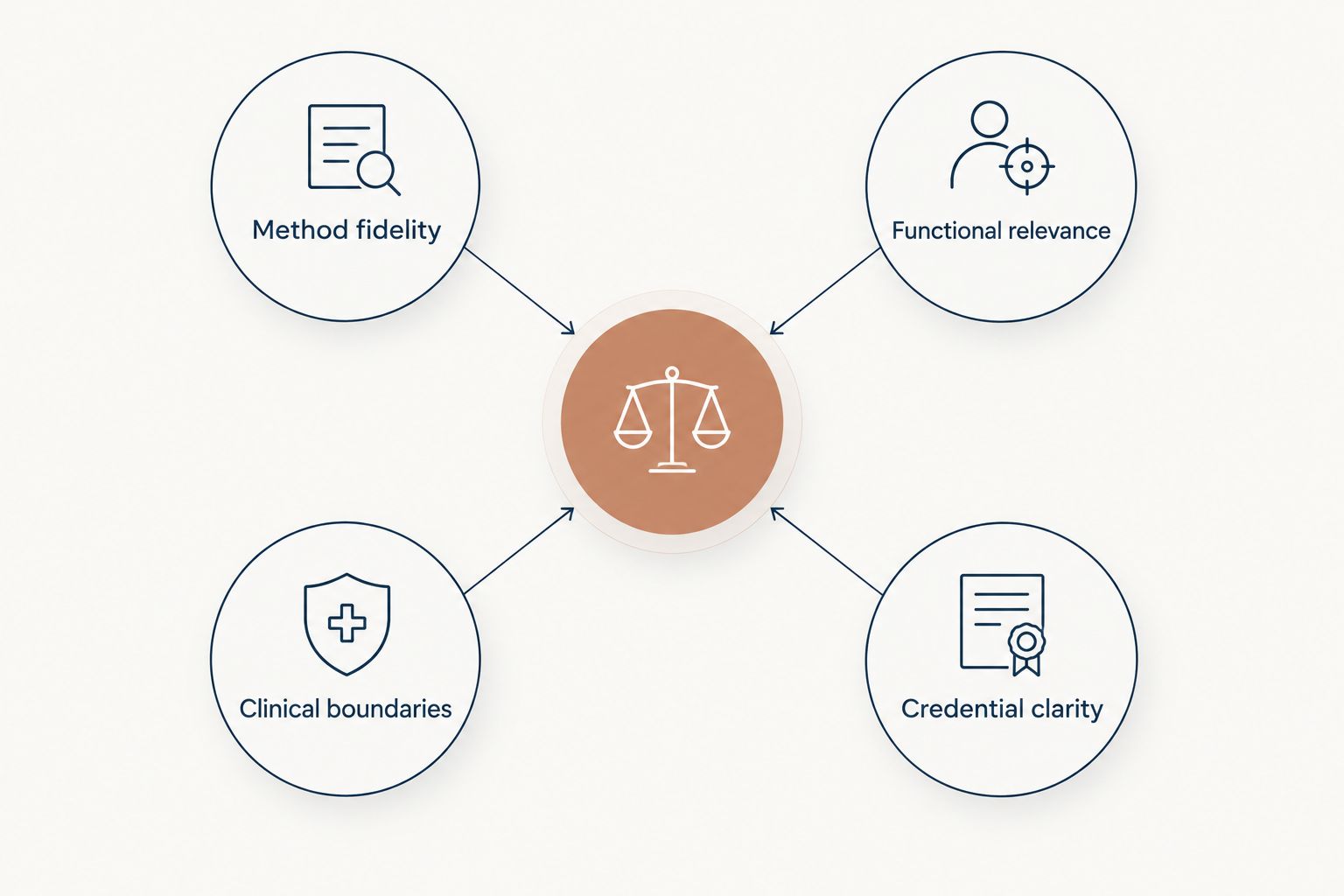
Use these criteria before comparing programs in 2026:
- Method fidelity: Does the training teach the named Somatic Experiencing method, introduce its developer’s work, or cover somatic trauma practice more broadly? These are different outcomes.
- Functional relevance: Can you connect the material to participation, activity tolerance, sensory experience, or other goals within your occupational therapy practice?
- Clinical boundaries: Does the subject fit your role and competence, or does it require assessment and treatment skills outside your scope?
- Practice depth: Are you seeking an introduction, sustained certificate study, or a focused course to address a recurring clinical presentation?
- Credential clarity: What certificate is awarded, and does the education meet your state board’s and employer’s continuing education requirements?
The comparison below ranks fit by learning goal, not by an unverified claim that one program confers Somatic Experiencing certification. In 2026, check each program’s current curriculum and CE documentation before treating any listing as a licensing decision.
The options at a glance
| Training | Best for | Standout focus | Key limitation |
|---|---|---|---|
| Integrative Somatic Trauma Therapy Certificate | Broad somatic trauma education | Body-centered framework for understanding and working with trauma | Not established here as a Somatic Experiencing credential |
| Healing Trauma: Working with Somatic Wounds | An introduction to Peter Levine’s work | Somatic wounds and trauma healing | A focused workshop, not a verified professional training pathway |
| Somatic Stress Release™ Certificate | Stress-response and regulation study | Extended somatic stress education | Stress-release focus does not establish Somatic Experiencing qualification |
| Somatic Attachment Therapy Certificate | Attachment-focused practice | Body-based approach to attachment trauma | Less directly focused on occupational performance or the named method |
The distinctions are practical. If your priority is to understand Peter Levine’s approach, start with the Levine workshop. If you need a broader framework to evaluate across different presentations, start with the integrative certificate. Neither choice replaces checking the requirements of a named professional credential.
1. Integrative Somatic Trauma Therapy Certificate: best for a broad foundation
The Embody Lab’s Integrative Somatic Trauma Therapy Certificate offers a body-centered framework for understanding and working with trauma. Its product description identifies it as a 3-month online certificate for work with yourself and clients. For an occupational therapist seeking somatic trauma education rather than a course on one presentation, it is the clearest starting point in this comparison.
The occupational therapy test is whether you can translate what you learn into the work you already do. Consider how attention to bodily experience might inform your observation of task participation, or how pacing a session might affect a client’s ability to remain engaged. Those are questions to bring to the curriculum—not claims that this certificate teaches a particular occupational therapy protocol.
Integrative Somatic Trauma Therapy Certificate pros:
- Addresses trauma through an explicitly body-centered framework.
- Provides a sustained certificate format rather than a single-topic workshop.
- Serves practitioners who want to assess somatic concepts across different clinical presentations.
Integrative Somatic Trauma Therapy Certificate cons:
- The program information here does not establish a Somatic Experiencing credential.
- Occupational therapy-specific CE eligibility is not established by the certificate title.
- A broad trauma framework requires you to make the connection to your own functional goals and scope of practice.
Best for: Occupational therapists seeking a broader somatic trauma foundation before selecting narrower training. Verdict: Choose this option as the default for general somatic trauma education; verify the credential and CE terms before enrolling in 2026.
2. Healing Trauma: Working with Somatic Wounds: best for Levine’s work
Healing Trauma: Working with Somatic Wounds is a workshop associated with Dr. Peter Levine. That makes it the most directly relevant option in this list when your interest is Levine’s approach rather than a general somatic certificate. Its focus is trauma and somatic wounds, not occupational therapy as a profession.
Treat it as a way to examine the clinical ideas before deciding on a longer training path. An introductory workshop can help you judge whether the language and methods are relevant to your practice; it does not, by itself, demonstrate that you have completed a professional Somatic Experiencing training pathway.
Healing Trauma: Working with Somatic Wounds pros:
- Centers work associated with Dr. Peter Levine.
- Keeps the learning goal focused on trauma and somatic wounds.
- Offers a distinct first step if the named method prompted your search.
Healing Trauma: Working with Somatic Wounds cons:
- The supplied course information does not establish it as a Somatic Experiencing credential.
- Its title does not establish occupational therapy CE eligibility.
- Its focused scope is a poor substitute for broader training if you need a sustained curriculum.
Best for: Occupational therapists who want an introduction to Peter Levine’s work before committing to a longer course of study. Verdict: Choose it for that introduction, but do not use it as evidence of professional qualification.
3. Somatic Stress Release™ Certificate: best for stress-response study
The Embody Lab’s Somatic Stress Release™ Certificate is a 100-hour certificate program focused on stress in the body. Its length makes it a different commitment from a focused workshop. For occupational therapists whose learning goal centers on bodily stress responses, it has a clearer subject fit than an attachment-focused certificate.
Keep the clinical application specific. Identify the activity or participation problem you want to address, the observations you can make within your role, and the part of the training that informs your response. Nervous system language does not, on its own, show that an intervention improves occupational performance.
Somatic Stress Release™ Certificate pros:
- Names stress release as its central subject.
- Provides a 100-hour certificate format for sustained study.
- Fits a learning goal centered on embodied stress responses.
Somatic Stress Release™ Certificate cons:
- Stress-release training is not the same credential as Somatic Experiencing training.
- The stated program details do not establish OT-specific instruction or CE acceptance.
- It is less targeted if your primary question concerns attachment or Peter Levine’s method.
Best for: Occupational therapists seeking extended somatic education on stress responses and regulation. Verdict: Choose it for that defined goal, after checking the current curriculum and CE documentation in 2026.
4. Somatic Attachment Therapy Certificate: best for attachment-focused work
The Embody Lab’s Somatic Attachment Therapy Certificate is a 60-hour certificate program addressing attachment trauma through the body. Choose it when attachment is the specific subject you need to study, rather than assuming a general trauma course will cover that material in the depth you want.
For occupational therapists, the boundary deserves attention. Attachment-focused material can inform how you understand relational patterns in care, but a certificate title does not expand your license or establish competence to provide psychotherapy. Examine the curriculum against your practice setting and referral relationships before enrolling.
Somatic Attachment Therapy Certificate pros:
- Has a defined attachment-trauma focus.
- Provides a 60-hour certificate format.
- Distinguishes a relational learning goal from general stress or trauma study.
Somatic Attachment Therapy Certificate cons:
- It is not presented here as a Somatic Experiencing credential.
- Attachment-focused education is not automatically training in occupational therapy interventions.
- Its narrower focus is a poor first choice if you need a broad somatic trauma foundation.
Best for: Occupational therapists whose learning goal specifically concerns attachment and embodied relational patterns. Verdict: Choose it for that subject, not as a substitute for general or method-specific training.
How these programs were ranked
This 2026 ranking starts with what each program explicitly addresses: broad somatic trauma, Peter Levine’s work, stress release, or attachment trauma. It then considers how clearly that subject answers an occupational therapist’s learning goal and where the credential boundary sits. No program earns a named Somatic Experiencing qualification in this comparison merely by teaching body-based trauma concepts.
The order is not a measure of clinical effectiveness, instructor performance, or state-board approval. Those claims require evidence specific to the program and your licensing jurisdiction. The 3-month, 100-hour, and 60-hour formats describe the programs above; they do not establish equivalent depth, supervised practice, or interchangeable credentials.
Which somatic training should you choose?
Choose the Integrative Somatic Trauma Therapy Certificate if you want the broadest somatic trauma starting point among these options. Choose Healing Trauma: Working with Somatic Wounds if the reason you searched is specifically to encounter Peter Levine’s work. Choose Somatic Stress Release™ Certificate for sustained study of stress responses, or Somatic Attachment Therapy Certificate when attachment is the defined learning goal.
If your goal is to become credentialed in the named Somatic Experiencing method, use that goal as your filter instead of treating any adjacent certificate as equivalent. Before committing in 2026, obtain the training pathway’s credential requirements and compare them with the program’s stated award. Then confirm CE acceptance with the body that governs your occupational therapy license.
A useful final check is to write down the client presentation, the functional goal, and the skill you expect the course to change in your practice. If you cannot connect all three without stepping outside your professional role, the course is not yet a clear fit.
FAQ
What is the best somatic experiencing training for occupational therapists in 2026?
The Embody Lab’s Integrative Somatic Trauma Therapy Certificate is the best overall fit here for broad somatic trauma education. If you mean a credential in the named Somatic Experiencing method, verify that credential’s training requirements separately.
Is a somatic therapy certificate the same as Somatic Experiencing certification?
No. A somatic therapy certificate does not establish qualification in the named Somatic Experiencing method. Check the exact credential awarded and its training requirements before enrolling.
Which option introduces Peter Levine’s work?
Healing Trauma: Working with Somatic Wounds is the option in this comparison associated with Dr. Peter Levine. Treat it as focused education, not a verified professional credential pathway.
Which somatic certificate focuses on stress responses?
The Embody Lab’s Somatic Stress Release™ Certificate focuses on stress in the body. Its 100-hour format suits a sustained learning goal, but OT continuing education eligibility still needs verification.
Is the Integrative Somatic Trauma Therapy Certificate specific to occupational therapy?
It is presented as a body-centered trauma certificate, not an occupational therapy-specific qualification. Compare its curriculum with your functional practice goals and confirm CE acceptance for your license.
When does attachment-focused somatic training make sense for an OT?
Somatic Attachment Therapy Certificate fits when attachment trauma is your defined learning subject. Check how you will apply that learning within occupational therapy scope rather than assuming it authorizes psychotherapy.
How should I check whether a course counts for OT continuing education?
Check the course’s current CE documentation against your state board’s and employer’s requirements before enrolling. A certificate title alone does not establish acceptance for your occupational therapy license.
One last thing
The closest-sounding course is not necessarily the right credential. In 2026, settle that distinction before comparing formats: decide whether you need education that informs occupational therapy practice, an introduction to Levine’s work, or qualification in the named Somatic Experiencing method. That decision determines which program details you need to verify next.