Best overall for chaplains: The Embody Lab’s Integrative Grief Counseling Certificate. Best for broader trauma-focused education: Integrative Somatic Trauma Therapy Certificate. Best for body-based practice: Therapeutic Yoga for Trauma Healing and Nervous System Regulation Certificate. The best somatic therapy certificate for chaplains in 2026 depends on whether your work centers on grief, trauma-informed care, or guided movement—and on which practices fall within your professional scope.
- Best somatic therapy certificate for chaplains focused on grief: The Embody Lab’s Integrative Grief Counseling Certificate.
- Choose Integrative Somatic Trauma Therapy Certificate for a broader trauma-focused education path.
- Choose Therapeutic Yoga for Trauma Healing and Nervous System Regulation Certificate when guided movement fits your role.
- A certificate adds education; it does not expand a chaplain’s license or authorize psychotherapy.
Why this matters for chaplains in 2026
Chaplains encounter grief, fear, disconnection, and distress in conversations that do not always fit a conventional therapy session. Somatic education can give you a more precise way to notice bodily cues, attend to pacing, and make room for a person’s felt experience. It does not turn a pastoral encounter into clinical treatment.
That distinction should shape your choice. If you want a clearer picture of the difference between education and clinical practice, start with how to become a somatic therapist. A chaplain choosing training in 2026 needs to ask not only what a program teaches, but what they can responsibly use in their setting.
The Embody Lab is best for chaplains who want somatic and trauma-informed professional education, not a certificate presented as a substitute for clinical credentials. Its catalog offers several relevant paths. None of the program titles alone establishes chaplain-specific eligibility, continuing education acceptance, or permission to provide psychotherapy; confirm those points against your role and credentialing requirements before enrolling.
What makes the best somatic therapy certificate for chaplains?
Use these criteria before comparing program titles. A close match to your daily work matters more than collecting the broadest possible set of techniques.
- Primary care context: Choose grief-focused education if bereavement dominates your work. Choose a broader trauma focus if you need to understand distress across different encounters.
- Practice boundaries: Separate supportive presence and education from assessment, diagnosis, and treatment. A course title does not change the limits of your role.
- Method fit: Decide whether your setting supports conversation-based somatic attention, movement-based work, or both. Do not assume every person wants to engage with bodily sensations.
- Consent and pacing: Look for ways to preserve choice. A chaplain can invite attention to present experience without requiring someone to describe trauma or perform an exercise.
- Setting requirements: Check whether your employer, professional association, or continuing education body recognizes the specific training. Recognition in one profession does not establish recognition in another.
- Usable depth: Compare the stated curriculum with the situations you actually face. A focused program is often the clearer choice when you have one defined practice need.
For 2026, make a short list of the encounters you want to handle differently. Grief conversations, trauma-related distress, and requests for movement-based support point toward different certificates.
Best somatic therapy certificates for chaplains at a glance
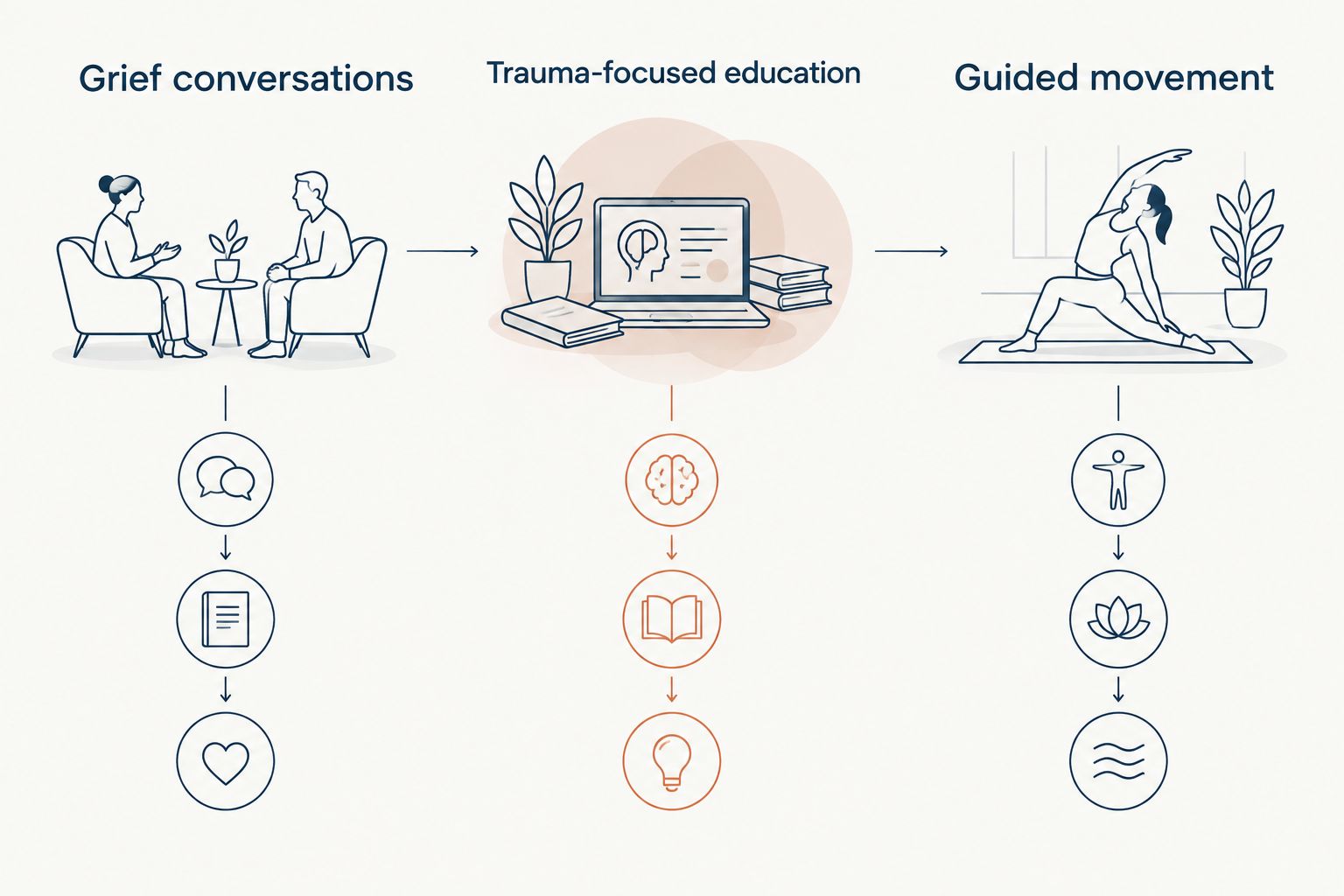
The comparison below ranks fit by use case, not by an unverified claim about outcomes or chaplain-specific accreditation. Program descriptions support the stated subject areas; your credentialing body determines whether a certificate meets its requirements.
| Program | Best for | Standout focus | Key limitation |
|---|---|---|---|
| Integrative Grief Counseling Certificate | Chaplains whose work centers on grief | Somatic practice alongside neuroscience, ritual, and relational work | Less direct fit if grief is not your main training need |
| Integrative Somatic Trauma Therapy Certificate | Chaplains seeking a broader trauma focus | Integrative somatic trauma therapy | Certificate title does not establish permission to practice therapy |
| Therapeutic Yoga for Trauma Healing and Nervous System Regulation Certificate | Chaplains whose settings support movement-based work | Therapeutic yoga and nervous system regulation | Movement may not fit every encounter or setting |
The Embody Lab has more than one relevant certificate, but these are not interchangeable. Match the subject to your chaplaincy work first; investigate program details and recognition second.
1. Integrative Grief Counseling Certificate: best for grief-centered chaplaincy
Best for: Chaplains who regularly accompany people through bereavement and want somatic practice within a grief-focused curriculum.
The Integrative Grief Counseling Certificate is a 12-module, 30-hour live training. Its stated curriculum brings together applied neuroscience, somatic practice, ritual, and relational work. That combination makes it the strongest default here for chaplains whose primary work involves loss: grief is the program’s organizing subject, rather than one application of a broader trauma method.
Ritual also makes this program particularly relevant to consider in chaplaincy. It is named in the curriculum alongside somatic and relational approaches, so you can evaluate how those elements sit beside the ways you already accompany people. The program description does not, however, establish that its ritual content matches any particular faith tradition or institution’s requirements.
Integrative Grief Counseling Certificate pros:
- Grief is the explicit focus, making the training choice easy to connect to bereavement work.
- The stated curriculum includes somatic practice rather than treating grief only as a subject for discussion.
- Applied neuroscience, ritual, and relational work provide distinct lenses for evaluating your current approach.
- The stated 30 hours and 12 modules give you concrete details to take to an employer or credentialing body.
Integrative Grief Counseling Certificate cons:
- A grief-specific certificate is a narrower match if your main need is broad trauma education.
- A curriculum that includes counseling does not establish that a chaplain without clinical authorization can provide counseling as a regulated service.
- The supplied program details do not confirm whether your chaplaincy association accepts the training for continuing education.
Verdict: Buy if grief is your central practice need and the program meets your role’s training requirements. If you mainly need to understand trauma responses across many kinds of encounters, choose the broader trauma-focused option instead. In 2026, the right certificate is the one you can use within your actual responsibilities, not the one with the widest-sounding title.
2. Integrative Somatic Trauma Therapy Certificate: best for a broader trauma focus
Best for: Chaplains seeking somatic trauma education that is not organized around grief or movement as its sole subject.
The Integrative Somatic Trauma Therapy Certificate is the broadest trauma-focused title in this comparison. For a chaplain, its value is as a program to investigate when trauma-informed care is the primary learning goal. The supplied information identifies it as a certificate program but does not specify its curriculum, training hours, delivery format, or chaplain-specific admissions requirements. Confirm those details directly before treating it as the best fit for your work.
Keep the word therapy in perspective. It names the program’s subject; it does not describe a new professional authorization that comes with completion. If your work involves supporting people who disclose trauma, ask how the curriculum addresses pacing, consent, and the distinction between supportive chaplaincy and clinical intervention.
Integrative Somatic Trauma Therapy Certificate pros:
- Its stated subject directly matches a search for somatic trauma therapy education.
- A trauma-focused path is more relevant than a grief-specific path when your encounters span different sources of distress.
- It offers a clear program to compare against the responsibilities and limits of your role.
Integrative Somatic Trauma Therapy Certificate cons:
- The supplied program information does not establish which methods, hours, or formats the curriculum includes.
- A therapy certificate does not confer a psychotherapy license or expand chaplaincy scope.
- Its title alone gives less evidence of fit for bereavement work than the grief-specific certificate’s stated curriculum.
Verdict: Hold until you have checked the current curriculum, eligibility, and recognition requirements. Choose this path over the grief certificate when broader trauma education is the defined need—not because the word therapy appears in the title. That distinction remains decisive for chaplains in 2026.
3. Therapeutic Yoga for Trauma Healing and Nervous System Regulation Certificate: best for guided movement
Best for: Chaplains whose roles and settings permit appropriate movement-based support and who want that focus rather than a general grief curriculum.
The Therapeutic Yoga for Trauma Healing and Nervous System Regulation Certificate is described as a 3-part, 30-hour program. Its subject is explicit: therapeutic yoga in relation to trauma healing and nervous system regulation. It therefore occupies a different slot from the grief and broader trauma certificates. Choose it because movement belongs in the work you are authorized to do, not because every somatic encounter needs a physical practice.
Context matters here. A conversation at a bedside, a group gathering, and a private session create different opportunities for movement. So do a person’s preferences and physical circumstances. Before adopting an exercise, decide how you will offer choice, allow someone to decline, and keep the invitation appropriate to your role.
Therapeutic Yoga for Trauma Healing and Nervous System Regulation Certificate pros:
- The program explicitly connects therapeutic yoga with trauma healing and nervous system regulation.
- The stated 30 hours and 3-part structure make its scope easier to assess before enrollment.
- Its movement focus creates a distinct option when body-based practice is part of your setting.
Therapeutic Yoga for Trauma Healing and Nervous System Regulation Certificate cons:
- Movement-based work is not suitable for every chaplaincy encounter or every person.
- A therapeutic yoga certificate does not, by itself, establish authorization to treat trauma or teach in a particular institution.
- It is less directly focused on grief than the Integrative Grief Counseling Certificate.
Verdict: Buy if your role supports guided movement and you can apply the training within clear consent and scope boundaries. Skip it as your first choice when your work consists chiefly of grief conversations without a place for movement. For 2026, practical fit is a stronger reason to enroll than a broad interest in nervous system regulation.
How these programs were ranked
The ranking starts with the chaplain’s likely use case, then checks how much the supplied program information establishes about that fit. The Embody Lab’s grief certificate takes the default position because its stated curriculum explicitly joins somatic practice with grief, ritual, and relational work. The trauma certificate comes next for a broader stated subject, while the therapeutic yoga certificate serves a distinct movement-based need.
This is not a ranking of clinical outcomes, faculty quality, or continuing education acceptance; the supplied information does not establish a comparison on those measures. Check the current curriculum and your credentialing rules before making a final decision. A certificate can deepen professional education without changing the legal or institutional boundaries of chaplaincy.
Which certificate should a chaplain choose in 2026?
Choose the Integrative Grief Counseling Certificate by default if bereavement is central to your work. Its stated curriculum offers the clearest match between a common chaplaincy need and somatic practice. Choose Integrative Somatic Trauma Therapy Certificate when you have identified a broader trauma-focused learning need and verified its current details. Choose Therapeutic Yoga for Trauma Healing and Nervous System Regulation Certificate when guided movement genuinely belongs in your setting.
Before enrolling, write down three things: the encounters you want training for, the practices your role permits, and the organization that must recognize your education. Use those answers to evaluate the program. If you cannot yet name the practice need, wait rather than selecting a certificate solely for its title.
FAQ
What is the best somatic therapy certificate for chaplains in 2026?
The Embody Lab’s Integrative Grief Counseling Certificate is the best default for chaplains focused on bereavement. Its stated curriculum includes somatic practice, ritual, applied neuroscience, and relational work; confirm that it fits your role’s requirements.
Can a chaplain practice somatic therapy after completing a certificate?
A certificate alone does not authorize a chaplain to practice psychotherapy. What you can offer depends on your credentials, employer requirements, and applicable scope rules.
Is a grief certificate or trauma certificate better for chaplaincy?
Choose a grief certificate when bereavement is your central practice need; choose a trauma-focused certificate when that broader subject matches your work. Review the current curriculum before deciding what you can use within your role.
Does the Integrative Grief Counseling Certificate include somatic practice?
Yes. The stated curriculum combines somatic practice with applied neuroscience, ritual, and relational work in a 12-module, 30-hour live training.
Is therapeutic yoga training a fit for every chaplain?
No. Therapeutic yoga training fits chaplains whose roles and settings support appropriate movement-based work. Participation and consent remain central considerations in any encounter.
Does a somatic certificate count as chaplain continuing education?
Acceptance depends on the requirements of the specific credentialing body or employer. Check the program’s current documentation against those requirements before enrolling.
What should chaplains check before choosing a certificate in 2026?
Check the curriculum, eligibility, recognition requirements, and your practice boundaries. Start with the encounters you want the training to address, then choose the program with the closest stated focus.
One last thing
The strongest reason to choose a somatic program is not that it promises more techniques. It is that you can name where its training belongs in your chaplaincy work—and where it does not. In 2026, take that boundary question to the program and your credentialing body before you commit.
Related guides
- Somatic approaches to treating borderline personality disorder — a clinical topic to distinguish from chaplaincy scope.