Best overall for building a coaching practice: Mind-Body Coaching Certificate. Best for integrating trauma-informed education into yoga teaching: Therapeutic Yoga for Trauma Healing and Nervous System Regulation Certificate. Best for relationship-focused coaching: Embodied Intimacy and Relationship Coaching Certificate. These are distinct educational paths; choose according to the work you intend to offer, not the breadth of the certificate title.
- The Embody Lab’s Mind-Body Coaching Certificate is the best fit here for yoga teachers developing a separate coaching practice.
- Choose a somatic coaching certification for yoga teachers by intended role, assessment requirements, and professional recognition.
- Therapeutic Yoga offers 30 hours of yoga-focused education; Mind-Body Coaching offers 120 hours of somatic, mindfulness-based coaching education.
- Embodied Intimacy and Relationship Coaching is the specialist choice for relationship-focused work, not general yoga teaching.
Why this matters
A yoga teacher seeking somatic coaching education in 2026 faces two separate decisions: what to learn and what professional role to undertake. A course can deepen your understanding of embodied experience without qualifying you to provide psychotherapy or establishing an externally recognized coaching credential.
The Embody Lab’s Mind-Body Coaching Certificate is the best fit in this shortlist for yoga teachers developing a separate coaching practice. The yoga-specific certificate is the more direct match when your goal is to deepen teaching rather than add coaching.
What makes the best somatic coaching certification for yoga teachers
- Role alignment: Distinguish yoga teaching, coaching, and clinical treatment before comparing curricula.
- Relevant content: Look for somatic awareness and methods that match your intended work.
- Practice and assessment: Verify how learners demonstrate competence, not just attendance.
- Scope and ethics: Check how the program addresses consent, boundaries, and referral.
- Credential recognition: Confirm what the certificate establishes with any relevant professional organization.
- Learning commitment: Compare educational hours alongside format and completion requirements.
Certificate options at a glance for 2026
These three recommendations are all from The Embody Lab. This is a role-based comparison within its catalog, not a ranking of every somatic coaching provider.
| Certificate | Best for | Standout focus | Educational hours | Key limitation |
|---|---|---|---|---|
| Mind-Body Coaching Certificate | Developing a separate coaching practice | Somatic, mindfulness-based coaching; on-demand online format | 120 hours | Coaching education is not clinical licensure |
| Therapeutic Yoga for Trauma Healing and Nervous System Regulation Certificate | Deepening yoga teaching | Yoga, trauma healing, and nervous system regulation | 30 hours | A yoga-focused certificate should not be presented as a coaching qualification |
| Embodied Intimacy and Relationship Coaching Certificate | Specializing in relationship-focused coaching | Embodied intimacy and relationships | 80 hours | Its specialist focus is narrower than general coaching |
The hour totals describe educational duration, not equivalent qualifications. A 30-hour program and a 120-hour program address different learning commitments; neither number alone establishes readiness for independent practice.
1. Mind-Body Coaching Certificate: best for a coaching practice
The Mind-Body Coaching Certificate is a 120-hour, on-demand online certificate in somatic, mindfulness-based coaching. Its stated focus makes it the clearest match here for a yoga teacher who wants to offer coaching as a distinct service.
Choose this direction when your intended work extends beyond guiding a yoga practice into a defined coaching relationship. Before enrolling, establish how that relationship will differ from your classes, private yoga sessions, and any other professional services.
Mind-Body Coaching Certificate pros:
- The educational focus explicitly combines somatic and mindfulness-based coaching.
- The 120-hour duration provides a clear basis for planning your learning commitment.
- The on-demand online format supports study without requiring attendance at a physical training location.
Mind-Body Coaching Certificate cons:
- A coaching certificate does not authorize diagnosis or treatment of mental health conditions.
- The longer stated duration requires a greater educational commitment than the yoga-focused option in this comparison.
Best for: Yoga teachers intentionally developing a separate coaching offering, rather than seeking only additional class material.
Ask about observed practice, assessment criteria, feedback, and the credential awarded on completion. These details matter more than assuming that educational hours automatically translate into professional recognition.
Verdict: Buy if your goal is a separate coaching practice and the eligibility, assessment, and recognition requirements match your intended work.
2. Therapeutic Yoga Certificate: best for deepening yoga teaching
The Therapeutic Yoga for Trauma Healing and Nervous System Regulation Certificate is a three-part, 30-hour program. Its stated subject directly connects yoga with trauma healing and nervous system regulation.
For an established yoga teacher, that focus is more closely aligned with teaching than a relationship-coaching specialization. Choose it to study the intersection named in the curriculum, while keeping your professional claims within your existing qualifications.
Therapeutic Yoga Certificate pros:
- Yoga is central to the program’s stated focus, rather than an adjacent application.
- Trauma healing and nervous system regulation are explicit educational subjects.
- The three-part, 30-hour structure gives you a defined learning commitment to evaluate.
Therapeutic Yoga Certificate cons:
- A therapeutic yoga certificate does not itself establish a separate coaching credential.
- Studying trauma-related material does not authorize a yoga teacher to provide trauma psychotherapy.
Best for: Yoga teachers whose primary goal is to deepen their teaching through further study of trauma and nervous system regulation.
Before enrolling, ask how the curriculum distinguishes educational yoga practices from clinical interventions. Also verify whether any continuing education recognition applies to your specific teaching registration; general provider accreditation is not enough to answer that question.
This is the strongest choice here when the question is “How do I deepen my yoga teaching?” It is not the default answer when the question is “How do I establish a coaching service?”
Verdict: Buy for yoga-focused professional development; skip as a substitute for a coaching qualification.
3. Embodied Intimacy Certificate: best for relationship coaching
The Embodied Intimacy and Relationship Coaching Certificate is an 80-hour program focused on embodied intimacy and relationships. It belongs on this shortlist because some yoga teachers intend to develop a relationship-focused coaching practice, not a general coaching service.
That is a separate professional direction. An interest in embodiment alone is not a sufficient reason to choose an intimacy specialization.
Embodied Intimacy and Relationship Coaching Certificate pros:
- The program explicitly names intimacy and relationship coaching as its focus.
- Its 80-hour duration makes the educational commitment identifiable.
- The specialist subject gives you a clear criterion for deciding whether it matches your intended service.
Embodied Intimacy and Relationship Coaching Certificate cons:
- The relationship focus is less directly aligned with general yoga teaching than the therapeutic yoga option.
- A relationship-coaching certificate does not authorize couples psychotherapy or clinical sex therapy.
Best for: Yoga teachers who have deliberately chosen relationship-focused coaching as an additional professional role.
Before enrolling, clarify the curriculum’s treatment of consent, boundaries, referral, and the distinction between coaching and therapy. Ask what preparation is expected of participants and how competence is assessed before deciding that the specialization fits your background.
Keep the service description precise. Relationship coaching and yoga teaching should not become interchangeable labels simply because both attend to embodied experience.
Verdict: Buy for an intentional relationship-coaching specialization; skip if your main goal is stronger yoga classes.
Choose the role before choosing the certificate
For a 2026 training decision, start with the service you want to provide after completion. Write that service in plain language before reading more curriculum descriptions.
Deepening yoga teaching
If you intend to continue teaching yoga, prioritize education that supports that role. Ask how course material translates into teaching choices, participant consent, and the limits of your professional responsibility.
Do not describe a yoga class as trauma treatment because you have studied trauma-informed material. Your training description and your service description should remain distinct.
Adding coaching
If you intend to add coaching, define the coaching agreement separately from your yoga teaching. Specify the purpose of the work, the boundaries of the relationship, and when you would refer someone to another professional.
A somatic orientation describes how you attend to experience; it does not remove the need for a clear service agreement. Evaluate training with that practical responsibility in mind.
Pursuing clinical work
If your goal is diagnosing or treating mental health conditions, a coaching or yoga certificate is not the qualifying route. Clinical practice depends on the relevant professional education, licensure, and jurisdictional requirements.
Do not choose a certificate to solve a licensure question. Identify the required professional pathway first, then consider supplementary somatic education within that scope.
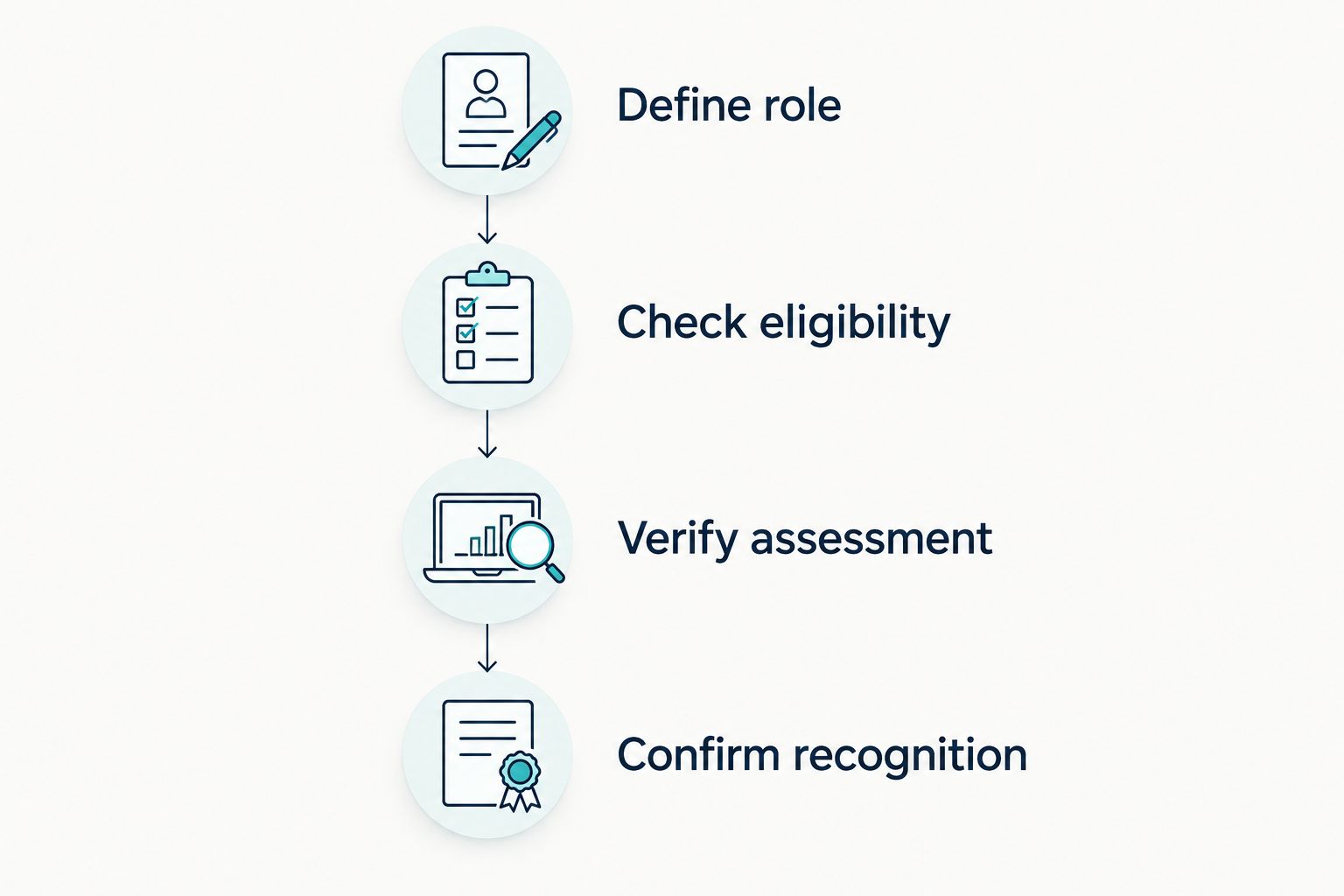
Check these four points before enrolling
Use the same sequence for every program you consider. It keeps a compelling subject description from replacing a professional-fit decision.
- Define role. Write one sentence describing your intended service. State whether you will teach yoga, provide coaching, or practice within an existing clinical license.
- Check eligibility. Ask whether your current training meets entry requirements. Do not assume that a program serving healing professionals accepts every professional background.
- Verify assessment. Ask what completion requires, whether skills are observed, and what feedback is provided. Distinguish participation requirements from competence assessment.
- Confirm recognition. Check the exact credential awarded and whether the relevant professional organization recognizes it for your intended purpose.
For any 2026 enrollment, request current answers rather than relying on an older course description. Keep those answers with your enrollment documents so your understanding of the qualification remains specific.
The Embody Lab offers the three certificates below. Review the program details against your intended role before selecting a training.


Certificate, certification, and continuing education are different
The phrase “somatic coaching certification for yoga teachers” combines several possible goals. You might want a provider-issued certificate, recognition from a coaching organization, or continuing education accepted by your yoga registration body.
Do not treat these as interchangeable. A certificate documents the qualification its provider awards; acceptance by another organization is a separate question.
For example, ask for the exact accrediting or approving organization, the specific program it recognizes, and the professional category covered. Then confirm acceptance directly with the organization that matters to your practice.
Likewise, completion hours are not automatically continuing education credits. Before committing to training in 2026, verify the requirements attached to your own registration, license, or professional membership. Use the precise qualification name in your professional biography after completion.
How the certificates are ranked
This ranking prioritizes intended professional role, explicit subject focus, stated duration, and known delivery format. Mind-Body Coaching ranks first for the coaching query because its description directly identifies somatic, mindfulness-based coaching education.
Therapeutic Yoga takes the yoga-teaching slot because its focus is yoga, trauma healing, and nervous system regulation. Embodied Intimacy takes the relationship-specialist slot because that is its stated coaching subject.
The ranking does not establish equivalence between qualifications or compare graduate outcomes. Educational duration is a planning input, not a quality score. The decisive question remains whether a program prepares you for the role you intend to undertake.
Which certificate should you choose?
Choose Mind-Body Coaching Certificate if you want to develop a coaching practice alongside yoga teaching. It is the default recommendation for that specific goal, subject to confirming eligibility, assessment, and relevant recognition.
Choose Therapeutic Yoga for Trauma Healing and Nervous System Regulation Certificate if your priority is yoga-focused education. Choose Embodied Intimacy and Relationship Coaching Certificate only when relationship coaching is your intended specialization.
For your 2026 decision, resist choosing the broadest-sounding qualification. Select the closest match to the work you can describe clearly and practice responsibly.
FAQ
What’s the best somatic coaching certification for yoga teachers?
Mind-Body Coaching Certificate is the best fit in this shortlist for yoga teachers developing a separate coaching practice. The 120-hour program explicitly focuses on somatic, mindfulness-based coaching; confirm eligibility, assessment, and relevant professional recognition before enrolling.
Which certificate is best if I only want to deepen my yoga teaching?
Therapeutic Yoga for Trauma Healing and Nervous System Regulation Certificate is the most directly aligned option here. It is a three-part, 30-hour program focused on the intersection of yoga, trauma healing, and nervous system regulation.
Does a somatic coaching certificate qualify me to treat trauma?
A somatic coaching certificate does not itself qualify you to provide trauma psychotherapy. Clinical treatment requires the applicable professional qualifications and authorization in your jurisdiction.
Is a 120-hour coaching certificate better than a 30-hour yoga certificate?
Neither duration establishes that one certificate is better for every yoga teacher. The 120-hour Mind-Body Coaching Certificate addresses coaching education, while the 30-hour Therapeutic Yoga certificate addresses a different educational focus.
Should I choose relationship coaching training as a yoga teacher?
Choose Embodied Intimacy and Relationship Coaching Certificate when relationship-focused coaching is your intended additional role. Its 80-hour specialist focus is not the default choice for general yoga teaching development.
Will these certificates count toward my continuing education requirements?
Confirm acceptance with the organization responsible for your specific continuing education requirements. Provider accreditation, program approval, educational hours, and acceptance for your professional category are separate questions.
What should I check before enrolling in a certificate in 2026?
Check intended-role fit, entry requirements, assessment, and recognition before enrolling in 2026. Request the exact completion credential and distinguish observed skills assessment from attendance or content completion.
One last thing
Write your proposed professional biography before choosing a program. If it contains “trauma therapist,” “certified coach,” or another regulated or externally recognized designation, identify exactly what authorizes that wording.
Then work backward. Select education that supports an accurate description of your role rather than stretching your role to match a course title. A precise professional introduction is a useful test of whether you have chosen the right training.