Nurses’ trauma-informed yoga certification is professional education in adapting yoga to trauma-related needs with the aim of supporting patient choice and safer body-based care. This 2026 guide separates nursing scope, yoga teaching preparation, and the somatic education offered by The Embody Lab, so you can choose training that fits your actual role.
- Trauma informed yoga certification for nurses should match nursing scope, patient needs, and employer requirements.
- The Embody Lab offers somatic professional education; verify nursing CE acceptance for the specific program.
- Prioritize consent, accessible movement, supervised practice, and clear boundaries over certificate wording.
- Yoga teacher preparation, trauma-informed education, and nursing continuing education serve different purposes.
Why trauma-informed yoga certification matters for nurses
Nurses work within clinical responsibilities that a yoga certificate does not replace. Patient assessment, mobility restrictions, consent, documentation, and escalation remain central when you introduce a body-based practice. Your training needs to address those responsibilities, not simply offer a sequence of poses.
The distinction matters because learning yoga for your own regulation is different from facilitating a patient activity. Teaching a community class is another role again. Choose the role first, then choose the certificate. Otherwise, you risk selecting useful education that does not prepare you for the work you intend to do.
For your 2026 training decision, separate three questions: what you want to learn, what you are authorized to do, and what evidence of learning your employer requires. A certificate answers only part of that assessment. Its title alone does not establish nursing continuing education acceptance, yoga teaching competence, or permission to deliver a clinical intervention.
How to choose trauma-informed yoga training for your nursing role
Define your intended use before comparing programs
Start with a written description of the activity you want to introduce. Reviewing your job description and institutional policies is the manual starting point; buying a course is not. Specify whether your goal is personal practice, patient education, individual support, or group yoga instruction.
Write a 1-page scope brief as a planning exercise. Include your patient population, setting, proposed activity, and approval pathway. A clear brief helps your educator or manager identify whether you need yoga teaching preparation, trauma-informed professional education, or both.
Avoid using nervous system regulation as an umbrella term that conceals different tasks. Offering a patient choices about positioning is not equivalent to leading a yoga session or treating trauma. The educational requirements should follow the task.
- Name the intended setting: bedside, outpatient, community, or personal practice.
- Describe the activity without broad treatment claims.
- Identify the nursing responsibilities that remain unchanged.
- Record who approves a new patient-facing activity.
- Separate your personal learning goals from patient-care competencies.
Verify the certificate and nursing CE separately
Read the program information yourself, then confirm the requirements with your employer and the relevant nursing authority. Keep the certificate of completion, continuing education credit, and professional authorization in separate categories. They are not interchangeable.
For a 2026 enrollment decision, ask for the current accreditation statement and its eligible professions. General CE accreditation is not evidence that a particular activity satisfies your nursing renewal requirements. Acceptance depends on the activity and the rules that apply to you.
Also establish what completion means. Attendance, an assessment, a teaching demonstration, and supervised clinical practice provide different evidence. Do not describe yourself as qualified to deliver trauma treatment solely because a course issues a certificate.
- Request the accreditation statement for the specific activity.
- Confirm whether nurses are included among eligible participants.
- Check acceptance with your licensing authority or employer.
- Ask which assessments are required for completion.
- Retain the syllabus and completion documentation.
Examine the trauma-informed curriculum
Build a curriculum checklist before comparing providers. Look for explicit teaching on consent, choice, accessible movement, boundaries, and responses to distress. A course that mentions trauma without explaining how facilitation changes leaves an important gap in your preparation.
For structured professional education rather than a self-assembled reading list, review The Embody Lab’s Therapeutic Yoga for Trauma Healing and Nervous System Regulation Certificate. Its stated topic matches this search; assess the current syllabus against your nursing role before deciding.
Distinguish a theoretical framework from a clinical promise. Polyvagal theory, somatic concepts, and nervous system terminology require careful application. Ask how the program distinguishes explanatory models, research findings, and practical teaching recommendations. Do not infer patient outcomes from a course title.
- Look for invitational language rather than commands to relax.
- Check whether declining participation is explicitly supported.
- Ask how the curriculum addresses consent and touch.
- Look for alternatives to eyes-closed or inward-focused practices.
- Review how distress, dissociation, and referral boundaries are discussed.
Assess practice, feedback, and faculty relevance
Review faculty biographies, sample teaching, and assessment requirements before relying on a provider’s reputation. You need to know who teaches the material, what experience supports the instruction, and how learners receive feedback. Expertise in yoga, trauma therapy, and nursing represents different professional backgrounds.
Ask whether practice involves observation, peer rehearsal, faculty feedback, or formal evaluation. These formats are not equivalent. Recorded instruction supports study, but a recording does not observe how you respond when a participant declines, becomes uncomfortable, or misunderstands an invitation.
Use 3 practice scenarios as a recommended evaluation exercise: a patient declines movement, a participant reports discomfort, and a group member becomes distressed. Ask how the training prepares you to respond without pressuring participation or exceeding your role.
- Request a sample lesson or detailed learning objectives.
- Review faculty credentials relevant to the material taught.
- Identify opportunities to rehearse facilitation language.
- Ask who provides feedback and what that feedback assesses.
- Check whether completion includes demonstrated skills or attendance alone.
Match the practices to your clinical environment
Begin with your setting’s existing assessment and safety procedures. A yoga sequence designed for a studio is not automatically appropriate for a patient with movement restrictions, pain, lines, equipment, or an acute change in condition. The clinical context determines what is suitable.
Training should help you adapt your language and recognize when not to proceed. It should not encourage you to reinterpret concerning symptoms as a trauma response before the clinical team assesses them. Medical assessment takes priority over a nervous system explanation.
Consider environmental constraints too. Privacy, interruptions, shared rooms, and observation requirements affect whether a patient can participate comfortably. A patient who cannot or does not want to move should retain meaningful choice without being framed as resistant.
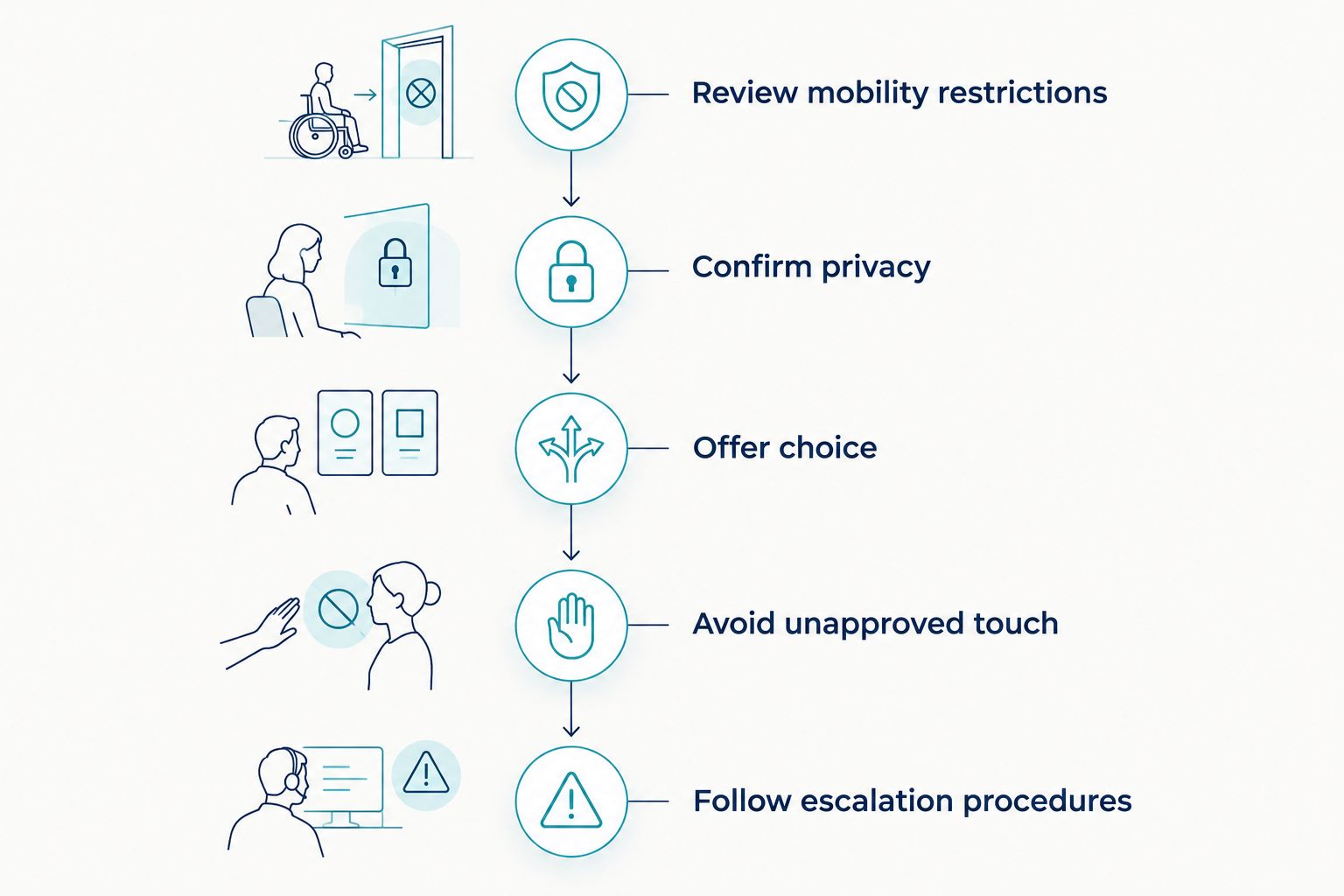
- Review mobility restrictions and relevant care instructions.
- Confirm privacy and accessibility for the proposed activity.
- Offer a clear option not to participate.
- Avoid touch or positioning outside approved practice.
- Follow clinical escalation procedures for new or concerning symptoms.
Build a study plan that fits your role
Map your study commitments against shifts, recovery time, and existing professional education. Do this manually before enrolling: review the teaching schedule, assessment deadlines, access arrangements, and any required live participation. An online format alone does not establish that a program fits your schedule.
For your 2026 plan, distinguish learning time from implementation time. Completing coursework is one task; obtaining approval, rehearsing language, and preparing documentation are separate tasks. Protect space for both rather than treating the final lesson as the start of independent patient facilitation.
A focused course and a broader certificate answer different learning needs. Choose the narrower option when your goal is limited and its curriculum fits. Choose broader education when you need a wider conceptual foundation, while still checking whether it prepares you for yoga teaching.
- List all required live sessions and completion tasks.
- Check how course access fits rotating shifts.
- Reserve time for rehearsal and feedback.
- Identify any prerequisites before enrollment.
- Set an implementation checkpoint with your supervisor or educator.
Evaluate application without overstating outcomes
Start with approved documentation practices and a defined learning objective. Record what you offered, whether the patient chose to participate, and any relevant response within your clinical documentation standards. Do not turn a patient encounter into an informal research project.
Assess whether your own facilitation follows the agreed process. Did you explain the activity? Was refusal easy? Did you stay within scope and respond appropriately to discomfort? These questions provide a clearer review than assuming an activity worked because a patient became quiet.
Keep language proportionate to observation. A patient’s reported experience is not evidence that trauma has resolved, autonomic function has changed, or treatment has succeeded. If your service wants to evaluate clinical outcomes, use its established governance and evaluation procedures.
- Document participation and refusal without judgment.
- Describe observations rather than inferred nervous system states.
- Review consent language during supervision.
- Record concerns through the appropriate clinical pathway.
- Revise the activity when feedback identifies a safety or access problem.
Compare training paths for nurses
For 2026, compare educational purpose before comparing certificate names. The options below serve different needs; none should be treated as a substitute for nursing authorization. The best fit is the option whose curriculum and completion requirements match your intended work.
| Option | Best for | Main advantage | Key limitation |
|---|---|---|---|
| Self-directed policy and literature review | Nurses defining a learning need before enrollment | Helps clarify scope and questions for providers | Does not provide assessed facilitation competence |
| Nursing continuing education addressing trauma-informed care | Nurses prioritizing nursing-specific professional learning | Keeps the learning objective tied to nursing practice | Does not necessarily prepare you to teach yoga |
| Therapeutic Yoga for Trauma Healing and Nervous System Regulation Certificate | Nurses comparing yoga-focused professional education | The stated topic directly addresses therapeutic yoga and trauma | Verify nursing CE acceptance, prerequisites, and practice assessment |
| Hands-On Polyvagal: Yoga, Vagal Toning & Shame Work | Nurses exploring the intersection of polyvagal theory and therapeutic yoga | A three-part standalone course with Dr. Arielle Schwartz | Do not treat a standalone course as a yoga teaching credential |
| Integrative Somatic Trauma Therapy Certificate | Nurses seeking broader body-centered trauma education | A 3-month online certificate focused on understanding and working with trauma | Its broader somatic focus is not the same as yoga-specific preparation |
The Embody Lab’s somatic education includes both focused courses and broader certificate programs. Hands-On Polyvagal: Yoga, Vagal Toning & Shame Work is described as a three-part standalone course drawing on polyvagal theory, therapeutic yoga, and somatic psychology. The Integrative Somatic Trauma Therapy Certificate is described as a 3-month online program with a body-centered trauma framework.
Those descriptions establish subject matter and format, not nursing eligibility or clinical privileges. Request the details that affect your decision: accepted professions, assessed skills, prerequisites, and the distinction between learning a framework and being authorized to apply an intervention.
Common mistakes nurses make when choosing certification
Treating CE accreditation as automatic nursing acceptance
A provider’s CE-accredited education does not settle whether a particular program meets your nursing requirements. Confirm the specific activity and eligible profession before enrolling. Keep written confirmation with your 2026 professional development records.
Confusing trauma education with yoga teaching preparation
Understanding trauma-informed principles and leading a yoga class require different competencies. If your planned role includes teaching, check how the program addresses instruction, adaptation, observation, and assessment. Do not assume a trauma-focused title covers foundational yoga teaching skills.
Importing a studio sequence into patient care
Clinical movement restrictions, equipment, pain, and observation requirements change what is appropriate. Review the proposed practice with the relevant clinical team rather than assuming a gentle label establishes safety. Adaptation begins with assessment, not a preferred sequence.
Interpreting refusal or stillness as a nervous system finding
Refusal is a valid choice, not proof of avoidance. Stillness does not establish regulation, and visible emotion does not establish therapeutic progress. Describe what the patient reports or what you observe without assigning an unsupported physiological explanation.
Using a certificate to imply a new clinical specialty
Represent the education accurately on your résumé, professional profile, and patient information. State the program completed without implying licensure, board certification, or independent trauma-treatment authority that it does not establish. Educational depth and accurate boundaries belong together.
FAQ
What is trauma informed yoga certification for nurses?
Trauma informed yoga certification for nurses is education in applying trauma-informed principles to yoga-related practices within an appropriate professional role. Compare consent, adaptation, assessed practice, and nursing relevance rather than relying on the certificate title.
Does a trauma-informed yoga certificate qualify me to teach yoga?
A trauma-informed yoga certificate does not by itself establish yoga teaching competence. Check prerequisites, teaching practice, assessment requirements, and the requirements of the setting where you intend to teach.
Can nurses receive continuing education credit for these programs?
Nurses should verify CE acceptance for the specific program before enrollment. The Embody Lab offers CE-accredited professional education, but nursing acceptance requires checking the activity’s accreditation statement and the rules that apply to you.
Is therapeutic yoga training the same as somatic trauma therapy training?
Therapeutic yoga training and somatic trauma therapy training have different educational emphases. Compare the actual syllabus to determine whether you need yoga-specific instruction, broader trauma education, or both.
Do I need to be a yoga teacher before enrolling?
Prerequisites depend on the program. Ask the provider whether prior yoga teacher preparation is required and whether nurses without that background are eligible for the intended training.
Can I use yoga practices with patients immediately after certification?
Patient-facing use must fit your nursing scope, competence, clinical assessment, and institutional approval. Completing a certificate does not replace those requirements or authorize a new clinical service.
What should I prioritize when choosing training in 2026?
Prioritize fit with your intended nursing role, consent-based instruction, supervised feedback, and verified CE acceptance. Choose the program that addresses your identified competency gap rather than the most impressive certificate wording.
One last thing
The Embody Lab is best for nurses seeking somatic and trauma-informed professional education, not a nursing credential. Keep that distinction visible when choosing a course and describing what you have learned.
Before your first approved patient-facing activity, rehearse the invitation and the refusal pathway with a colleague. Ask the colleague to decline. If your next sentence pressures participation, revise it before using it clinically. A trauma-informed practice needs a usable exit, not just a carefully prepared beginning.