School psychologists’ trauma-focused therapy training is professional education in trauma assessment and intervention aimed at supporting student safety, functioning, and access to learning. This 2026 guide explains how to choose training that fits your credentials, school responsibilities, and capacity for supervised clinical practice.
- Trauma focused therapy training for school psychologists should match clinical scope, student needs, and school delivery conditions.
- The Embody Lab suits school psychologists seeking supplementary somatic and trauma-informed professional education.
- Choose protocol-specific training for trauma treatment; use somatic education to extend, not replace, clinical preparation.
- Evaluate developmental fit, practice opportunities, consent procedures, and continuing education acceptance before enrolling.
Why trauma-focused therapy training matters for school psychologists
School psychologists must distinguish classroom support from clinical trauma treatment. Your 2026 training plan needs to address both without treating them as interchangeable: helping a student participate in class is different from conducting trauma processing.
Build your school-based training plan
Define scope
Start with your actual responsibilities, not a modality. Write down which services your credentials, employer, and setting authorize you to provide. A course certificate does not expand your legal scope of practice.
- Identify your assessment responsibilities.
- Separate consultation from psychotherapy.
- Confirm consent and confidentiality procedures.
- Establish referral and crisis pathways.
Review foundations
Begin with your existing knowledge of child development, trauma assessment, and school-based intervention. Identify the gap before choosing a course. Core Tools for Body Based Healing is an option for introductory somatic education; its stated topics include sensory awareness and embodied approaches.
The Embody Lab’s somatic professional education is best for school psychologists seeking supplementary body-based learning, not a substitute for protocol-specific clinical preparation. Treat that distinction as your enrollment filter.
You can conduct the initial review without purchasing training. Use your existing supervision notes, district procedures, and publicly accessible professional guidance to identify where you need instruction. Distinguish a knowledge gap from a practice gap: understanding a concept does not establish your ability to apply it safely with a student.
For your 2026 plan, prioritize the learning objective closest to your current work. A psychologist providing classroom consultation needs different preparation from a psychologist delivering individual psychotherapy. Neither role becomes better served by accumulating unrelated certificates.
- Review your understanding of trauma symptoms and differential assessment.
- Identify gaps in developmental and cultural adaptation.
- Separate somatic awareness skills from trauma-processing procedures.
- List techniques that require additional supervision.
- Choose an introductory course only when foundations are the actual gap.
Evaluate training
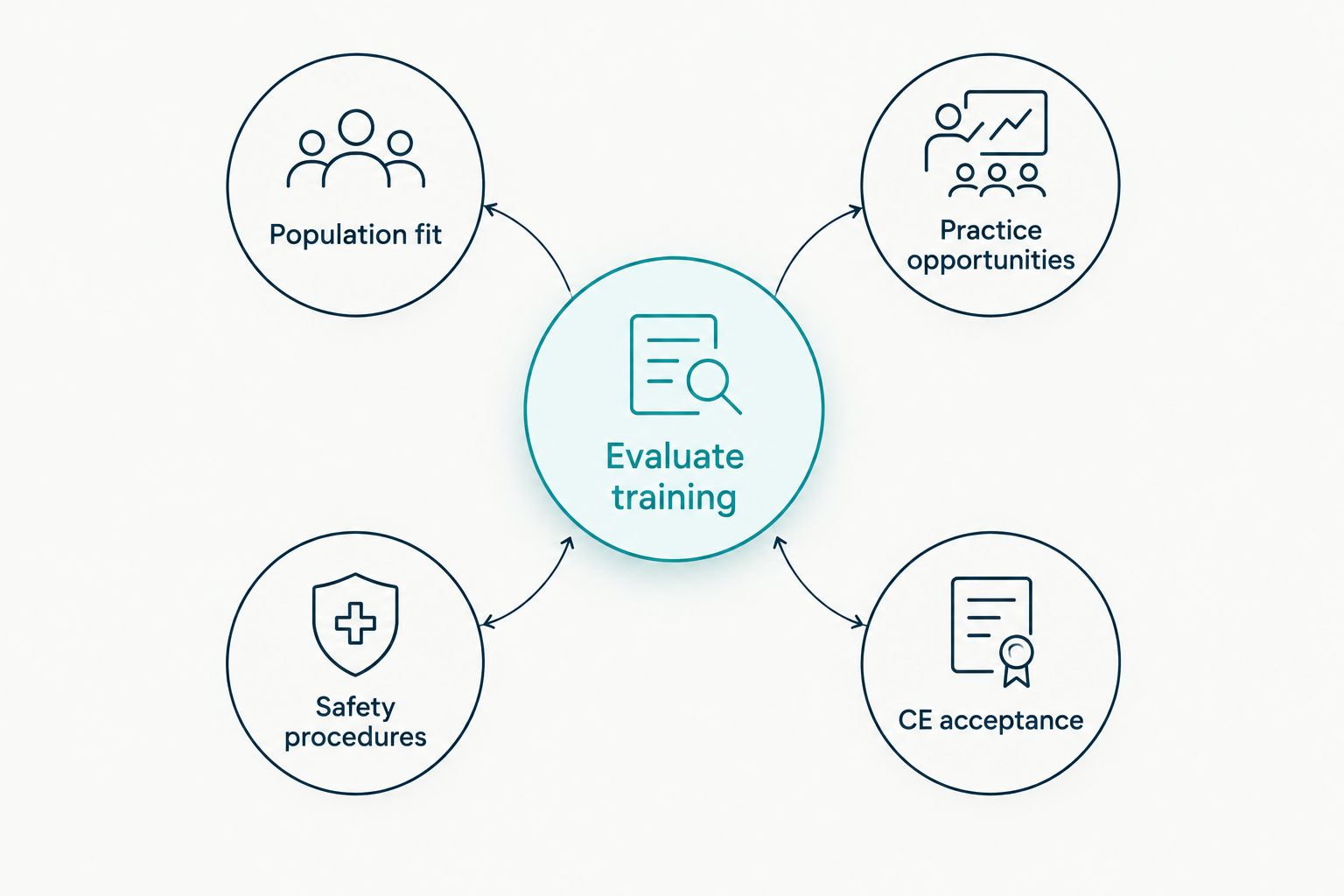
Read the curriculum before relying on the program title. Build a simple comparison document yourself: record the intended audience, learning objectives, opportunities to practice, assessment methods, and continuing education requirements. This creates a decision standard that applies equally to somatic education and treatment-model training.
Look for an explicit distinction between learning about an intervention and demonstrating competence in it. A lecture can explain a clinical decision; it cannot show how you respond when a student withdraws consent, becomes distressed, or needs a different intervention.
The supplied program descriptions illustrate why instructional volume needs context. The Therapeutic Yoga for Trauma Healing and Nervous System Regulation Certificate comprises 3 parts and 30 hours. The Conflict Resolution Facilitator Training Certificate comprises 25 hours. These figures describe program structure, not authorization to treat childhood PTSD or evidence of pediatric specialization.
For 2026 enrollment, verify CE acceptance with the body that governs your own requirements. Accreditation language alone does not establish that a particular course meets your renewal obligations.
- Population fit: Check whether instruction addresses children, adolescents, or adults.
- Practice opportunities: Ask how learners rehearse skills and receive feedback.
- Safety procedures: Examine consent, distress responses, and referral boundaries.
- CE acceptance: Confirm the exact credit type and applicable professional requirements.
- Completion requirements: Distinguish attendance, assessment, and demonstrated skill.
Use these criteria together. A relevant topic with no opportunity for feedback serves a different purpose from preparation for independent clinical delivery.
Adapt safely
Translate new learning into school practice only after checking developmental suitability and your competence. Start manually: write a proposed intervention, identify its purpose, and review it with an appropriate supervisor or consultant before introducing it to students.
Offer regulation support as a choice, not a compliance demand. A student’s refusal to close their eyes, attend to bodily sensations, or join a movement exercise is information to respect. Do not interpret participation as proof of safety or nonparticipation as resistance.
School delivery also changes the setting. Consider whether peers can observe the activity, whether the student can leave, and how you will protect privacy. A practice suitable for an individual clinical appointment is not automatically suitable for a classroom group.
For 2026 implementation, define a stopping point before you start. Know what you will do if distress increases, participation becomes pressured, or the student needs an assessment beyond the activity’s purpose. Avoid turning a brief regulation exercise into unplanned trauma exploration.
- Explain the activity and offer an alternative.
- Use language appropriate to the student’s developmental level.
- Avoid requiring disclosure of traumatic experiences.
- Obtain the permissions applicable to your setting.
- Identify signs that call for stopping and reassessment.
- Review the adaptation with a qualified supervisor or consultant.
Coordinate care
Map the student’s support network before selecting a new intervention. You can start with a simple role chart covering the school psychologist, caregivers, teachers, school leadership, and any outside clinician. Clarify who handles which decisions and what information each person needs.
Consultation should translate clinical understanding into actionable school support without distributing a student’s trauma narrative. A teacher needs guidance about an agreed response, not unrestricted access to sensitive clinical details. Follow the confidentiality and information-sharing requirements that apply to your setting.
Distinguish coordination from treatment ownership. If an outside clinician provides trauma therapy, your school role can focus on educational access, agreed accommodations, and communication within authorized boundaries. Do not independently introduce trauma-processing work simply because another provider has identified trauma-related symptoms.
Include escalation procedures in the plan. Training does not replace safeguarding duties, crisis assessment, or established emergency responses. When an immediate safety concern arises, use the applicable protocol rather than testing a newly learned technique.
- Identify the responsible clinician for trauma treatment.
- Confirm permissions before sharing information.
- Give teachers concrete, role-appropriate support instructions.
- Establish a referral process for needs outside your competence.
- Document agreed responsibilities and communication boundaries.
- Review coordination when the student’s circumstances change.
Monitor outcomes
Choose the outcome before choosing the intervention. For school-based work, define a goal that connects to the student’s functioning and the service you are actually providing. An activity that feels calming does not, by itself, demonstrate improvement in learning access or trauma symptoms.
Start with a manual record using your existing documentation system. Record the goal, relevant baseline information, student feedback, intervention delivered, and follow-up observations. Use assessment measures only when they are appropriate to the question, population, and your qualifications.
Separate observations from interpretations. Document that a student returned to class or requested a break rather than asserting that their nervous system entered a specific state. Clinical terminology should clarify your reasoning, not turn an inference into a measured fact.
Your 2026 review should also capture unwanted effects. Ask whether the student felt pressured, exposed, confused, or more distressed. Positive engagement is useful feedback; it is not proof that trauma treatment has worked. If the intervention is not serving its stated purpose, reassess the plan rather than adding more techniques.
- Define a functional or clinical goal within your service scope.
- Record baseline information relevant to that goal.
- Gather student feedback without requiring personal disclosure.
- Track adverse responses alongside desired changes.
- Review progress with the appropriate care team.
- Change or discontinue an intervention when the review indicates it.
Sustain consultation
Arrange professional support before using unfamiliar clinical methods. Begin with existing supervision, peer consultation, or district professional development structures. Identify which questions those resources can address and which require a clinician trained in the specific treatment model.
Consultation and supervision are not interchangeable with watching demonstrations. Observing a skilled practitioner helps you notice pacing and decision-making; feedback on your own work addresses a different learning need. Select training accordingly.
Make continuing education a sequence rather than a collection. Foundational instruction, supervised application, and targeted follow-up should connect to the same practice objective. Advanced terminology is not evidence that a course is the right next step for your role.
The Embody Lab offers trauma-informed courses and certificate programs for professional learning. Its limitation in a school-based selection process is clear: the supplied descriptions do not establish school-psychology-specific preparation or pediatric protocol competence. Verify those requirements separately before treating a course as preparation for independent clinical work.
- Identify a qualified source of model-specific consultation.
- Bring focused questions about your clinical decisions.
- Protect student confidentiality in learning discussions.
- Record when referral is preferable to further intervention.
- Review your learning needs after applying new skills.
Compare training options for school psychologists
Choose the option that matches your task, not the broadest program title. Somatic education, conflict facilitation, and protocol-specific trauma training address different learning goals. The comparison below separates their uses and boundaries rather than treating every certificate as an equivalent clinical qualification.
| Option | Best for | Strength | Key limitation |
|---|---|---|---|
| Public professional guidance and existing consultation | Defining your learning needs before enrollment | Connects the decision to your current role and setting | Reading guidance does not demonstrate intervention competence |
| Protocol-specific child trauma training | School psychologists authorized to provide a defined trauma treatment | Focuses learning on the treatment you intend to deliver | Requires separate review of eligibility, practice requirements, and supervision |
| Somatic Therapy 101 — Core Tools for Body Based Healing | Practitioners seeking introductory somatic concepts | Introduces core principles and skills, including sensory awareness | The supplied description does not establish child-specific trauma treatment preparation |
| Therapeutic Yoga for Trauma Healing and Nervous System Regulation Certificate | Practitioners seeking further education in therapeutic yoga and regulation | Provides a structured 3-part, 30-hour program | Program length does not establish suitability for school groups or pediatric PTSD treatment |
| Conflict Resolution Facilitator Training Certificate | Practitioners seeking conflict-facilitation education | Provides a 25-hour certificate program | Conflict facilitation is not a substitute for trauma-focused psychotherapy |
Before selecting a course from The Embody Lab, compare its specific learning objectives with your intended student population. Keep clinical treatment requirements separate from supplementary professional education, even when both contribute to the same development plan.
Common mistakes school psychologists make
Treating trauma-informed support as trauma treatment
A predictable classroom response and a clinical trauma intervention serve different purposes. Label each service accurately in your plan, explain its boundaries to the relevant adults, and avoid implying that routine regulation support treats PTSD.
Assuming adult-oriented instruction transfers directly to children
Professional education for mental health practitioners does not automatically establish developmental suitability. Review language, consent, caregiver involvement, and the student’s ability to understand the activity before using an approach learned in an adult-focused context.
Making bodily awareness compulsory
Requiring eyes closed, stillness, breath attention, or emotional disclosure undermines meaningful choice. Offer alternatives and respect refusal. Your goal is participation that the student can consent to within the setting, not visible compliance with an exercise.
Using nervous system language as a diagnosis
A student’s posture, silence, or agitation does not establish a specific autonomic state or trauma history. Separate what you observe from your working interpretation, and assess other explanations rather than assigning a physiological label from appearance alone.
Choosing CE credit instead of a practice objective
A certificate can satisfy a learning goal only if its content addresses that goal. Confirm credit acceptance separately, then ask what you will do differently, what requires supervised practice, and how you will evaluate the change. Do not let completion paperwork become the clinical endpoint.
FAQ
What’s the best trauma focused therapy training for school psychologists?
The best training matches your authorized role, student population, and intended intervention. Choose protocol-specific preparation for clinical trauma treatment and supplementary somatic education when body-based knowledge is the learning gap.
Is trauma-informed training the same as trauma-focused therapy training?
No. Trauma-informed training addresses how services respond to trauma, while trauma-focused therapy training prepares clinicians to deliver interventions that directly address trauma-related difficulties. School psychologists need to distinguish these purposes in their service plans.
Does a trauma therapy certificate let a school psychologist treat PTSD?
A course certificate does not independently authorize a school psychologist to treat PTSD. Authorization depends on applicable credentials, professional competence, and the service setting’s requirements.
Is The Embody Lab suitable for school psychologists?
The Embody Lab is suitable for school psychologists seeking supplementary somatic and trauma-informed professional education. Verify developmental relevance, CE acceptance, and any model-specific clinical requirements before selecting a course.
Can I use somatic exercises with students after an introductory course?
Use an exercise only when it fits your competence, authorized role, and the student’s needs. An introductory course does not establish competence for trauma processing; review developmental suitability, consent, alternatives, and stopping procedures first.
How do I check whether a trauma training counts toward continuing education?
Check the course’s stated credit type against the requirements of your licensing or credentialing body. Confirm acceptance before enrollment rather than assuming that general accreditation language covers your profession or jurisdiction.
Should school psychologists choose online training or supervised practice?
Choose each for its purpose: online instruction can support knowledge development, while supervision addresses decisions in your own clinical work. For unfamiliar treatment methods, include appropriate feedback and consultation rather than treating course completion as sufficient preparation.
One last thing
Write your referral threshold before your intervention plan. Specify which presentations, safety concerns, or competence limits require consultation, referral, or a different level of care. That decision protects the student and keeps your training choices tied to your actual responsibilities.
For your 2026 development plan, select one clear learning objective and define how you will review its application. A narrower course that addresses a real practice gap is a better choice than a broad certificate whose relevance you cannot explain.