Chaplains’ breathwork certification is structured education in breath-based practices with the aim of supporting spiritual care within professional boundaries. This 2026 guide explains how to assess training, distinguish a course certificate from a professional credential, and protect patient choice when bringing somatic awareness into chaplaincy.
- Breathwork certification for chaplains should complement spiritual care, not authorize medical treatment or psychotherapy.
- The Embody Lab is best for chaplains seeking somatic education alongside, not instead of, chaplaincy training.
- Assess consent, scope, supervised practice, and referral procedures before choosing breathwork training.
- The Breathwork & Movement Therapy for Trauma Healing Certificate is a 60-hour online program.
Why breathwork matters for chaplains
Breathwork belongs in a chaplain’s practice only when it serves the person receiving care. Your task is not to produce a particular breathing pattern, emotional release, or nervous system state. It is to offer spiritual support without overriding consent, clinical care, or religious preference.
The setting changes the training requirements. A bedside encounter involves different responsibilities from a voluntary educational group, and a person discussing grief needs something different from a participant seeking movement-based learning. Choose training for the encounters you actually serve, not for the most dramatic technique it teaches.
The Embody Lab provides somatic and trauma-informed professional education. For chaplains evaluating its courses in 2026, the central question is how that education fits your existing role—not whether a certificate creates a new clinical scope.
Build a chaplaincy-specific training plan
1. Define your scope before choosing a course
Start with your job description, employer policies, and current professional credentials. Write down what you are authorized to offer and which decisions belong to nursing, medicine, mental health care, or another qualified professional. This review requires no new enrollment.
Separate supportive spiritual care from treatment claims. A chaplain can discuss whether someone wants a body-focused practice without presenting that practice as treatment for trauma, respiratory illness, or a psychiatric condition. If you also hold a clinical license, identify which role governs the encounter.
Create a one-page scope statement before comparing programs. A brief document makes boundaries easier to discuss with a supervisor than a broad intention to integrate breathwork.
- Name your setting: bedside care, hospice, community care, or staff support.
- Describe the spiritual-care purpose of any proposed practice.
- Identify who approves new practices in your workplace.
- List the circumstances requiring consultation or referral.
2. Establish consent and a non-breath alternative
Begin with ordinary conversation and attentive presence. You do not need a breathwork certificate to ask whether a person wants silence, prayer, conversation, or another form of spiritual support. Breath-focused participation must remain an invitation rather than an expectation.
Consent also includes how you frame the practice. Explain what you propose, avoid promises about healing, and make refusal easy. Someone accepting a chaplain visit has not automatically consented to body-focused work.
Ask 3 consent questions when designing your approach: Does the person want this? Can the person stop it? What support will you offer instead? These are planning prompts, not a clinical screening instrument.
- Ask permission before introducing attention to breathing or bodily sensations.
- Offer a clear alternative that does not involve breath awareness.
- Explain that participation can end without explanation.
- Avoid interpreting refusal as resistance or lack of spiritual openness.
3. Evaluate the curriculum against your responsibilities
Read the published curriculum and request clarification from the education provider. Look for learning objectives that distinguish theory, demonstration, experiential learning, and assessed practice. A course title alone does not show what you will be prepared to do.
The Embody Lab’s breathwork education includes a 60-hour online certificate program focused on breathwork, movement, and trauma healing. That provides a defined study commitment; it does not establish chaplaincy credentialing, employer approval, or competence in every technique associated with breathwork.
For your 2026 course comparison, use 4 curriculum criteria: scope, consent, practice assessment, and referral. These criteria keep the decision tied to professional responsibilities rather than a certificate’s name.
- Request the full syllabus and learning objectives.
- Check how the course addresses consent and professional boundaries.
- Ask how faculty assess practical application, if assessment is included.
- Confirm whether prerequisites match your background.
- Ask which continuing education approvals apply to your credential.
4. Distinguish supportive awareness from intensive techniques
Do not treat breathwork as one uniform intervention. Quiet attention to ordinary breathing is not the same activity as deliberately rapid breathing, forceful breathing, prolonged breath retention, or an intensive group process. Evaluate the actual method, not just the category label.
Your chaplaincy plan should specify which practices fall outside your role. Do not introduce intensive methods in a care encounter simply because they appeared in a training demonstration. Follow workplace protocols and obtain guidance from the responsible clinical team when medical concerns are present.
Training should help you recognize when not to proceed. If someone reports distress or a concerning symptom during a practice, stop the practice and follow the setting’s clinical response procedures. Do not explain symptoms away as spiritual release or trauma processing.
- Identify the breathing methods the course teaches.
- Separate observation of ordinary breathing from deliberate breathing changes.
- Exclude techniques outside your authorization or preparation.
- Ask how the training addresses stopping and referral.
- Keep spiritual interpretation separate from medical assessment.
5. Rehearse decisions, not just techniques
Start with peer discussion or supervision using hypothetical chaplaincy encounters. Practice explaining an invitation, accepting a refusal, and deciding not to offer breathwork. These conversations expose gaps that watching a demonstration does not resolve.
Use cases relevant to your work: a person who associates inward attention with distress, a family member seeking prayer rather than instruction, or a staff member requesting support after a difficult shift. Keep cases hypothetical or appropriately de-identified, and follow your workplace’s confidentiality requirements.
An online certificate can structure your study. It does not replace local review of how you translate that learning into patient-facing care. A useful practice review includes the decision to refrain, not only the ability to facilitate.
- Rehearse a neutral explanation of the proposed practice.
- Practice responding to refusal without persuasion.
- Discuss when consultation should precede an invitation.
- Review how you would end an uncomfortable encounter.
- Ask a supervisor to challenge your scope assumptions.
6. Integrate learning through an approved care process
Begin implementation with a written plan rather than an informal experiment at the bedside. Describe the purpose, consent process, limits, documentation, and referral pathway. Submit that plan through your organization’s established approval process.
Use a simple decision sequence: scope check, consent check, appropriate invitation, and practice review. A person’s interest does not override a scope restriction, and employer approval does not replace individual consent.
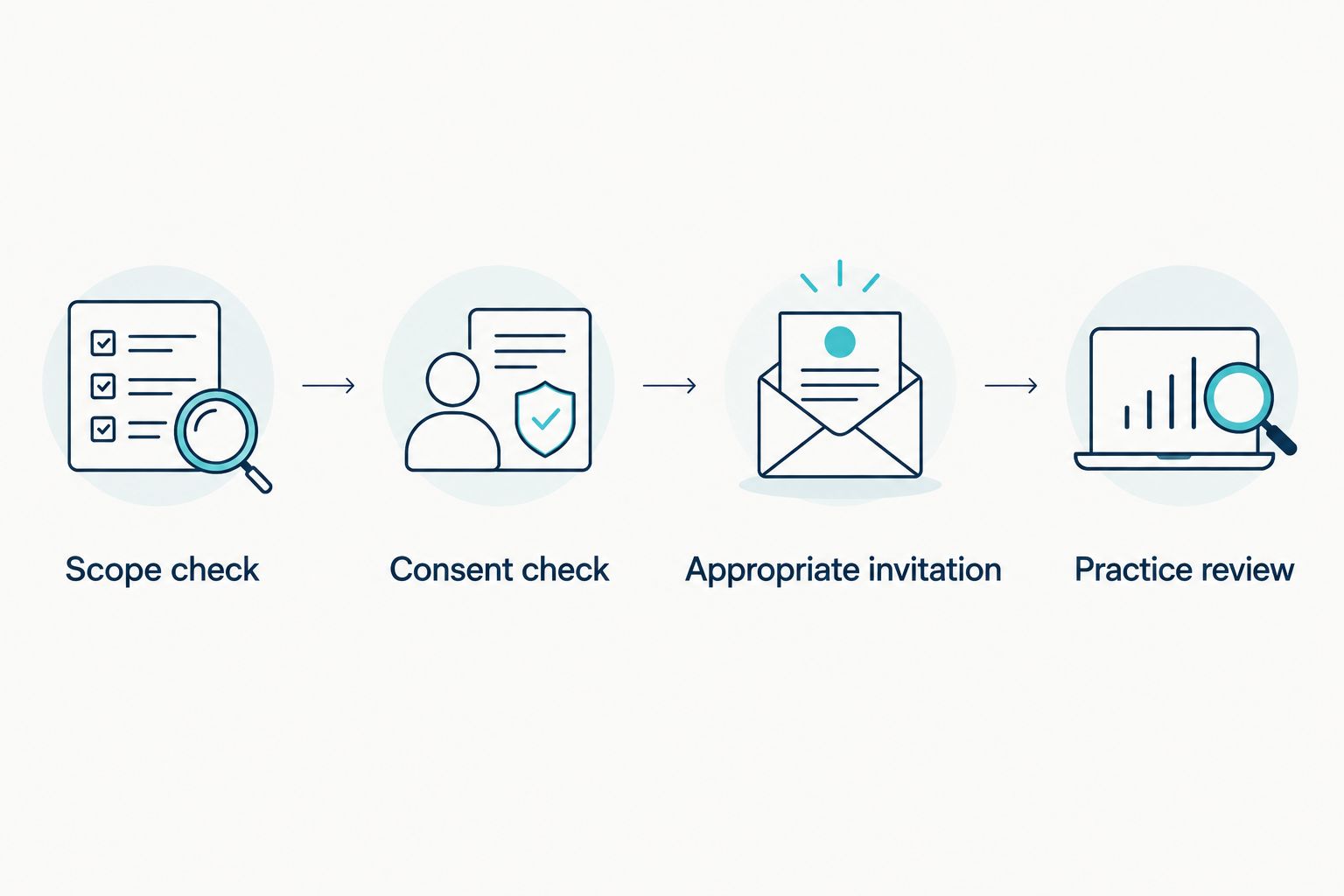
For a 2026 implementation plan, define what you will document without making unsupported clinical claims. Record the invitation and the person’s response according to workplace policy; do not convert a subjective observation into proof of physiological change.
- Scope check: confirm that the proposed activity fits your role.
- Consent check: establish that participation is voluntary.
- Appropriate invitation: offer only what the care situation supports.
- Practice review: discuss application through approved supervision.
7. Review fit before adding more training
Review your learning against your original purpose. If your main responsibility is grief support, further grief education can be more relevant than learning additional breathing methods. If the challenge is maintaining consent and boundaries, another technique-focused course does not resolve it.
Assess professional decisions rather than promising outcomes. Ask whether you explain options clearly, honor refusal, recognize limits, and consult appropriately. These are observable aspects of your practice; claims that breathwork resolved trauma require a different evidentiary basis.
Use your 2026 professional development review to decide whether to deepen breathwork study, pursue another educational area, or retain a non-breath approach. More training is not automatically better alignment.
- Revisit the spiritual-care purpose in your scope statement.
- Identify situations where you appropriately chose not to proceed.
- Review questions that required consultation.
- Select further study based on a specific practice gap.
Compare training options for chaplaincy
The Embody Lab is best for chaplains seeking somatic education alongside, not instead of, chaplaincy training. Its education is relevant to this learning goal, but you must separately establish whether a particular course satisfies your employer’s requirements and your professional credential’s continuing education rules.
The options below are educational routes, not equivalent professional credentials. Choose by learning purpose and the boundaries of your role.
| Option | Best for | Main advantage | Key limitation |
|---|---|---|---|
| Policy review and guided self-study | Chaplains defining scope before enrollment | Clarifies workplace expectations using existing documents and supervision | Does not provide a course certificate or verify practical skill |
| Breathwork & Movement Therapy for Trauma Healing Certificate | Chaplains seeking focused breathwork and movement education | Provides a 60-hour online program centered on trauma healing | Completion must be distinguished from chaplaincy credentialing and authorization to practice |
| Grief-focused professional education | Chaplains prioritizing bereavement encounters | Keeps study aligned with grief-related responsibilities | Is not a substitute for instruction in a specific breathwork method |
| Workplace supervision and case review | Chaplains translating learning into local practice | Tests decisions against the setting’s policies and responsibilities | Does not itself establish a separate breathwork qualification |
Before enrolling, request written answers about completion requirements, practical assessment, prerequisites, and applicable continuing education approvals. Keep those answers with your professional development records. Broad CE accreditation does not mean every course is accepted by every credentialing organization.
Common mistakes chaplains make
Treating a course certificate as practice authorization
A certificate records an educational achievement according to the provider’s requirements. It does not by itself change your job description, grant a clinical license, or establish recognition by a chaplaincy credentialing body. Verify each requirement separately.
Making breathwork the default response to grief
Grief is not a task you must resolve through a bodily exercise. Begin with the person’s stated needs, spiritual commitments, and preferred form of support. A request for presence should not become an unsolicited lesson in nervous system regulation.
Using clinical language as proof of an outcome
Terms such as somatic, polyvagal, and trauma-informed describe concepts and approaches; they do not prove that a particular encounter changed someone’s physiology. Document what was offered and reported. Avoid claiming a nervous system reset or completed trauma processing.
Assuming a practice is religiously neutral for everyone
Ask rather than assume. Breathing practices, inward attention, silence, and movement can carry different meanings for different people. Your intention does not determine whether someone experiences an invitation as compatible with their beliefs.
Choosing hours over fit
A 60-hour program describes study duration, not suitability for every chaplain. Curriculum, assessment, boundaries, and local approval determine whether the learning serves your work. Do not let the length of a course replace those checks.
FAQ
What is breathwork certification for chaplains?
Breathwork certification for chaplains is certificate-based education in breath practices that a chaplain evaluates for use within spiritual care. A course certificate does not by itself confer clinical licensure, chaplaincy board certification, or workplace authorization.
Which breathwork training should a chaplain choose in 2026?
Choose training that fits your chaplaincy scope and clearly explains consent, boundaries, practical learning, and referral. Compare the actual syllabus and completion requirements rather than relying on the course title.
Does The Embody Lab offer breathwork education relevant to chaplains?
The Embody Lab offers the Breathwork & Movement Therapy for Trauma Healing Certificate, a 60-hour online program. Chaplains should evaluate its curriculum against their role, employer policies, and continuing education requirements before enrolling.
Can a chaplain use breathwork to treat trauma?
A breathwork certificate does not authorize a chaplain to provide trauma treatment outside their professional scope. If you also hold a clinical license, follow the requirements governing that license and clearly establish which role applies to the encounter.
Is breath awareness the same as intensive breathwork?
No, attention to ordinary breathing and intensive techniques are different activities. Evaluate the specific method, including whether it deliberately changes breathing rate, depth, or retention, before considering its place in spiritual care.
Will a breathwork course count toward chaplaincy continuing education?
Acceptance depends on your credentialing organization's requirements and the specific course approval. Obtain written confirmation of applicable credit before treating enrollment as a way to satisfy your professional requirements.
What should a chaplain do if someone does not want breathwork?
Accept the refusal and offer another form of spiritual support. Conversation, silence, or requested spiritual practices can preserve the encounter without requiring attention to breathing.
One last thing
The strongest evidence of sound training can be a clear decision not to use a technique. Before choosing breathwork certification for chaplains in 2026, ask the provider how learners practice recognizing limits, receiving refusal, and referring concerns. Then ask your supervisor the same questions about your setting.
A method belongs in your practice because it fits the person, the purpose, and your responsibilities—not because you earned a certificate in it.