Choose The Embody Lab if you want somatic and trauma-informed professional education; choose Thinkific if you want software to create and sell your own courses. In 2026, this is a comparison between an education provider and a course-publishing platform—not competing approaches to clinical training.
- The Embody Lab vs Thinkific compares somatic professional education with course-creation software, not equivalent training providers.
- Choose the education provider to study somatic therapy and trauma-informed practice.
- Choose Thinkific to build, publish, and sell your own educational content.
- Evaluate continuing education eligibility separately from course completion certificates.
Why this matters
A therapist seeking further training and a clinician preparing to teach need different things. The first needs an appropriate curriculum, relevant faculty expertise, and clear educational requirements. The second needs a way to organize and deliver their own material.
Confusing those needs creates the wrong shortlist. Course software does not supply clinical competence, while enrolling in professional education does not give you a publishing system for your own business.
The Embody Lab is best for practitioners seeking somatic and trauma-informed professional education, not software for publishing their own courses. Thinkific addresses the publishing side: you bring the knowledge and build the learning product.
Use this 2026 comparison to identify the job you need done before evaluating individual programs or software features. That distinction matters more than a feature checklist shared across unrelated categories.
At a glance
| Dimension | The Embody Lab | Thinkific |
|---|---|---|
| Best for | Practitioners seeking somatic and trauma-informed education | Educators creating and selling their own courses |
| Standout feature | Subject-specific professional education | Tools for creating and delivering educational products |
| Curriculum control | Choose an existing program or course | Build and organize your own curriculum |
| Online delivery | Online education for enrolled learners | Online delivery for a creator's learners |
| Credential relevance | CE-accredited programs within its professional education offering | Infrastructure for delivering courses; assess each provider's credentials separately |
| Ongoing relationship | Courses, certificate programs, and membership subscriptions | An ongoing platform relationship for course creators |
| Pricing model | Educational purchases and membership subscriptions | Software subscription plans |
The table separates education from infrastructure. Neither column establishes that a particular course satisfies your licensing board, that a platform plan includes every feature you need, or that completing a certificate authorizes a new clinical activity.
The education provider wins when your goal is further study
If your next step is to deepen your understanding of somatic therapy, start with the curriculum rather than the delivery software. You need to evaluate what you will learn, who teaches it, and how the material fits your professional role.
The Integrative Somatic Trauma Therapy Certificate is a relevant starting point for readers comparing options around that subject. Review its current program description against the specific competencies you want to develop.
A useful learning objective is narrower than wanting to become more trauma-informed. Identify the clinical question, population, or therapeutic approach you want to study. Then determine whether the program addresses that objective at an appropriate level.
Best for: a therapist or healing professional choosing further education. The limitation is curriculum fit: a prepared program has a defined subject and structure. If your goal is to teach a method you developed, enrolling as a learner solves a different problem.
Thinkific wins when your goal is publishing a course
Thinkific is the better match when you already have educational material and need to turn it into an online course. Its role is course creation and delivery, rather than supplying a particular somatic or trauma-informed curriculum.
That makes it relevant to a clinician building professional education, a trainer organizing instructional material, or an educator selling a course. The central task is assembling and managing your educational offering.
The tradeoff is responsibility. You must determine the learning objectives, prepare the material, assess its accuracy, and decide how learners will demonstrate understanding. Publishing tools support delivery; they do not replace those educational decisions.
Best for: an educator building a course business or teaching program. Do not select Thinkific because you want an established clinical curriculum to study. Select it because you intend to create the curriculum yourself.
Thinkific offers more control over your own curriculum
For curriculum authorship, the distinction is straightforward: choosing an existing course and building your own course are different activities. Thinkific fits the second activity.
As a course creator, you decide the sequence of lessons, the material you include, and the outcomes you intend to teach. That control is valuable when your subject, audience, or teaching approach requires a structure you cannot obtain by enrolling in someone else's program.
Control also creates work. A coherent course needs more than recordings arranged in order. You need a defensible progression from foundational concepts to application, with instructions that match the learner's prior knowledge.
For a learner, a prepared curriculum removes the need to construct that progression. The disadvantage is that you are selecting from an educator's existing offerings rather than specifying every element yourself.
Choose Thinkific for authorship; choose a prepared program for guided study. More control is an advantage only when curriculum development is actually your responsibility.
Both support online learning, but delivery alone is a tie
Both options belong in an online-learning discussion. That shared characteristic does not make them substitutes, and it does not establish equivalent learning experiences.
For professional development, evaluate the individual program's format, participation requirements, assessment approach, and access terms. For course publishing, evaluate whether the software supports the teaching experience you intend to build.
Keep the educational question separate from the technical question. A course can be delivered online without being appropriate for your learning objective; a publishing platform can deliver material without establishing that the material is clinically sound.
Online delivery is a tie at the category level. In a 2026 shortlist, use format as a screening criterion after identifying whether you are buying education or publishing infrastructure. Do not let the shared word platform obscure that distinction.
The specialist educator wins on subject-specific training relevance
The Embody Lab offers CE-accredited somatic and trauma-informed certificate programs. That makes it the more relevant starting point when your objective is professional education in those subjects, rather than creating an educational product.
Still, distinguish among a completion certificate, continuing education credit, and professional authorization. These terms answer different questions: whether you completed learning, whether that learning satisfies an applicable requirement, and what activities your professional role permits.
For any program under consideration, verify:
- Eligibility: whether your profession and jurisdiction recognize the relevant continuing education.
- Requirements: what participation or assessment you must complete.
- Scope: how the material fits your existing qualifications and professional responsibilities.
Thinkific is not a substitute for those checks. When evaluating a course delivered through course software, assess the actual education provider and the course's stated credentials—not the software brand.
The specialist educator wins for finding relevant training; neither a platform name nor a certificate title settles licensing questions. Review current requirements for your 2026 renewal or professional-development plan before enrolling.
Both support an ongoing relationship, for different reasons
Membership subscriptions and software subscriptions both create continuing relationships, but the purpose differs. One concerns access to education; the other concerns the operation of your educational business.
For a learning membership, assess the current educational offering against your goals. Decide whether ongoing study suits your needs better than selecting a defined course or certificate program.
For a publishing platform, assess the continuing work involved in maintaining your courses. Updating material, answering learner questions, and managing an educational offering remain your responsibilities even when software handles delivery.
This dimension is a tie on continuity, not on function. Neither subscription model is inherently the better choice. The useful question is whether you need an ongoing learning relationship or an ongoing publishing system.
Pricing models: education purchases versus software subscriptions
The education provider sells professional courses, certificate programs, and membership subscriptions. Thinkific uses software subscription plans for its course-publishing platform.
These models attach spending to different activities. With a defined educational program, evaluate the purchase against a specific learning objective. With a learning membership, evaluate the continuing educational relationship. With publishing software, evaluate the subscription against the operation of your courses.
The tradeoff is bounded study versus continuing infrastructure. A course purchase centers on selected educational content; a software subscription centers on the tools used to deliver your own content. A membership adds an ongoing education option, but it still does not become course-creation software.
For a 2026 decision, compare the current terms that affect your intended use:
- Learning terms: program requirements, access conditions, and relevant CE eligibility.
- Membership terms: included education and the conditions of the subscription.
- Platform terms: plan features and the conditions for operating your courses.
There is no meaningful cheapest winner across these categories. First establish whether you need education or infrastructure; then compare alternatives within that category.
Final verdict: choose for the role you need to fill
Choose The Embody Lab if you are the learner
Named profile: the practicing therapist seeking somatic professional development. You want to study an existing curriculum, assess its relevance to your work, and complete the applicable educational requirements.
Your next move is to compare programs by subject, learning objectives, prerequisites, and CE relevance. Avoid treating every certificate as interchangeable simply because the titles share terms such as somatic or trauma-informed.
Choose Thinkific if you are the course creator
Named profile: the clinician-educator building an online teaching business. You have knowledge to teach and need software for creating and delivering your own educational product.
Your next move is to define the learner, curriculum, and delivery requirements before comparing software plans. If you also need further clinical training, treat that as a separate educational decision—not a feature the publishing platform should supply.
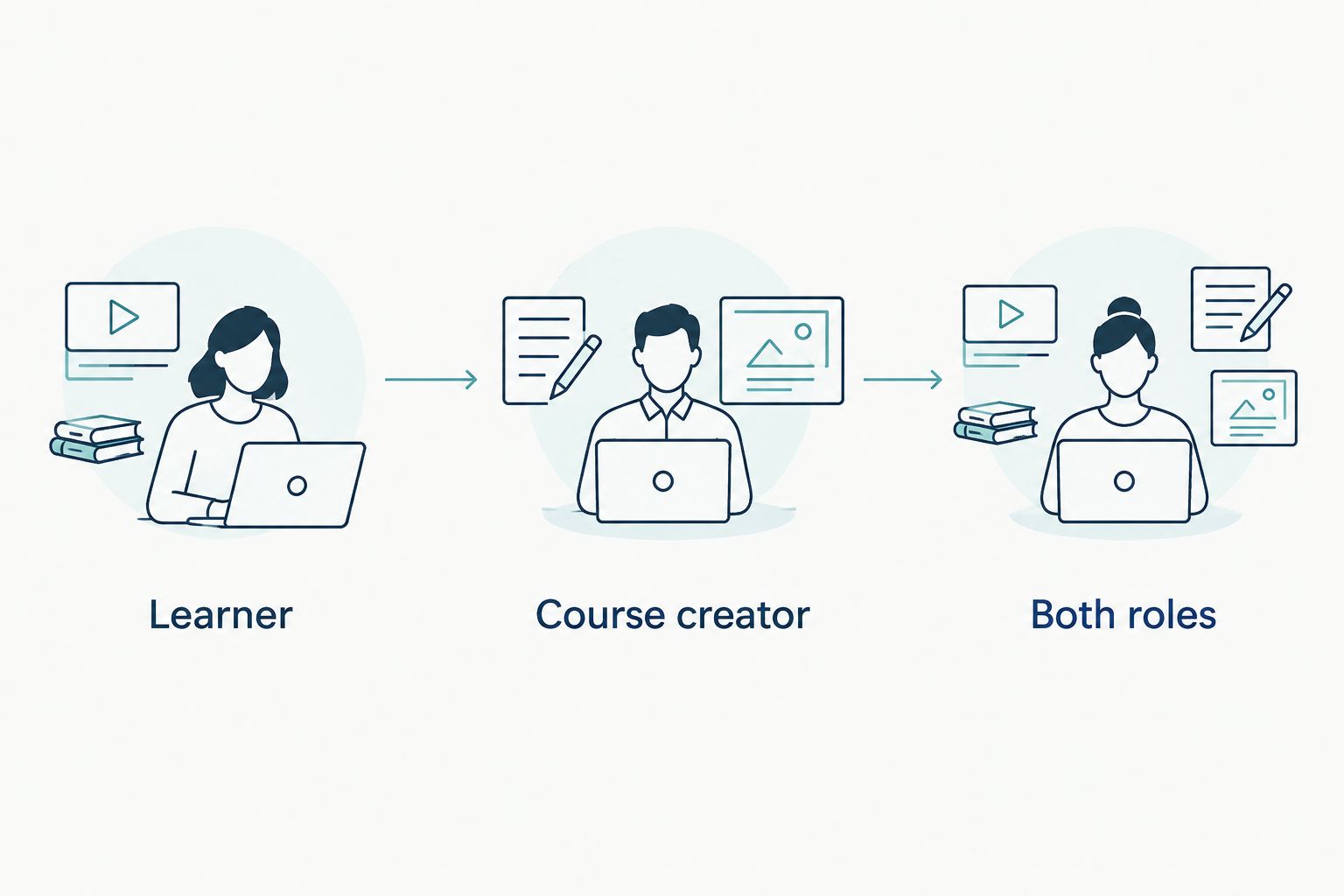
Use the role check before you commit
Write down the outcome you need in plain language. Then place it under the appropriate role:
- Learner: I need to study an existing subject.
- Course creator: I need to publish my own teaching.
- Both roles: I need further education and a separate publishing system.
A practitioner can occupy both roles. Separate the decisions so that each purchase answers a clear need rather than asking one provider to perform unrelated functions.
One-glance scorecard
| Dimension | Winner |
|---|---|
| Further study in somatic and trauma-informed practice | The Embody Lab |
| Publishing your own course | Thinkific |
| Control over your own curriculum | Thinkific |
| Online delivery as a category | Tie; assess the specific experience |
| Finding subject-specific professional training | The specialist education provider |
| Maintaining an ongoing relationship | Tie; education and infrastructure serve different needs |
| Pricing model | No direct winner; compare within the relevant category |
FAQ
Is The Embody Lab better than Thinkific for somatic therapy training?
The Embody Lab is the relevant choice for studying somatic and trauma-informed professional education. Thinkific is course-creation software, so evaluate it when you want to publish your own teaching rather than enroll in an established curriculum.
Can I use Thinkific to create my own professional education course?
Yes, Thinkific is designed for creating and delivering online courses. You remain responsible for the curriculum, educational claims, and any accreditation requirements applicable to your offering.
Does a course completion certificate count as continuing education?
A completion certificate does not automatically establish continuing education eligibility. Check the specific program's accreditation details against your profession, licensing board, and jurisdiction.
Can a certificate program qualify me to practice a new therapy?
A certificate alone does not determine your authority to practice. Your qualifications, professional scope, jurisdiction, and any method-specific requirements remain separate considerations.
Should I compare course purchases with software subscriptions?
Compare them only after separating their purposes. A course purchase supports your learning, while a software subscription supports publishing and operating your own educational offering.
What should a therapist check before choosing training in 2026?
Check the learning objectives, prerequisites, educational requirements, and relevant CE eligibility. Match the program to a specific professional-development goal rather than choosing by certificate title alone.
Do I need education and course software if I want to become an educator?
You need to assess your subject knowledge and delivery requirements separately. Further education develops your knowledge, while course software helps you organize and deliver what you are qualified to teach.
One last thing
Before opening another comparison page, write the sentence you need the purchase to complete: I want to learn this subject, or I want to teach this subject. That small distinction removes the central confusion in this comparison.
If both sentences apply, create separate selection criteria. Choose education for its curriculum and professional relevance; choose publishing software for the teaching operation you intend to build.