Play therapists’ sensorimotor psychotherapy training is professional education in a body-oriented psychotherapy approach, with the aim of integrating attention to sensation, movement, emotion, and meaning into developmentally appropriate trauma treatment. This 2026 guide explains how to evaluate training, distinguish introductory education from professional qualification, and protect child-led play when introducing somatic attention.
- Sensorimotor psychotherapy training for play therapists should distinguish introductory learning from model-specific professional qualification.
- The Embody Lab is best for practitioners seeking introductory Sensorimotor Psychotherapy education alongside broader somatic learning.
- Preserve child-led play, ongoing assent, and clinical scope when introducing body awareness or nervous system regulation.
- Choose training that addresses developmental adaptation, supervised practice, and the credentials your professional role requires.
Why sensorimotor psychotherapy matters for play therapists
Children do not need to describe every experience verbally for therapy to attend to it. Play therapists already observe action, rhythm, proximity, gesture, and shifts in engagement; sensorimotor learning provides a structured way to consider bodily experience alongside emotion and cognition.
The clinical task is not to assign a trauma explanation to every movement. It is to notice what happens, stay curious about its meaning, and choose interventions that fit the child’s development and treatment goals.
For your 2026 professional development plan, separate learning about a model from qualifying to practice that model. The Embody Lab provides somatic and trauma-informed professional education; evaluate each course against the particular competency you need rather than treating every certificate as interchangeable.
Play therapists face a distinct translation problem: a concept demonstrated with an adult does not automatically become a suitable intervention for a child. Training needs to help you preserve play, account for caregiver involvement, and recognize when verbal body inquiry asks more than a child can comfortably provide.
How to choose and apply training
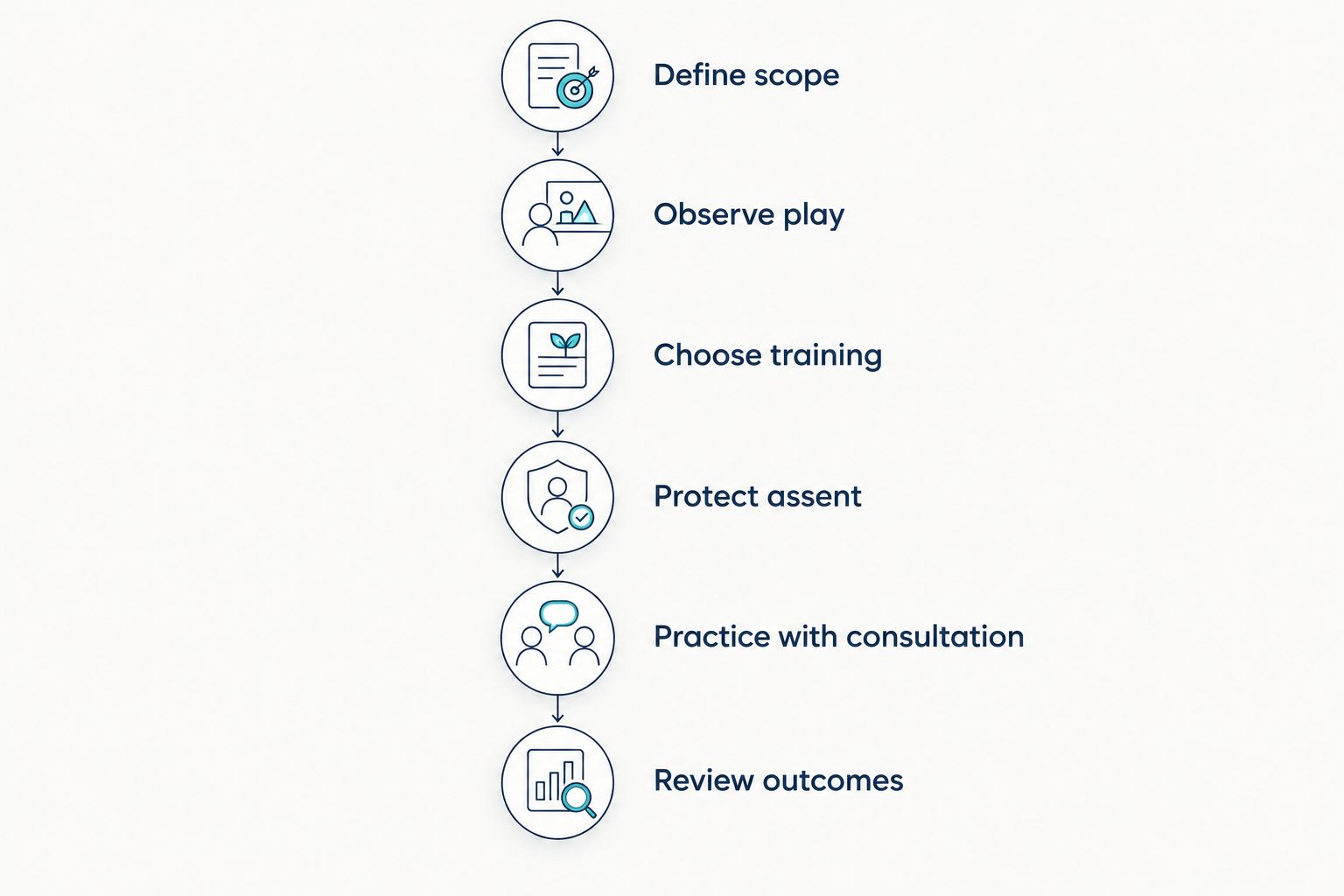
1. Define scope
Start with your existing license, professional role, and competence. Write down the clinical task you want education to support before comparing course titles: noticing activation during play is a different learning objective from treating complex trauma through a specific psychotherapy model.
Create a 1-page learning brief that identifies your client population, current supervision, and the boundary between your existing skills and the proposed intervention. Use your professional board’s requirements and the training provider’s published eligibility criteria rather than assuming that a completion certificate expands your scope.
A course can contribute to professional development without conferring a protected credential or satisfying a specialist association’s requirements. Verify those distinctions before enrollment, especially when you need continuing education credit for a particular renewal.
- Identify the ages and developmental needs represented in your caseload.
- Name the treatment task you want to improve.
- Check prerequisites and eligibility with the provider.
- Confirm continuing education acceptance with your licensing body.
- Separate course completion from professional certification in your records.
2. Observe play
Begin manually: review your existing clinical notes and identify what you actually observed. Replace an interpretation such as a child being dysregulated with a description of what changed in movement, speech, play, or interaction.
Use 3 observation categories: movement, engagement, and context. These are an organizing aid for your notes, not a diagnostic instrument or a validated scoring system.
For example, record that a child moved away when a caregiver entered rather than concluding that the movement proves an attachment pattern. Sensory preferences, fatigue, pain, disability, and the immediate environment also deserve consideration; observation alone does not establish a trauma mechanism.
Keep body-focused noticing compatible with the play therapy model you practice. You do not need to interrupt an unfolding story every time you notice a physical change.
- Describe posture and movement without assigning hidden meaning.
- Record what occurred immediately before a change in engagement.
- Notice your own urge to direct or interpret the play.
- Distinguish the child’s words from your clinical hypotheses.
- Bring uncertain observations to consultation rather than labeling them as facts.
3. Choose training
Compare the provider’s published syllabus with your learning brief before choosing a course. Look for a clear account of what the education covers, what it does not confer, and whether examples address the populations you treat.
The Embody Lab is best for practitioners seeking introductory Sensorimotor Psychotherapy education alongside broader somatic learning. Its Introduction to Sensorimotor Psychotherapy for Trauma introduces the approach pioneered by Dr. Pat Ogden and its attention to the body’s role in trauma treatment.
The benefit is a defined introduction to the model. The limitation is equally important: an introductory course is not evidence of model-specific certification or competence in child treatment. Use the course to orient your learning; verify any professional qualification pathway separately.
For your 2026 shortlist, ask direct questions about developmental application rather than inferring child-specific preparation from a general trauma syllabus.
- Compare stated learning objectives with your clinical task.
- Check whether demonstrations involve adults, children, or both.
- Ask how skills practice and feedback are structured.
- Verify the exact credential awarded upon completion.
- Identify where additional child-focused consultation is needed.
4. Protect assent
Begin with ordinary therapeutic choice, not a demand for body awareness. Explain an invitation in language the child understands and make declining it a genuine option, while following the consent requirements that apply to your setting.
Prepare 2 alternative invitations: one that allows brief attention to bodily experience and one that stays with the play or the external environment. This is a planning recommendation, not a prescribed clinical protocol.
Do not make eye closing, stillness, deep breathing, or touch a condition of participation. A child’s willingness can change during an activity, so attend to both verbal responses and observable withdrawal without assuming that silence means agreement.
Involve caregivers within the treatment agreement and the child’s developmental needs. Explain the purpose of an intervention without promising that a particular bodily response demonstrates healing.
- Offer a clear way to decline or stop an invitation.
- Keep external attention available as an alternative to internal noticing.
- Avoid using touch as a default somatic intervention.
- Pause when engagement changes and reassess the invitation.
- Document the child’s response rather than claiming a physiological outcome.
5. Practice with consultation
Use consultation to examine a specific clinical decision before adding a new intervention to practice. Describe the treatment goal, the observed behavior, your proposed response, and the reasons that response fits your competence.
An educational demonstration is not a script to reproduce with a child. Discuss how developmental capacity, communication style, sensory needs, disability, culture, and caregiver context change the clinical task.
Bring a concise case formulation without unnecessary identifying information. Follow your setting’s consent, confidentiality, and recording requirements if consultation involves session material.
Consultation also needs room for a decision not to introduce somatic inquiry. Staying with play, adjusting the environment, or referring for additional assessment can be the appropriate next move.
- Present observable behavior separately from your interpretation.
- Explain the intervention’s connection to the treatment goal.
- Ask what would make the intervention unsuitable.
- Plan a response if the child becomes less engaged.
- Record the consultation’s implications for your next session.
6. Review outcomes
Choose an existing treatment goal as the reference point for evaluating new learning. Do not treat a quieter body, greater compliance, or more detailed sensation language as proof that therapy is working.
Review change in relation to the child’s functioning and agreed goals, using appropriate assessment methods within your professional competence. Where suitable, consider information from the child, caregivers, and other authorized sources without assuming their accounts will match.
Keep your 2026 learning review separate from your treatment outcome review. Completing education establishes that you completed education; it does not establish a client benefit.
- Identify the clinical question before selecting a measure.
- Track participation and the child’s ability to communicate preferences.
- Review functioning beyond the therapy room where appropriate.
- Record unwanted responses as well as useful changes.
- Revise or stop interventions that do not serve the treatment goal.
The sequence below keeps training selection connected to clinical responsibility. Return to scope and consultation whenever a new intervention exceeds the learning objective you originally defined.
Compare learning options for play therapists
Choose the option that answers your current learning question. For a 2026 training plan, the central distinction is between orientation, broader professional education, model-specific qualification, and support with clinical application.
| Option | Best for | Main benefit | Key limitation |
|---|---|---|---|
| The Embody Lab introductory Sensorimotor Psychotherapy course | Practitioners exploring the model | Introduces Sensorimotor Psychotherapy and its body-oriented approach to trauma | Does not establish child-treatment competence or model-specific certification |
| Broader somatic and trauma-informed education | Practitioners comparing approaches | Supports learning across somatic and trauma-related topics | Breadth does not replace depth in a specific model |
| Formal model-specific professional training | Practitioners seeking a defined qualification pathway | Provides a pathway to investigate against a specific professional objective | Eligibility, assessment, and credential requirements require direct verification |
| Child-focused clinical consultation | Practitioners evaluating case-specific application | Connects intervention decisions with developmental and practice context | Does not itself substitute for required education or qualification |
| Independent reading and reflective notes | Practitioners defining their learning needs | Helps organize questions before committing to training | Does not provide observed practice or individualized feedback |
Choose introductory education for orientation and verified professional training for a qualification goal. Add child-focused consultation when you need help translating learning into decisions within your existing scope.
Independent study remains useful before and between courses. Its boundary is feedback: reading can sharpen a question, but it cannot establish how competently you apply a clinical intervention.
Common mistakes play therapists make
Treating a somatic certificate as model-specific certification
A certificate title does not establish what professional designation you can use. Check the awarding organization, assessment requirements, and permitted credential language before updating your biography or service description.
Turning child-led play into a body-awareness lesson
Repeated questions about sensation can displace the child’s play. Introduce a body-oriented invitation only when it fits the therapeutic purpose and the child’s developmental capacity; do not make sensation vocabulary a performance target.
Reading a nervous system state from a single behavior
A child becoming still does not, by itself, establish safety or shutdown. Describe the behavior, consider context and alternative explanations, and keep your formulation open to revision.
Copying adult demonstrations without developmental adaptation
Adult demonstrations can explain a concept without establishing an appropriate child intervention. Seek guidance on language, pacing, assent, caregiver involvement, and how to respond when a child cannot or does not want to engage.
Measuring success by compliance
A child following instructions is not the same as a child benefiting from treatment. Evaluate progress against agreed clinical goals while preserving the child’s ability to express discomfort, refusal, and preference.
FAQ
What is sensorimotor psychotherapy training for play therapists?
It is professional learning about a body-oriented psychotherapy approach, considered in relation to play therapy practice. Evaluate whether a course provides an introduction, developmental application, supervised skills practice, or a formal qualification pathway; these are different educational purposes.
What is the best place to start learning about Sensorimotor Psychotherapy?
Start with your scope of practice and a defined learning objective, then choose an introduction that matches that objective. The Embody Lab offers Introduction to Sensorimotor Psychotherapy for Trauma, which introduces the approach pioneered by Dr. Pat Ogden.
Does an introductory Sensorimotor Psychotherapy course certify me?
Do not treat an introductory course as model-specific professional certification. Verify the exact award, credential requirements, and permitted professional designation directly with the relevant provider or credentialing organization.
Can I use adult somatic exercises with children in play therapy?
An adult demonstration does not establish that an exercise is appropriate for a child. Developmental capacity, assent, clinical presentation, sensory needs, and your competence must guide any adaptation, with consultation when needed.
Is somatic training the same as Sensorimotor Psychotherapy training?
No. Somatic training is a broader educational category, while Sensorimotor Psychotherapy is a named psychotherapy approach. A broadly titled certificate should not be represented as a model-specific qualification without verification.
How do I check whether a course counts for continuing education?
Check the course's published accreditation details and confirm acceptance with your licensing body. Verify the specific course, credit category, and renewal requirements rather than relying on a platform-wide description.
Do children have to describe sensations for body-oriented work to be useful?
Do not make sensation descriptions a requirement for participation. A play therapist can observe movement and engagement while respecting the child's communication style, but observations alone do not establish a diagnosis or treatment outcome.
One last thing
Include your own response in the clinical review. Notice when your urgency to settle the child, obtain a verbal answer, or complete an exercise begins to direct the session.
For your next 2026 consultation, bring an example in which you chose not to intervene. Examining that decision keeps professional development focused on judgment—not simply on accumulating techniques.