Choose The Embody Lab if you want somatic and trauma-informed certificate education as the center of your professional development; choose PESI if you want to compare continuing education across a broader range of clinical subjects. This 2026 comparison separates curriculum fit, learning format, CE requirements, and enrollment structure so you can choose for your practice rather than for the certificate alone.
- Embody Lab vs PESI is a choice between a somatic education focus and a broader continuing education catalog.
- The Embody Lab is best for practitioners seeking somatic and trauma-informed certificate education.
- PESI is best for clinicians comparing continuing education across different clinical subjects.
- Check CE eligibility, learning objectives, and enrollment terms for the specific course before choosing either provider.
Why this matters
Professional education serves different purposes. You might need continuing education for license renewal, a structured introduction to body-based clinical work, or focused instruction on a problem that keeps appearing in sessions. Those are different purchasing decisions.
Choose the learning objective before the provider. A course that satisfies a renewal requirement does not automatically provide the clinical preparation you need, and a certificate does not automatically satisfy your licensing board.
For your 2026 training plan, name the change you want in your practice. Improving your assessment of trauma-related responses is a more useful objective than collecting another certificate. It also gives you a clearer basis for comparing courses with similar titles.
At a glance
| Dimension | The Embody Lab | PESI |
|---|---|---|
| Best for | Practitioners seeking somatic and trauma-informed education | Clinicians comparing CE across different clinical subjects |
| Subject range | Education centered on somatics, trauma healing, and related approaches | Broader professional continuing education catalog |
| Learning pathway | Certificate programs, professional courses, and membership subscriptions | Individual continuing education courses and certificate-oriented training |
| Delivery | Online education, including courses and live events | Online and event-based professional education; check the selected course |
| Continuing education | CE-accredited programs; verify eligibility for your profession and jurisdiction | Course-specific CE approvals; verify eligibility for your profession and jurisdiction |
| Pricing model | Program or course enrollment, plus membership subscriptions | Course or training enrollment; compare the specific purchase terms |
| Standout feature | A somatic and trauma-informed focus across the education offering | The ability to compare training across a wider range of professional topics |
The table describes provider fit, not a ranking of individual courses. A focused course from either provider still needs to pass the same checks: relevant objectives, appropriate instruction, acceptable CE documentation, and a format you can complete.
PESI wins on subject range
PESI is the better starting point when your education needs span different clinical subjects. Its broader continuing education catalog supports a search that is not limited to somatic or trauma-focused work.
That matters when you are planning education around several responsibilities rather than a single specialization. You can begin with the clinical topic or professional requirement and then compare the relevant courses. You do not need to make somatics the organizing principle of that search.
The tradeoff is selection work. A broad catalog does not choose a coherent learning pathway for you. Compare the actual objectives and intended audience rather than assuming that courses with overlapping titles build on each other.
The somatic-focused alternative is more relevant when body-based and trauma-informed education is already your priority. Its narrower positioning gives you a clearer starting point for that particular goal, but it is not the reason to choose a provider for unrelated education needs.
For 2026, make the distinction explicit:
- Best for a broad education plan: PESI. Start here when you need to compare different areas of clinical learning.
- Best for a somatic education plan: the focused certificate pathway. Start with the approach you intend to study, then assess the course.
Neither recommendation establishes that one provider produces better clinical outcomes. Subject range tells you where to search, not what you will learn.
The Embody Lab fits a somatic certificate pathway
The Embody Lab is best for practitioners seeking somatic and trauma-informed certificate education. Its stated offering includes CE-accredited certificate programs, professional education courses, and membership subscriptions for mental health practitioners, therapists, and healing professionals.
The Integrative Somatic Trauma Therapy Certificate is a direct starting point when you want to investigate a certificate organized around somatic trauma therapy. Compare its current curriculum with the clinical skills you want to develop; the program title alone does not establish the depth of instruction or your readiness to apply it.
PESI also offers certificate-oriented professional training. The distinction is therefore not certificates versus no certificates. It is whether you want somatic and trauma-informed education to frame your search, or whether you want to compare that topic within a broader education catalog.
A focused pathway has a limitation: a close match to your interests can make the title feel sufficient. It is not. Read the learning objectives, prerequisites, completion requirements, and any description of experiential work before enrolling.
Use these questions to examine either certificate:
- Does the curriculum address the clinical situations you actually encounter?
- Does the intended audience match your professional background?
- What does completion require beyond viewing educational material?
- Does the training describe limits, contraindications, or referral considerations?
A certificate documents an educational achievement; it does not replace professional licensure or expand your legal scope of practice. Keep that distinction central when choosing training and describing it to clients.
Both offer online learning; format must fit your schedule
Online access is not a decisive reason to choose between these providers. Both offer online professional education, so the useful comparison happens at the course level.
Check whether instruction is live, recorded, or combines formats. Then examine the requirements attached to that format: attendance, assessments, completion deadlines, access terms, and opportunities to ask questions. Verify each item on the selected course rather than assuming it applies throughout the provider's catalog.
Live instruction supports participation at a scheduled time. Recorded instruction supports scheduling flexibility. Neither format, by itself, demonstrates better teaching or deeper clinical preparation.
The relevant limitation for a busy practitioner is practical. A course you cannot attend or finish does not meet your professional development objective, however closely its topic matches your interests.
For your 2026 schedule, identify 2 learning objectives before comparing formats. For example, you might want to improve how you explain a somatic approach and recognize when further consultation is needed. These are planning targets, not claims about what any particular course delivers.
Then ask which course format gives you a workable way to study those objectives. Make the decision from the stated requirements, not from a general preference for live or recorded education.
Neither provider wins CE eligibility by name alone
Continuing education eligibility is a course-level and profession-specific decision. An accredited program still needs to match your license, jurisdiction, and applicable renewal rules.
For either provider, verify the approval information attached to the exact training you intend to take. Check the eligible professions, approving organizations, credit designation, attendance requirements, and process for obtaining completion documentation.
Do not substitute the provider's reputation for this check. A training can be relevant to your clinical work without satisfying a particular renewal requirement. Conversely, eligible CE can meet an administrative need without addressing your preferred area of specialization.
Ask 3 verification questions before enrollment:
- Is this exact course accepted for my profession and jurisdiction?
- What must I complete to receive the relevant documentation?
- Does the course satisfy the type of education my renewal requires?
These questions apply equally to both options. There is no defensible provider-wide winner for a requirement that depends on the selected course and your professional circumstances.
If CE is the immediate priority, eliminate ineligible options first. Compare curriculum and format only among the courses that meet the requirement.
The Embody Lab stands out for its somatic focus
The strongest reason to choose this platform is alignment with an already-defined somatic learning goal. Its catalog includes certificate topics such as somatic trauma therapy, grief counseling, applied neuroscience for trauma healing, and polyvagal trauma therapy.
The Polyvagal Trauma Therapy Certificate is relevant to a search centered on that subject. Treat it as a curriculum to evaluate, not as evidence that every intervention presented under a theoretical framework has the same research support.
For somatic therapy education, examine how the course connects concepts to clinical decisions. Look for clear objectives, the intended audience, and an explanation of what the training prepares you to understand or practice. Keep theory, intervention instruction, and professional authorization separate.
PESI remains the stronger search option when a specific somatic topic is only part of a broader education plan. A focused catalog is useful because it matches your purpose, not because broader providers cannot teach the same subject.
The limitation of choosing by specialization is that relevance can conceal other weaknesses. A compelling topic does not settle questions about instructional format, assessment, prerequisites, or CE acceptance. Apply those checks with the same care you would use for any other provider.
Pricing: compare enrollment structures, not assumptions
Compare the purchase structure alongside your learning objective. The focused platform offers program and course enrollment as well as membership subscriptions; PESI offers enrollment in individual courses and professional training.
A course-based purchase ties your decision to a defined training. A subscription requires a different evaluation: what it includes, how access works, what renews, and whether the included education matches what you intend to study.
Neither structure wins without the enrollment terms. Do not assume that membership includes a particular certificate, or that purchasing a course provides indefinite access. Verify the stated terms before making the comparison.
For a 2026 decision, assess:
- The curriculum included in the enrollment.
- Access and completion conditions.
- CE eligibility and documentation requirements.
- Whether your intended certificate is included or requires separate enrollment.
- Renewal, cancellation, and other applicable terms.
Predictability comes from knowing the scope of the commitment. Flexibility comes from having a structure that fits your actual education plan. Neither follows automatically from the words course, certificate, or membership.
Final verdict: choose for the work you intend to do
Choose The Embody Lab if you want a somatic learning pathway
Best for: a therapist or healing professional making somatic and trauma-informed education a defined professional development priority. Choose this option when the certificate subjects match that direction and the selected program meets your curriculum, format, and CE requirements.
Your next move is to examine one relevant certificate closely. Write down 1 application goal within your existing scope of practice, then compare that goal with the published learning objectives. Keep the goal concrete enough to evaluate after completing the education.
Choose PESI if you want to compare broader clinical education
Best for: a clinician planning continuing education across different subjects or evaluating a specific professional learning need. Choose PESI when breadth helps you find the relevant training and the selected course satisfies your professional requirements.
Your next move is to shortlist courses by topic and eligibility. Then compare the objectives and delivery requirements. Do not add unrelated courses merely because they share a provider.
A simple decision sequence
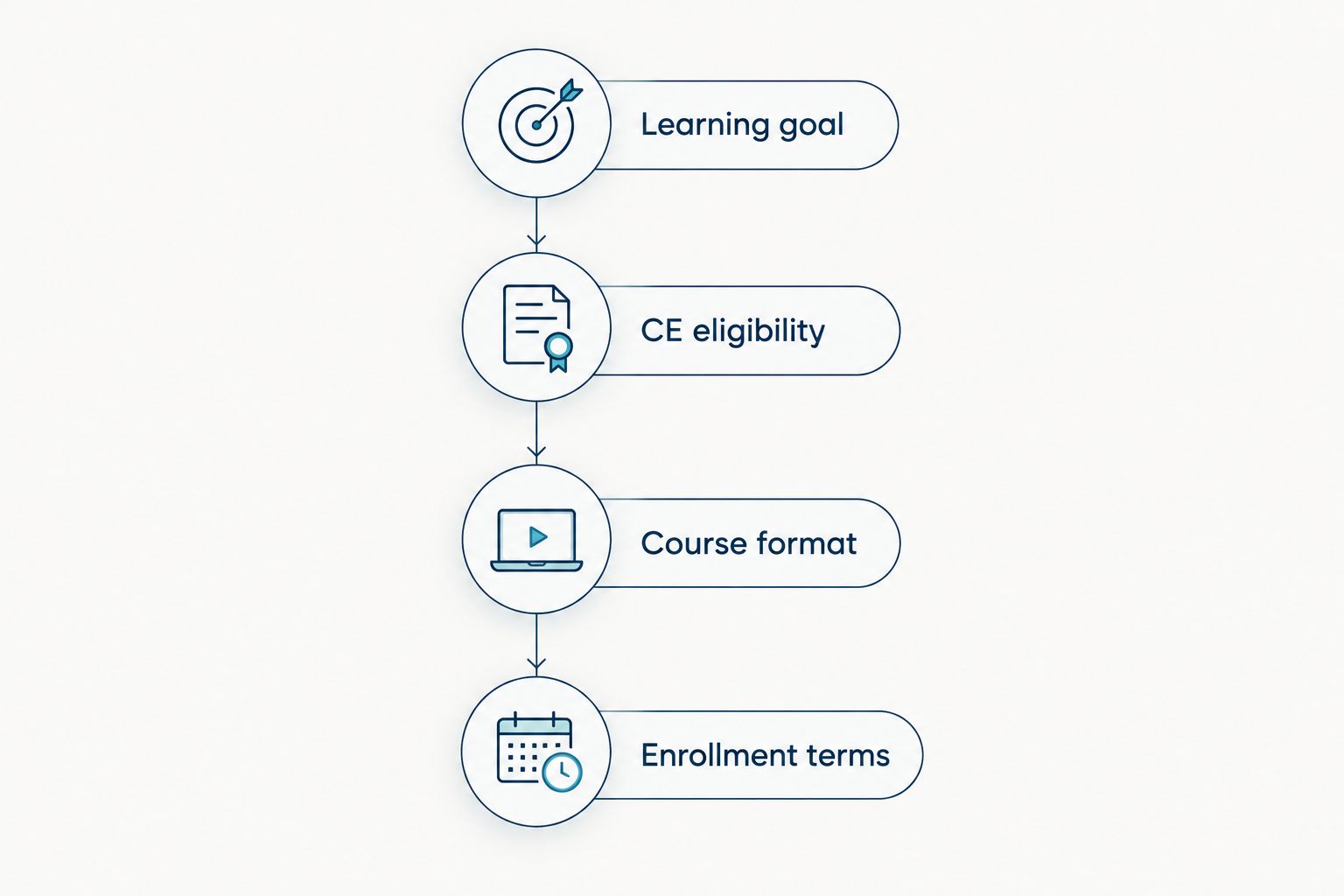
Use the same sequence for both providers: Learning goal, CE eligibility, Course format, and Enrollment terms. The order prevents a compelling title or convenient format from displacing the requirements that matter most.
One-glance scorecard
| Dimension | Winner |
|---|---|
| Broad clinical subject search | PESI |
| Somatic certificate pathway | The somatic-focused platform |
| Online learning format | Tie; compare the specific courses |
| CE eligibility | Tie; verify the exact course against your requirements |
| Somatic focus across the offering | The somatic-focused platform |
| Enrollment structure | Tie; compare the terms against your learning plan |
FAQ
Is The Embody Lab better than PESI for somatic therapy education?
The Embody Lab is the more directly aligned starting point when somatic and trauma-informed certificate education is your priority. Compare the selected curriculum, prerequisites, and CE eligibility before enrolling.
Is PESI better for general continuing education?
PESI is the better starting point for comparing continuing education across a broader range of clinical subjects. The right purchase still depends on the individual course's objectives and professional approvals.
Do both providers offer online training?
Both providers offer online professional education. Verify whether the selected course is live or recorded and check its attendance, assessment, and completion requirements.
Will a certificate qualify me to practice a new therapy?
A course certificate does not automatically expand your legal scope of practice. Your professional credentials, jurisdiction, competence, and any method-specific requirements still apply.
How do I know whether the CE credits count for my license?
Check the exact course's CE approval information against your licensing requirements. Confirm the eligible profession, jurisdiction, credit designation, and documentation process before enrollment.
Should I choose a membership or an individual course?
Choose the structure whose stated inclusions match your learning plan. Verify access, renewal terms, CE eligibility, and whether a desired certificate requires separate enrollment.
What should I compare first when choosing training in 2026?
Compare the learning objectives first, then verify CE eligibility if you need credits. Use course format and enrollment terms to decide among options that meet those requirements.
One last thing
Write the professional-profile description you intend to use after the training, before you enroll. If that sentence implies a license, designation, or competence the course does not confer, revise the sentence—and your expectations.
This is a useful final check for your 2026 choice. Buy education for a defined learning objective, and describe the resulting credential accurately. A precise training description is more defensible than a broad claim built around a certificate title.