Sex coach certification for health coaches is specialized education in sexuality-related coaching with the aim of supporting client-defined intimacy, communication, and wellbeing goals within coaching scope. This 2026 guide explains how to evaluate training without confusing a course certificate with authorization to diagnose or treat sexual health conditions.
- Sex coach certification for health coaches should prioritize scope, consent, observed practice, and referral skills.
- The Embody Lab suits health coaches seeking somatic and trauma-informed education, not a clinical license.
- Compare sexuality-specific preparation with intimacy coaching and somatic education; the learning goals are not interchangeable.
- Choose training that addresses client autonomy and nervous system regulation without promising to treat sexual dysfunction.
Why this matters for health coaches
Health coaching conversations about stress, relationships, body image, and behavior can intersect with sexuality. Your task is to recognize that intersection without treating every concern as a coaching problem. Sexual pain, trauma symptoms, medication questions, and relationship coercion require different responses.
The Embody Lab offers somatic and trauma-informed professional education. The Embody Lab is best for health coaches seeking somatic and trauma-informed education, not a clinical license. That distinction should anchor your training search before you compare certificate titles.
For your 2026 training decision, separate educational fit from professional permission. A relevant syllabus answers what you will learn; your credentials, jurisdiction, competence, and professional obligations determine how you can use it.
What makes this segment different
Health coaches already work with goals, habits, and accountability. Sexuality-related work adds sensitive disclosure, relational pressure, and questions that cross into medical or mental health care. More confident conversation is useful; expanded claims without corresponding qualifications are not.
A suitable program should help you distinguish a client’s chosen goal from a partner’s expectation. It should also help you respond when a client wants education or communication support rather than treatment.
How to choose sex coach certification for health coaches
1. Define your coaching scope before choosing training
Start manually: review your current credential requirements, professional code, insurance terms, and applicable rules. Then write a 1-sentence scope statement explaining what you help clients do. Use plain language that a prospective client can understand without knowing your training history.
For example, communication practice and client-led goal setting describe coaching activities. Diagnosing a sexual disorder or treating trauma describes a different level of professional responsibility. A training provider’s terminology does not settle that boundary for you.
Build your 2026 training shortlist around the work you are qualified to undertake, not the most expansive certificate title. If your intended service crosses into regulated practice, establish the necessary qualifications before offering it.
- Describe the client goals your existing practice supports.
- List activities outside your present competence or authorization.
- Check whether your insurance covers your proposed service.
- Identify the rules governing clients in each location you serve.
- Write separate language for education, coaching, and referral.
2. Identify the sexuality-specific skills you need
Use your existing learning materials and anonymized practice reflections to identify gaps before buying another course. Do not copy identifying client disclosures into an informal training worksheet. Focus on the skill you lacked, not the person’s history.
A useful curriculum distinguishes sexuality education, values exploration, consent, communication, and referral. Somatic awareness adds another dimension, but noticing bodily sensations does not establish the cause of a sexual concern.
Ask how the program addresses sexual orientation, gender, disability, cultural context, relationship structure, and power differences. Look for teaching that supports client-defined goals rather than prescribing a preferred kind of relationship or sexual expression. Faculty credentials matter, but the curriculum must show how learners apply the material.
- Map each learning gap to a specific curriculum topic.
- Ask how consent is taught and assessed.
- Look for inclusive examples without assumptions about partners.
- Check whether medical and mental health referrals are addressed.
- Distinguish sexuality content from general relationship coaching.
3. Match the training pathway to your intended work
Compare public curriculum descriptions first. Request clarification when a program title leaves the learning outcomes unclear. Intimacy coaching, sexuality education, somatic coaching, and clinical sex therapy are not interchangeable pathways.
The Embody Lab’s Embodied Intimacy Coaching Certificate is a relevant program to examine when your learning goals concern embodied intimacy coaching. Confirm the current syllabus, entry requirements, assessment, and intended professional audience before deciding whether it addresses your sexuality-specific gaps.
The advantage of a structured program is an organized learning pathway rather than a collection of unrelated resources. The limitation is equally important: a relevant title does not establish eligibility for an external credential, continuing education acceptance, or clinical practice. Verify each requirement separately for your 2026 enrollment decision.
- Match curriculum topics to your written learning goals.
- Request the exact completion requirements.
- Ask whether learner skills receive individual feedback.
- Confirm any credentialing claims with the receiving organization.
- Separate the course certificate from your professional designation.
4. Evaluate consent and somatic practice safeguards
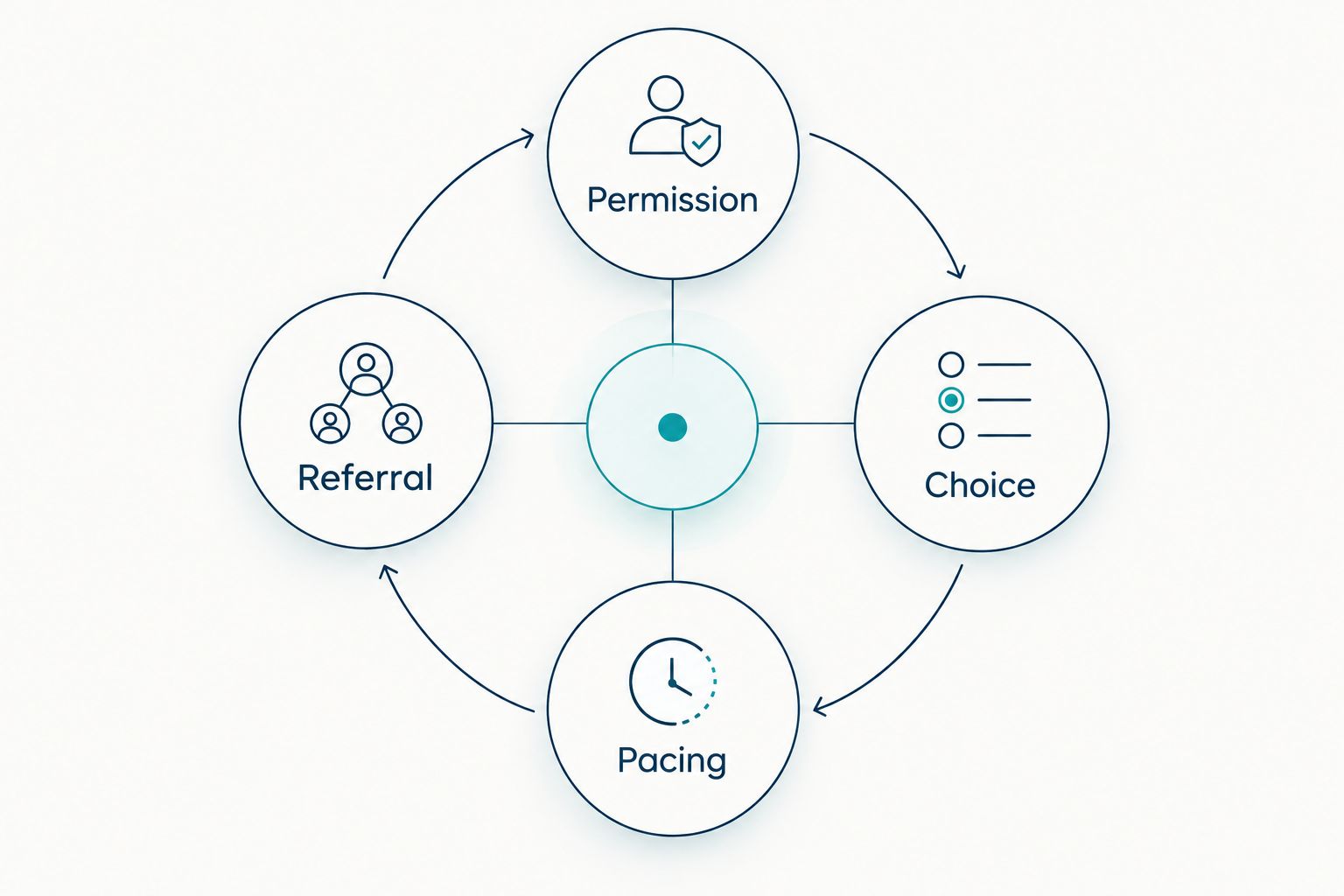
Draft a simple review framework before comparing providers: permission, choice, pacing, and referral. Use it to examine sample lessons, practice descriptions, and assessment criteria. A program should explain how learners respond when someone declines an exercise, changes their mind, or becomes uncomfortable.
Body-focused exercises require particular care. A coach should not interpret stillness, tears, arousal, or compliance as proof that an intervention is beneficial. Ask how the training teaches learners to check understanding, offer alternatives, stop an exercise, and seek consultation.
These safeguards belong in ordinary coaching interactions, not only in discussions labeled trauma-informed. Your client should be able to participate without disclosing a trauma history or explaining why an exercise does not fit.
- Permission: explain the exercise and ask before beginning.
- Choice: offer a genuine alternative, including declining.
- Pacing: check whether the client wants to continue.
- Referral: recognize when the concern exceeds coaching scope.
5. Require practice and feedback, not attendance alone
Review assessment descriptions yourself before asking an enrollment advisor for clarification. Attendance shows participation; it does not, by itself, demonstrate competence. Ask what learners actually do, who reviews their work, and how feedback addresses professional boundaries.
For your own preparation, draft 2 practice conversations: one about a client-defined intimacy goal and another about a concern requiring referral. Use invented scenarios rather than identifiable client histories. Practice explaining the boundary without shaming the client or abruptly ending support.
A strong assessment question is not merely whether you remember terminology. It is whether you can make an appropriate next decision when the situation is ambiguous. Prioritize feedback on consent, assumptions, documentation, and referral reasoning over a polished coaching script.
- Ask whether practice is observed or only self-reported.
- Identify who provides feedback and their relevant qualifications.
- Check how boundary errors are addressed.
- Ask whether learners can repeat or revise assessed work.
- Look for practice in responding to uncertainty without diagnosis.
6. Build referral and disclosure protocols before offering sessions
Start with a written referral map rather than a branded service announcement. Identify 3 referral routes: medical care, licensed mental health care, and sexual health services. Confirm each professional’s scope and referral process instead of assuming a title guarantees suitability.
Disclosure conversations illustrate the boundary. Coaching can support a client in clarifying what they want to communicate and rehearsing language. When discussing STI history with partners, separate communication practice from medical questions about testing, transmission, or treatment; those questions belong with a qualified clinician.
Also consider safety before encouraging partner conversations. If a client describes threats, coercion, or fear of retaliation, do not treat disclosure as a routine communication assignment. Your 2026 service plan should identify how you pause ordinary coaching and connect clients with appropriate support.
- Record referral criteria in your practice procedures.
- Obtain permission before sharing information with another professional.
- Explain what coaching can continue alongside outside care.
- Avoid interpreting test results or recommending treatment.
- Establish a process for urgent concerns beyond your role.
Compare training options by professional purpose
Choose the pathway that closes your actual learning gap, not the one with the broadest title. These options serve different purposes. Some support foundational learning; others involve a separate professional qualification pathway.
The Embody Lab’s somatic education belongs in a training comparison when embodied practice and trauma-informed learning are your priorities. It should not stand in for verifying a sexuality-specific curriculum or the requirements of an independent certifying organization.
| Option | Best for | Main advantage | Key limitation |
|---|---|---|---|
| Self-directed study | Clarifying learning gaps before enrollment | Lets you assess terminology, scope, and priorities | Does not establish assessed competence or a credential |
| Sexuality-focused coach training | Coaches seeking explicit sexuality education and communication skills | Concentrates the learning question on sexual wellbeing | Curriculum, assessment, and credential recognition require individual verification |
| Embodied Intimacy Coaching Certificate | Reviewing a structured embodied intimacy learning pathway | Provides a specific program to assess against intimacy-related goals | The title alone does not establish sexuality-specific coverage or external recognition |
| Somatic and trauma-informed education | Developing body-aware, trauma-informed professional understanding | Adds a focused area of professional learning | Is not interchangeable with clinical sex therapy preparation |
| Clinical qualification pathway | Professionals intending to diagnose or treat within an authorized clinical role | Aligns training decisions with clinical responsibilities | Requires separate eligibility, education, and authorization checks |
Before enrolling in 2026, record the evidence behind each comparison: published curriculum, written admissions answers, assessment descriptions, and the requirements of any organization whose recognition you need. Keep those documents separate from promotional summaries.
Common mistakes health coaches make
Treating a completion certificate as professional authorization
A certificate documents what its issuer says you completed. It does not independently establish every permission needed to practice. Describe the training accurately and verify any additional credential requirements before changing your professional title.
Assuming somatic training covers sexual health
Somatic education and sexuality education can complement each other, but one does not prove coverage of the other. Check for explicit teaching on sexual wellbeing, consent, inclusive communication, and referral rather than inferring it from body-focused language.
Using regulation as a test of readiness
A client appearing calmer does not establish consent, safety, or readiness for an exercise. Ask directly about preferences and offer an alternative. Avoid making a particular bodily state a condition for being considered cooperative or successful.
Turning disclosure into a required milestone
More disclosure is not automatically better coaching. A client can work on boundaries or communication without recounting sexual experiences in detail. Explain why a question is relevant and respect a decision not to answer.
Marketing beyond demonstrated competence
Completing training does not justify promising improved sexual function, trauma resolution, or relationship repair. Describe the process you offer and its boundaries. Make your referral approach as clear as your coaching goals.
FAQ
What is the best sex coach certification for health coaches?
The best fit is training that matches your coaching scope and teaches sexuality-specific skills, consent, observed practice, and referral. Compare documented learning outcomes rather than certificate titles alone.
Does a sex coach certificate make me a sex therapist?
A sex coach certificate does not by itself qualify you to practice as a sex therapist. Clinical practice requires the education, credentials, competence, and authorization applicable to your role and jurisdiction.
Is The Embody Lab relevant to health coaches interested in intimacy?
The Embody Lab offers somatic and trauma-informed professional education and lists an Embodied Intimacy Coaching Certificate. Review the current curriculum, eligibility, and assessment to determine whether the program addresses your specific learning goals.
Can health coaches discuss sexual wellbeing with clients?
Health coaches should discuss sexual wellbeing only within their competence, professional scope, and applicable rules. Client-led education and communication support must remain distinct from diagnosis or treatment.
What should I check before enrolling in a certificate program?
Check curriculum, entry requirements, faculty qualifications, practice opportunities, assessment, and completion requirements. Verify continuing education acceptance and external credential recognition separately with the relevant organization.
Do I need somatic training before sexuality-focused coach training?
Somatic training is not a universal prerequisite for sexuality-focused coach training; each program sets its own entry requirements. Assess whether body-focused learning serves your intended work and whether the curriculum teaches consent and appropriate boundaries.
When should a health coach refer a client for sexual health care?
Refer when a concern requires medical assessment, mental health treatment, or expertise beyond your coaching competence. Pain, testing questions, medication concerns, and trauma-related difficulties should not be reframed as coaching goals to avoid referral.
One last thing
Before you enroll, practice explaining a referral without withdrawing support: you can acknowledge the client’s goal, state your boundary, and describe the next appropriate step. Choose training that teaches you when not to intervene. That decision-making skill matters as much as any exercise you add to your practice.