Instead of repeatedly rewriting your training history, use a manual Embody Lab certificate–to–Zencare profile workflow: verify your completion record, draft a precise training entry, and check the public profile after submitting the change. Keep certificate education separate from professional licensure throughout your 2026 update.
- Use the embody lab certificate zencare profile workflow to document completed somatic training, not imply new licensure.
- The Embody Lab suits practitioners seeking somatic professional education; directory wording must reflect the actual completion record.
- Keep certificate titles exact, distinguish training hours from CE credit, and verify the published Zencare profile.
- Use a factual training entry plus a separate explanation of your clinical approach when appropriate.
Why this matters
A prospective client needs to understand both your professional qualifications and how you practice. A certificate title answers a different question from a license: it identifies education completed, not permission to practice independently.
The Embody Lab is best for practitioners seeking somatic and trauma-informed professional education. Its certificate programs belong in your training history without replacing the license, registration, or other professional status under which you work.
Use The Embody Lab as the provider reference, but use your individual completion record as the authority for what you earned. A program description explains the curriculum; your record establishes your completion.
For your 2026 profile, separate three things: the education you completed, the approach you actually use, and the services you are authorized to provide. Combining them into one credential claim creates avoidable ambiguity.
Before you start
- Gather your records. Have your completion certificate, exact program title, completion date, and any separate continuing education documentation ready. Use the name shown on your records consistently.
- Confirm editing access. Sign in through your existing Zencare account and establish how your profile changes are submitted. If someone manages the listing for you, prepare the wording and supporting record for that person.
- Check the credential distinction first. A certificate of completion, a professional certification, and a license are not interchangeable. Do not turn a course title into a postnominal credential or specialist designation without a separate basis for doing so.
This is a manual documentation workflow. Work through the profile-editing controls presented in your account; do not assume that completing a course automatically changes a directory listing.
Completion record
Build your source entry
- Open the certificate or completion record for the program you finished. Transcribe the title exactly rather than shortening it into a different credential.
- Record the provider, your completion date, and any hours explicitly documented for your participation. Keep enrollment confirmations separate from completion evidence.
- Check whether your continuing education record is a separate document. Record CE information only as that document supports it, including the relevant approving organization when applicable.
- Create a private source entry containing the wording you intend to publish and the document that supports each factual statement.
Expected result: You have one defensible training entry before touching your public profile. Every claim traces to your own record, not to a promotional description.
Check hours without overstating them
Training duration helps describe an educational program, but it does not establish your individual completion or CE eligibility. Keep those distinctions visible when preparing your 2026 update.
The following examples show why copying a number without its context creates problems. These are program descriptions supplied by the provider, not a substitute for your transcript or certificate.
| Program | Published educational scope | Best for documenting | Useful detail | Limitation |
|---|---|---|---|---|
| Therapeutic Yoga for Trauma Healing and Nervous System Regulation Certificate | 30-hour, 3-part certificate program | Completed education in therapeutic yoga and trauma healing | The title identifies the training focus clearly | Program hours alone do not establish individual CE credit or a separate yoga credential |
| Breathwork & Movement Therapy for Trauma Healing Certificate | 60-hour online certificate program | Completed education in breathwork and movement therapy for trauma healing | The title distinguishes the training from general trauma education | Completion does not by itself establish authorization to offer every intervention discussed |
Copy the hours shown on your completion documentation, not the largest number associated with a program. If your document does not state hours, leave hours out of the public entry rather than calculating them from sessions or modules.
Profile wording
Draft the factual training entry
- Write a plain-language statement identifying the completed program and The Embody Lab as the provider. Add the actual completion date if the profile format calls for it.
- Preserve the distinction between completing a certificate program and holding an independently governed professional certification. Prefer a factual completion statement over an unsupported certified-specialist label.
- Keep licensure information separate. Do not append a certificate title to your professional suffixes unless the awarding body explicitly grants that designation and its use is appropriate for your profession.
- Remove claims that the certificate proves treatment effectiveness, guarantees results, or authorizes a new scope of practice.
Expected result: Your draft describes education accurately without asking a prospective client to infer what the qualification means.
For example, the wording pattern is simple: identify that you completed the named program, identify its provider, and state the completion date when relevant. This is a drafting pattern, not a statement to copy before verifying your own completion.
Choose between a training entry and a clinical explanation
A training entry documents education. An approach statement explains what clients can expect from your existing practice. Use both only when each adds distinct information.
| Profile approach | Best for | Advantage | Limitation |
|---|---|---|---|
| Factual training entry | Establishing what education you completed | Precise and easy to check against a certificate | Does not explain the experience of working with you |
| Clinical approach statement | Explaining relevant aspects of your practice | Connects professional learning with client-facing language | Requires careful boundaries around competence and outcomes |
Do not make the approach statement a list of techniques you encountered in a course. Describe only work you actually provide within your competence, with appropriate consent and attention to the client's needs.
For somatic work, concrete language is stronger than a broad claim about healing the nervous system. Explain whether your practice includes attending to bodily sensations, discussing physiological responses to stress, or offering collaborative body-awareness practices—only where those descriptions are accurate.
Profile submission
Transfer and check your wording
- Open the profile-editing area accessible through your Zencare account. Identify where the current format permits education or training information, and where it permits a description of your approach.
- Place the factual completion entry in the most appropriate location offered. If no suitable structured location exists, use a clearly labeled passage in your professional description rather than forcing the certificate into a license field.
- Add a separate approach statement only if it contributes meaningful information. Keep the certificate title out of repeated specialty claims and keyword lists.
- Follow the submission process shown in your account. Retain a copy of the submitted wording and note the submission date in your private record.
- Inspect the public listing once the change appears. Compare the displayed title, provider, dates, and surrounding language with your source entry.
Expected result: The public profile reflects the intended educational claim, and the wording remains accurate outside the editing screen.
Use this sequence for the 2026 check: Verify records, Draft wording, Submit changes, Check profile. The final check belongs in the workflow because saved text and publicly displayed text are different checkpoints.
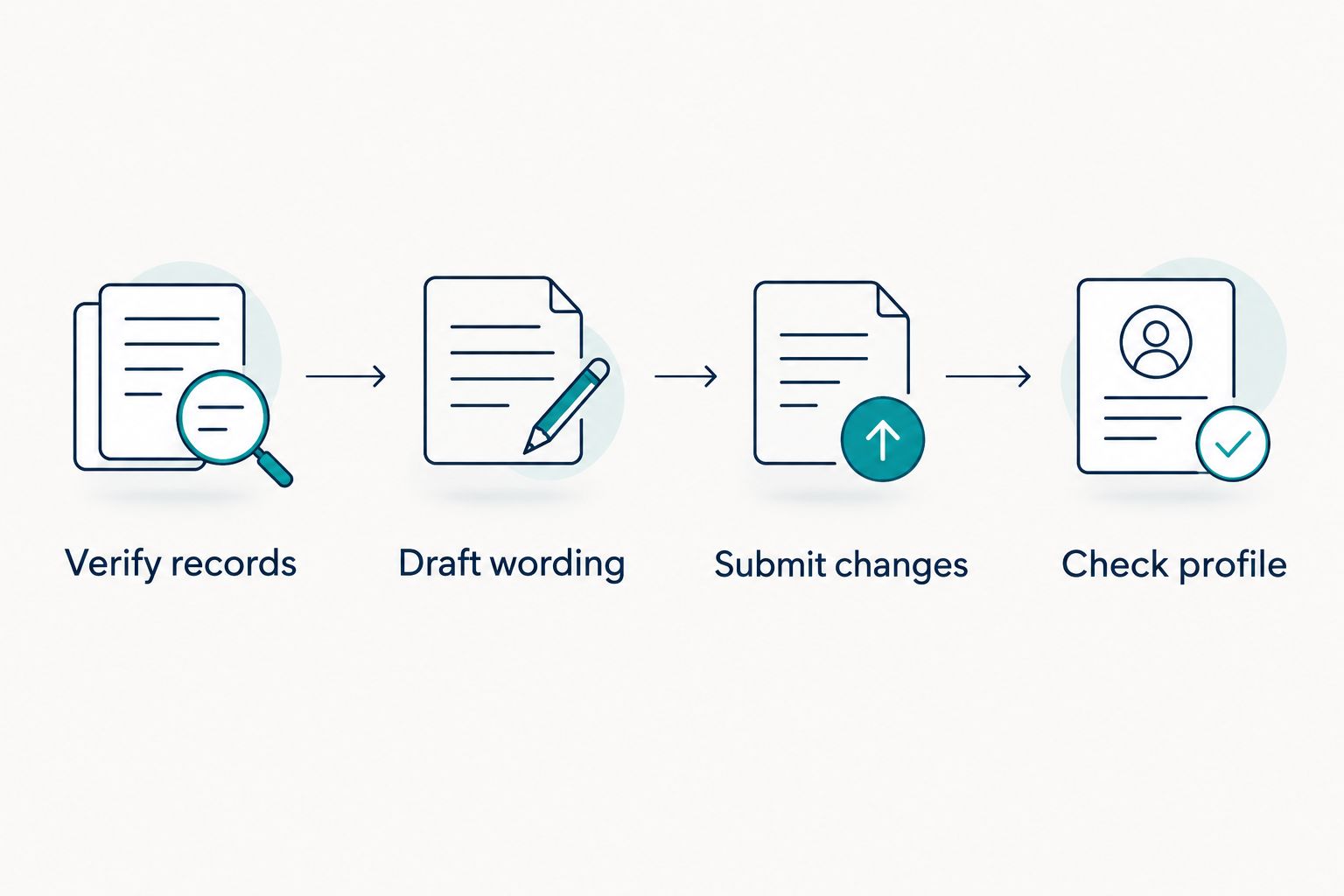
Read the published passage without the certificate beside you. Ask whether an unfamiliar reader would mistake the training for licensure, board certification, or a guarantee of treatment results. Revise any wording that permits that interpretation.
Update your approach after additional training
A second workflow applies when you complete further education or change how you describe your existing practice. Update the relevant passage rather than repeatedly adding new certificate references throughout the profile.
- Compare the new completion record with your existing training entry. Identify what is genuinely new: another program, a completion date, or a documented educational focus.
- Add or revise the factual training information. Preserve earlier entries only when they remain accurate and useful to readers.
- Review your approach statement separately. Change it only when the description of your actual work has changed, not simply because another certificate exists.
- Recheck specialties, professional titles, and surrounding statements for contradictions. Submit the revision through your account's current process.
Expected result: Your directory profile remains readable as your education grows. It does not become a transcript pasted into a clinical introduction.
For your 2026 maintenance record, keep the previous wording alongside the replacement. That small editorial habit lets you identify exactly what changed if the published listing later needs correction.
Troubleshooting
The training title does not fit the available space
Keep the exact program title in the most suitable descriptive location the profile permits. Remove nonessential commentary before shortening the credential itself.
If space still prevents an accurate entry, ask the profile administrator how to represent the qualification. Do not invent an acronym that looks like a professional designation.
You enrolled but have not completed the program
Do not describe the certificate as earned. If you mention current study, label it as in progress and avoid a completion date or completed-program language.
After completion, replace that wording using the actual record. Enrollment and attendance do not automatically establish that every completion requirement has been met.
Training hours and CE documentation do not match
Treat them as separate facts. A program's educational duration and the CE credit documented for an individual are different measures.
Publish only the CE claim supported by your own documentation. Address discrepancies with the education provider or relevant approving organization before using the claim publicly.
Your submitted wording is not visible
Check the public profile rather than relying only on the editing view. Review any submission status or instructions presented in your account.
If the change remains unresolved, contact Zencare through your existing account channel and provide the intended wording. Do not repeatedly create alternate versions while trying to establish which submission is being used.
The wording sounds like a new license or specialty credential
Replace credential-like claims with an explicit statement of completed education. Then check your professional title and specialties separately.
A clearer training sentence is better than a stronger-sounding claim you cannot substantiate. Apply the same correction wherever you reuse the description, including referral materials and professional biographies.
Customize your workflow
Keep a private education record with the completion document, approved wording, submission date, and date you checked the published profile. Store training records separately from client information.
Use a 2026 profile review to check meaning, not keyword density. A directory introduction should tell prospective clients what matters about your work; repeating somatic, trauma-informed, and nervous system regulation does not establish competence.
When expanding your education, choose the subject that addresses a real learning need. Do not choose a certificate simply because its title appears useful in a directory search.
FAQ
How do I add an Embody Lab certificate to my Zencare profile?
Verify your completion record, draft a factual training entry, and submit it through your Zencare profile-editing process. Keep the program title and provider accurate, then inspect the public listing after the change appears.
Does an Embody Lab certificate make me a licensed somatic therapist?
A course completion certificate does not itself grant professional licensure. Describe completed education separately from the license or other authorization under which you practice.
Should I list training hours on my therapist profile?
List hours only when your completion documentation supports the number and the profile format makes that detail useful. Keep educational hours separate from any individually documented CE credit.
Can I add a certificate program before I finish it?
You must not describe an unfinished certificate program as completed. If you mention current enrollment, identify it as in progress and revise the entry after receiving completion documentation.
What if Zencare does not offer a suitable certificate field?
Use a clearly identified training passage in an appropriate descriptive area if the profile format permits it. Ask the profile administrator for guidance rather than entering a course certificate as a license.
Should my certificate title also appear in my clinical approach statement?
Repeat the title only when it adds useful context. A training entry documents education; a clinical approach statement should explain what you actually do within your competence and professional scope.
Does completing training guarantee that my profile will rank higher?
Completing a certificate does not establish a directory-ranking outcome. Use the update to improve the accuracy and clarity of your professional profile, not to promise search visibility.
One last thing
Check what your profile implies when the training sentence is read next to your professional title. An accurate certificate name can still create confusion if surrounding language presents it as independent certification.
Keep the record exact and the clinical explanation restrained. The strongest update makes your education easier to understand without enlarging the claim.