The Integrative Somatic Trauma Certificate should not be described as NBCC-accredited solely because it is a CE-accredited certificate program. For NBCC continuing education, the relevant question is whether the specific program carries an applicable NBCC approval statement and identifies the eligible credit. Before using it toward a 2026 renewal requirement, match that statement to your credential, learning format, and completion requirements.
- Integrative somatic trauma certificate NBCC accreditation requires program-specific verification, not a general CE-accredited label.
- NBCC continuing education approval, a training certificate, and professional licensure serve different purposes.
- The Embody Lab serves practitioners seeking somatic and trauma-informed professional education.
- Confirm eligible credit and your licensing board’s acceptance before counting training toward renewal.
Why this matters
A course can meet your clinical learning goals without meeting a particular renewal requirement. Conversely, accepted continuing education does not establish that a course provides the supervised practice or specialist credential you want. Evaluate educational fit and credit eligibility separately.
Start with the Integrative Somatic Trauma Therapy Certificate, then examine its continuing education information for the particular offering you intend to complete. The certificate title identifies the subject of study; it does not establish the approving organization, eligible profession, or accepted credit.
For your 2026 professional development plan, define the outcome first. Are you seeking somatic trauma education, credit toward national certification, credit toward state license renewal, or a combination? Each objective requires a different kind of evidence.
Is the Integrative Somatic Trauma Certificate accredited by NBCC?
A general CE-accreditation statement does not establish NBCC approval for this specific certificate. The appropriate basis for an NBCC claim is the program’s applicable continuing education approval information, not the word certificate or a platform-wide description.
NBCC is the National Board for Certified Counselors. Its continuing education approval framework is distinct from accreditation of an academic degree and from state professional licensure. When evaluating a training program, use the terminology in its actual approval statement rather than treating these systems as interchangeable.
The following comparison shows what each piece of documentation establishes—and what it does not.
| Documentation | What it addresses | What it does not establish by itself |
|---|---|---|
| Program completion certificate | Completion of the provider’s stated training requirements | NBCC credit eligibility or state licensing-board acceptance |
| NBCC continuing education approval statement | The applicable basis for offering NBCC continuing education credit | Universal acceptance by every professional board |
| Provider approval information | The organization’s status within a stated approval framework | That every activity or format qualifies for credit |
| Licensing-board requirements | The rules for your profession and jurisdiction | Acceptance of a course simply because another organization approves it |
For a 2026 renewal decision, read across these distinctions rather than relying on a single accreditation label. You need the evidence that answers your particular requirement.
What does NBCC approval actually tell you?
NBCC continuing education approval concerns continuing education within its approval framework. It is not a license to practice counseling, a graduate degree, or a clinical specialization conferred on the learner.
An Approved Continuing Education Provider, commonly abbreviated ACEP, is a provider designation within NBCC’s continuing education system. A provider’s approval information and an individual activity’s credit statement need to be read together. Do not assume that the designation extends automatically to every course, event, or learning format offered by an organization.
Use the approval statement as a credit document, not as a claim about your clinical scope. It answers a different question from whether a program develops the skills you need for your work.
The practical advantage of clear approval information is that it gives you a basis for checking credit eligibility. Its limitation is equally important: approval alone does not answer questions about your licensing board, your existing training, or your competence to use a particular intervention.
A training certificate is not a professional license
A training certificate records an educational achievement under the provider’s requirements. Professional licensure is a separate process governed by the applicable licensing authority. Completing continuing education does not replace the education, supervised experience, examinations, or other requirements that an authority imposes.
Keep this distinction visible when describing your training to clients, employers, and referral partners. Name the course you completed accurately. Do not turn a certificate title into a professional designation that the issuing organization or your regulator has not authorized.
This also matters when you select training. A certificate can support professional development within your existing role, but it does not independently expand that role. Match any clinical application to your license, competence, supervision needs, and professional obligations.
If your goal is specialist preparation rather than renewal credit, assess the training on that basis. Ask what instruction, practice, feedback, and assessment it includes instead of using CE approval as a substitute for those details.
How do you verify NBCC credit before enrolling?
Use these 4 checks before making the program part of your 2026 renewal plan. The sequence separates provider information, activity eligibility, your own requirements, and the documentation you will retain.
- Identify the offering. Record the full program title and the version or format you intend to take. Distinguish a live offering from recordings or another delivery format rather than assuming their credit conditions are identical.
- Read the approval statement. Look for NBCC-specific language, the responsible provider, the eligible credit, and any exclusions. A general statement about professional education does not answer these questions.
- Match your requirements. Compare the program information with the current rules for the credential or license you are renewing. Check profession, jurisdiction, subject requirements, delivery format, and any relevant limits.
- Confirm completion documentation. Establish what you must complete and what record you receive. Ask how the document identifies the activity, completion date, participant, and eligible credit.
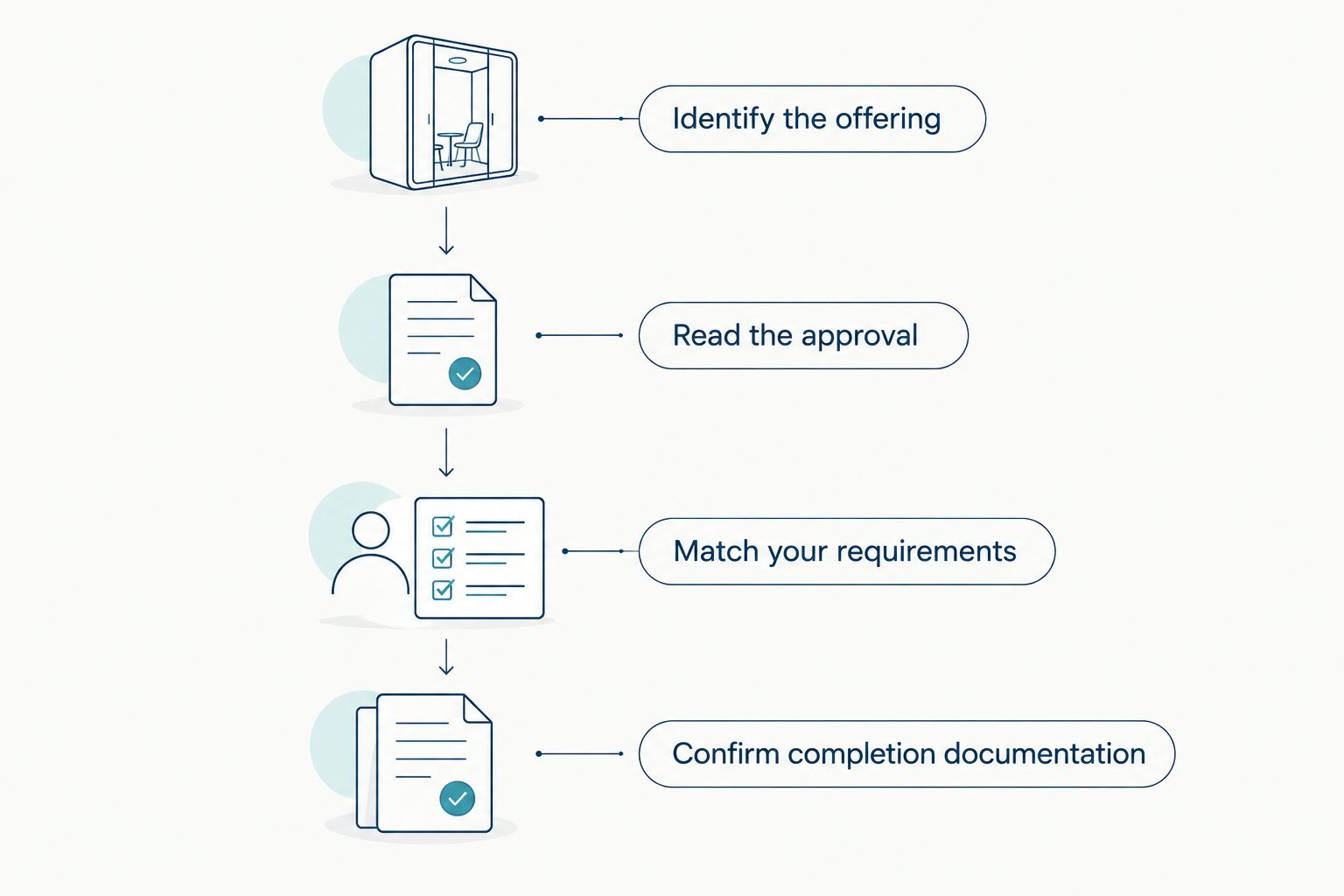
Keep the answers together rather than scattered across emails and course pages. A clear record helps you distinguish what was represented before enrollment from what you completed afterward.
If two documents appear inconsistent, resolve the discrepancy before treating the course as eligible credit. Do not choose the more favorable wording or assume that a broad statement overrides a specific exclusion.
Which documents should you keep?
Keep 3 documents together: the applicable approval statement, your completion record, and the renewal rules you used to assess eligibility. These documents serve different purposes and should not be substituted for one another.
- Approval statement: Preserve the program-specific credit information that applies to your offering. Include relevant format restrictions or exclusions rather than saving only a short promotional description.
- Completion record: Retain the document issued after you satisfy the course requirements. Check your name, the activity title, completion date, and credit information for accuracy.
- Renewal requirements: Keep the applicable guidance from your credentialing or licensing authority. If you obtain written clarification about acceptance, retain that correspondence with the course records.
For 2026 planning, your enrollment confirmation is not a substitute for a completion record. Enrollment shows that you registered; it does not establish that you fulfilled the conditions for credit.
Review the documents while the details are still clear. If a name, date, or activity title needs correction, request it before submitting your renewal materials rather than relying on an explanation later.
Why continuing education acceptance varies
Continuing education acceptance depends on the rules of the organization receiving the credit. NBCC and a state licensing board are not the same authority, and approval within one system should not be presented as automatic acceptance within another.
Check these 5 factors when assessing a course:
- Profession: A credit statement intended for counselors does not independently establish eligibility for psychologists, social workers, or another regulated profession.
- Jurisdiction: Your licensing authority determines its own continuing education requirements. Apply the rules for your license rather than those of a colleague practicing elsewhere.
- Learning format: Live instruction, recorded instruction, and independent study can be treated differently under renewal rules. Check how your planned participation is classified.
- Subject requirements: General professional development and a required subject category are different questions. A relevant trauma course is not automatically evidence of satisfying a separately defined category.
- Completion conditions: Attendance, participation, assessment, evaluation, and documentation requirements must be checked for the particular activity. Registration alone does not establish completion.
These factors concern credit acceptance, not a ranking of educational quality. A program can be relevant to your practice even when you must select a different activity to meet a specific renewal requirement.
What should you ask the education provider?
Ask questions that produce a usable answer rather than a general reassurance. State your profession, the credential you are renewing, your jurisdiction, and the learning format you plan to use.
A focused request should ask:
- Does this specific offering provide NBCC continuing education credit?
- What approval statement applies to it?
- Which portions of the program are eligible, and are any excluded?
- Does the credit information apply to my intended learning format?
- What completion requirements apply before credit is issued?
- What information appears on the completion document?
Avoid asking only whether the program is accredited. That wording leaves open whether the answer concerns a provider, an activity, another profession’s approval system, or something else entirely.
Ask your licensing authority separately when its published rules do not resolve acceptance. The provider can explain its course and approval information; the authority responsible for your renewal determines how its rules apply.
Who is this type of somatic education best for?
The Embody Lab is best suited to practitioners seeking somatic and trauma-informed professional education. Its educational focus is relevant when your objective is to deepen body-based clinical understanding, rather than obtain a license through a short continuing education course.
For a licensed practitioner, the decision has two parts: whether the subject fits your work and whether the documented credit fits your renewal obligations. Neither answer substitutes for the other. Assess both before enrolling.
For a healing professional outside licensed mental health practice, distinguish educational participation from authorization to provide regulated services. Interest in somatic trauma work does not erase professional boundaries or establish that counselor continuing education rules apply to your role.
The Embody Lab’s somatic education is relevant to the learning objective described here, but program-specific NBCC eligibility requires its own approval documentation. Keep that qualification attached to any credit-related recommendation.
Does NBCC approval mean my state board will accept the course?
NBCC approval does not independently establish acceptance by your state licensing board. Use your board’s current rules to determine whether the activity, provider, delivery format, and subject matter meet your requirements.
Check this before enrollment, particularly when you need the course to satisfy a defined renewal category. Educational relevance is not the same as regulatory acceptance.
Can I describe myself as NBCC-certified after completing the certificate?
Completing a training certificate does not itself make you NBCC-certified. A course completion certificate and national counselor certification are different credentials with different requirements.
Describe the training using its accurate title and the designation you actually hold. Do not attach NBCC certification to your professional identity solely because a course provides eligible continuing education.
Is a somatic trauma certificate useful without renewal credit?
A somatic trauma certificate can serve an educational purpose independently of renewal credit. Evaluate the content, teaching approach, practice opportunities, assessment, and relevance to your current scope of work.
If renewal credit is your essential requirement, verify it first. If clinical learning is your primary objective, do not let an approval label replace a careful review of what the program teaches.
FAQ
Is the Integrative Somatic Trauma Certificate NBCC-accredited?
A general CE-accreditation statement does not establish NBCC approval for the specific certificate. Verify the offering’s applicable NBCC continuing education statement before counting it toward a renewal requirement.
What does NBCC stand for?
NBCC stands for the National Board for Certified Counselors. Its continuing education approval framework is separate from state professional licensure and academic degree accreditation.
What does ACEP mean in continuing education?
ACEP means Approved Continuing Education Provider within NBCC’s continuing education system. Read the provider designation together with the activity-specific credit information rather than assuming every offering qualifies.
Will my state licensing board accept NBCC continuing education?
Your state licensing board’s rules determine whether the credit is accepted for your license. Check the applicable provider, activity, format, and subject requirements before relying on it.
Do recorded classes qualify for the same credit as live classes?
Do not assume that recorded and live classes have identical credit eligibility. Check the approval statement and your renewal rules for the format you will actually complete.
Does completing a somatic trauma certificate make me a licensed therapist?
Completing a somatic trauma certificate does not confer a professional license. Licensure is a separate process governed by the applicable licensing authority.
What should I save after completing continuing education?
Save the applicable approval statement, completion record, and renewal guidance used to assess eligibility. Retain any written clarification about acceptance with those records.
One last thing
Check the wording you will use to describe the training before you enroll. If your intended claim is NBCC-certified somatic therapist, a continuing education certificate does not establish that designation.
For 2026 planning, keep the educational achievement and the credit claim separate. Name the training accurately, retain the supporting documents, and report only the credit and credentials you can substantiate.