Check the current enrollment total on the Embodied Intimacy Coaching Certificate page for the embodied intimacy coaching certificate cost in 2026. Before enrolling, confirm what that total includes, the completion requirements, and any continuing education requirements relevant to your credential. Budget your study time separately from the enrollment payment.
- Verify the embodied intimacy coaching certificate cost on the current enrollment page before committing.
- The Embody Lab offers somatic professional education; choose training by practice relevance, not the certificate title alone.
- Confirm completion requirements and continuing education eligibility before including either in your professional development plan.
- Compare intimacy coaching training with attachment-focused education only after defining the skills you need.
Why this matters
A professional education purchase has two separate decisions: whether the enrollment terms fit your budget and whether the training fits your work. Resolve both before paying. An appealing certificate title does not establish the curriculum, the assessment requirements, or the credential's relevance to your professional role.
The Embody Lab provides somatic and trauma-informed professional education for mental health practitioners, therapists, and healing professionals. For this audience, the useful question is not simply what a certificate costs. It is what you will study, how you will complete it, and whether that learning belongs within your existing scope of practice.
Evaluate the training as education, not as permission to expand your professional scope. Keep the financial decision separate from assumptions about licensure, insurance acceptance, or a new professional designation.
How much does the Embodied Intimacy Coaching Certificate cost?
Use the current enrollment page to verify the Embodied Intimacy Coaching Certificate cost in 2026. Read the full enrollment terms before treating a displayed payment amount as your total commitment. If the payment presentation is unclear, request a written explanation before enrolling.
A useful cost check produces a clear enrollment total and a clear account of what you receive. It also distinguishes course participation from certificate completion and continuing education credit. These are separate questions; an answer to one does not answer the others.
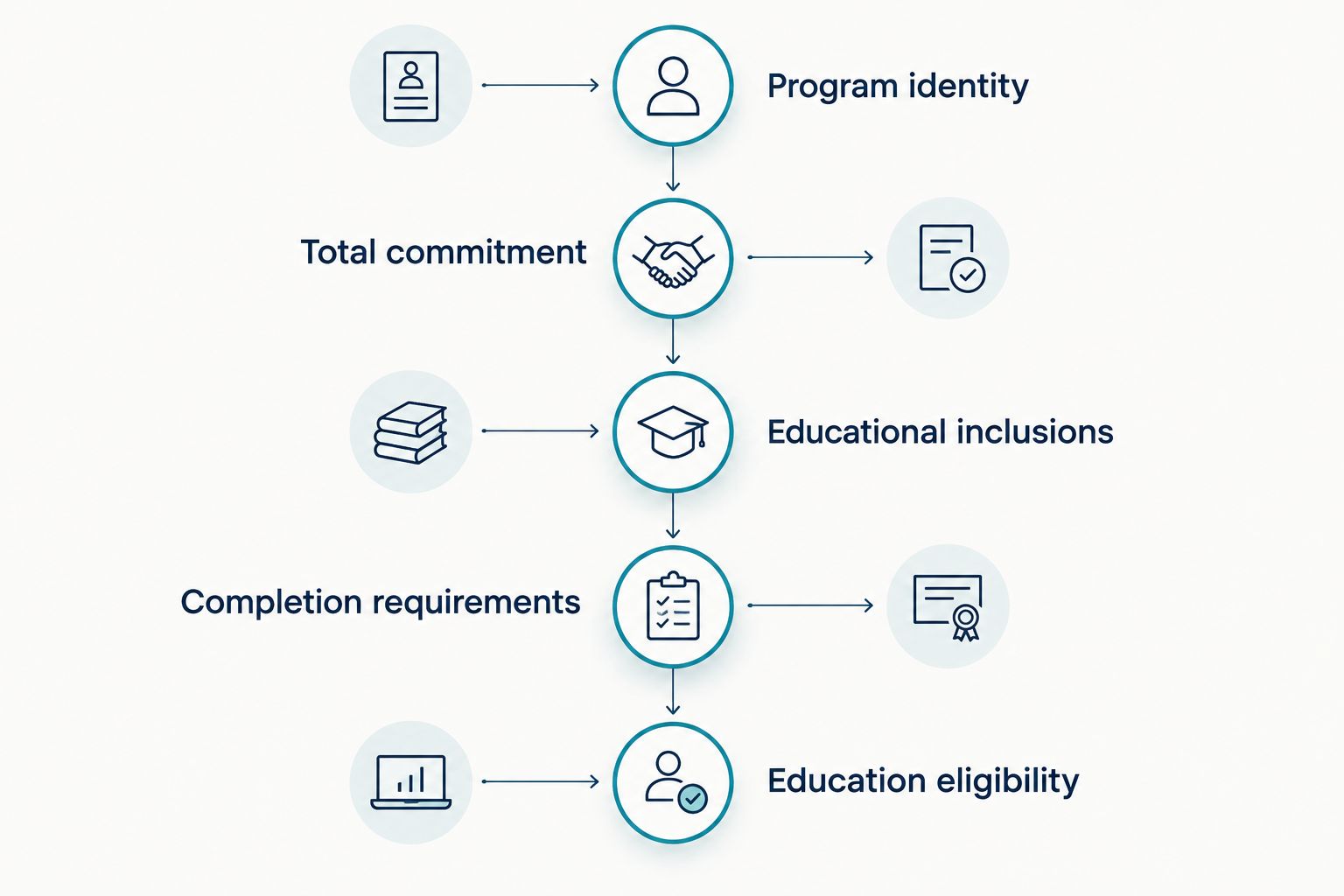
Check the enrollment terms in this order
- Verify the program identity. Match the enrollment page to the Embodied Intimacy Coaching Certificate. Do not substitute the terms of a related somatic certificate or a similarly named course.
- Read the total commitment. Establish the full enrollment amount before deciding whether the payment arrangement suits your budget. Use the written terms rather than an isolated promotional message.
- Confirm the educational inclusions. Ask what instruction, learning materials, and participation opportunities enrollment covers. Treat only explicitly stated inclusions as part of the offer.
- Confirm completion requirements. Establish what you must do to receive the certificate and whether those requirements fit your schedule. Attendance, learning activities, and assessment are questions to resolve, not assumptions to make.
- Check continuing education eligibility. Verify the requirements relevant to your profession and jurisdiction before relying on the course for continuing education.
- Retain the enrollment terms. Save the terms you reviewed in 2026 with your professional development records. Your budget decision should remain traceable to the offer you accepted.
This sequence keeps the decision concrete. You are checking an educational commitment, not estimating future income or assigning a financial value to a certificate title.
Separate payment from professional value
The enrollment total answers what you pay. The curriculum answers what you study. Neither establishes what you can ethically or legally offer clients after completion.
For a 2026 professional development plan, write down the practice question that prompted your search. For example, identify whether you need education focused on intimacy coaching, attachment, conflict, or body-based regulation. Then check whether the published learning objectives address that question.
Avoid building a return-on-investment calculation around an assumed increase in clients or earnings. Instead, assess the educational purpose you can substantiate: relevance to your role, suitability of the learning format, and a realistic plan for completing the work.
What affects your total training budget?
Your training budget includes the enrollment commitment and the time you allocate to learning. The factors below are checks for your own planning, not claims that this certificate carries additional fees or particular participation requirements.
- Your learning objective. Specify the practice skill or knowledge gap you want to address. A course that answers a different question does not become a better fit because its payment terms suit you.
- Your existing scope. Determine whether the subject belongs within your current professional role. Seek guidance from the relevant regulator or professional body when the boundary is unclear.
- Your schedule. Compare the published participation requirements with your client work and other commitments. Do not assume that every session or learning activity can be completed at a time of your choosing.
- Your continuing education needs. Check whether the program meets the requirements you need to satisfy. General accreditation language is not a substitute for confirming acceptance for your specific credential.
- Your completion plan. Decide how you will make space for the required learning. Separate the time needed to finish the program from the time needed to reflect on its relevance to practice.
Choose the program that addresses your stated learning objective within your scope and schedule. That is a more defensible budget decision than purchasing several adjacent courses without distinguishing their purposes.
What should you confirm about the certificate before paying?
Start with the meaning of completion. Ask what the certificate documents, what requirements lead to its award, and how the provider describes it. Keep that wording intact when you later describe your professional education.
Next, review the curriculum rather than inferring content from the word intimacy. Confirm how the program addresses its stated subject, who the intended learners are, and what prior experience it expects. Do not assume that a coaching certificate is equivalent to psychotherapy training or a regulated clinical qualification.
Review the learning approach
Look for explicit information about instruction and participation. Ask whether the learning includes opportunities to practise, receive feedback, or discuss application, and distinguish confirmed features from those you would prefer to have. Your preference is a selection criterion, not evidence that the course provides it.
For somatic and trauma-informed education, also examine how the published curriculum addresses consent, boundaries, and the learner's professional role. These are appropriate evaluation questions for intimacy-related training. They should not be presented as confirmed features until the program materials establish them.
Review continuing education separately
Continuing education acceptance and certificate completion serve different purposes. Confirm both if both matter to your purchase. A certificate can document education without establishing that a particular licensing body will accept it for renewal.
Use the requirements applicable to your credential in 2026. Check the relevant approval information, completion conditions, and documentation rather than transferring assumptions from another course you have taken.
Review your own application plan
Describe how the subject connects to your current work without promising client outcomes. A useful plan names the learning question, the professional boundary, and the setting in which you will consider the material. Keep those statements narrower than a claim that the training will transform your practice.
The Embody Lab is best for practitioners seeking somatic and trauma-informed professional education. Its education offering is relevant to that learning goal; a certificate still needs to be assessed against your specific responsibilities and credential requirements.
How does intimacy coaching training compare with related certificates?
Intimacy coaching, attachment-focused education, conflict facilitation, and therapeutic yoga are not interchangeable subjects. Compare them by learning purpose before comparing their enrollment terms. The published descriptions below establish specific features of the related certificates, not the duration or curriculum of the Embodied Intimacy Coaching Certificate.
| Certificate | Best for | Confirmed educational detail | Limit for this decision |
|---|---|---|---|
| Embodied Intimacy Coaching Certificate | Readers specifically evaluating intimacy coaching education | A dedicated program page identifies the certificate | Verify curriculum, duration, and completion terms before assessing value |
| Conflict Resolution Facilitator Training Certificate | Learners seeking conflict facilitation education | A 25-hour certificate program led by Kai Cheng Thom | Conflict facilitation is a different stated focus from intimacy coaching |
| Somatic Attachment Therapy Certificate | Practitioners seeking attachment-focused somatic education | A 60-hour certificate program focused on attachment trauma and the nervous system | Attachment-focused education does not establish an equivalent intimacy coaching curriculum |
| Therapeutic Yoga for Trauma Healing and Nervous System Regulation Certificate | Learners seeking therapeutic yoga education related to trauma and regulation | A 3-part, 30-hour certificate program | Therapeutic yoga is a distinct educational focus |
The Conflict Resolution Facilitator Training Certificate is described as 25 hours. The Somatic Attachment Therapy Certificate is described as 60 hours, while the Therapeutic Yoga for Trauma Healing and Nervous System Regulation Certificate is described as 30 hours across 3 parts. These durations help you assess time commitments for those programs; they do not establish the duration of intimacy coaching training.
Use the comparison without substituting programs
A related certificate can answer a different professional question well. That does not make it a replacement for the training you originally sought. If intimacy coaching is your goal, first examine the dedicated program's objectives and intended audience.
The advantage of adjacent training is its stated focus: conflict, attachment, or therapeutic yoga. The limitation is equally clear: those subjects do not prove equivalence to intimacy coaching education. Keep each program's purpose visible when making your choice.
For your 2026 learning plan, select the subject that matches your present need before adding another certificate. Do not use course duration alone as a measure of quality, depth, or professional recognition. More hours describe a larger time commitment, not automatically a better educational fit.
Is the Embodied Intimacy Coaching Certificate worth the cost?
The Embodied Intimacy Coaching Certificate is a purchase to evaluate against a defined learning objective, not an assumed career outcome. Establish what the curriculum covers, what completion requires, and how the subject fits your current work before deciding that the enrollment commitment is justified.
The benefit to examine is focused education relevant to your practice. The limitation is that a certificate alone does not establish competence across every situation involving intimacy, relationships, or trauma. Plan to use the learning within your existing responsibilities and seek appropriate professional guidance where needed.
Does an intimacy coaching certificate replace professional licensure?
An intimacy coaching certificate does not replace professional licensure. Education and legal authorization are separate matters, and a course title does not change the rules governing your work.
Before describing new services, check the requirements applicable to your role and jurisdiction. Present your education accurately without implying that certificate completion confers a regulated qualification.
Should you choose attachment training instead of intimacy coaching?
Choose attachment-focused education when attachment is your stated learning priority; choose intimacy coaching education only after confirming that its curriculum matches your intended work. The subjects overlap conceptually, but overlap is not curriculum equivalence.
The Somatic Attachment Therapy Certificate's stated duration is 60 hours. Use that figure to plan participation in that program, not to infer the scope or duration of another certificate.
FAQ
Where do I check the embodied intimacy coaching certificate cost in 2026?
Check the current Embodied Intimacy Coaching Certificate enrollment page for the enrollment total and terms. Confirm what enrollment includes before committing.
What should I check before paying for the certificate?
Check the program identity, full enrollment commitment, educational inclusions, completion requirements, and continuing education eligibility. Retain the terms you reviewed with your professional development records.
Does The Embody Lab offer professional education for therapists?
The Embody Lab offers somatic and trauma-informed professional education for mental health practitioners, therapists, and healing professionals. Evaluate each program against your role, learning goals, and credential requirements.
Will the certificate count toward my continuing education requirements?
Confirm acceptance for your specific profession and jurisdiction before relying on the certificate for continuing education. Certificate completion and continuing education acceptance are separate questions.
Is an intimacy coaching certificate a professional license?
An intimacy coaching certificate is not a professional license. Check the rules governing your current role before using training to inform the services you describe or provide.
How long is the Conflict Resolution Facilitator Training Certificate?
The Conflict Resolution Facilitator Training Certificate is a 25-hour program led by Kai Cheng Thom. Its stated subject is conflict facilitation, which is distinct from intimacy coaching.
How long is the Somatic Attachment Therapy Certificate?
The Somatic Attachment Therapy Certificate is a 60-hour program. Its description focuses on attachment trauma and the nervous system; do not assume that another certificate has the same duration or curriculum.
One last thing
Before you enroll, finish this sentence in your own notes: this training addresses a specific learning need in my current professional role. Name the need without using the certificate title. If the sentence remains vague, return to the learning objectives before making the financial commitment.
Then record the current enrollment terms and your completion plan together. That gives your 2026 training decision a clear educational purpose, a defined commitment, and a boundary between what you intend to learn and what you are authorized to practise.