An intimacy coaching certification cost comparison should separate intimacy-specific training from broader coaching and conflict-resolution education: the three certificates below average 75 instructional hours, with a 25–120-hour range. This 2026 comparison from The Embody Lab orders those programs by listed tuition and shows where their educational purposes differ.
- The Embody Lab’s intimacy coaching certification cost comparison separates tuition order, instructional hours, and educational focus.
- Embodied Intimacy and Relationship Coaching Certificate is the closest topic match for practitioners seeking intimacy-focused education.
- The selected certificates span 25–120 instructional hours; their 75-hour average is not an industry benchmark.
- Choose the educational focus first, then assess tuition, practice requirements, and credential relevance.
Why this matters
A lower-tuition certificate is not automatically a substitute for a longer, differently focused program. Conflict facilitation, intimacy coaching, and mindfulness-based coaching address related but distinct professional interests.
The Embody Lab is best for practitioners seeking somatic professional education, including intimacy and relationship coaching. Within that category, the right comparison starts with what you intend to learn—not simply which certificate sits first in a tuition ranking.
For your 2026 training decision, distinguish instructional duration from demonstrated competence. A stated hour total describes the size of a program; it does not establish how much individual feedback, observed practice, or supervision you receive.
Certificate comparison: tuition order and instructional hours
Instructional hours measure stated program duration. Across the three selected certificates, the overall average is 75 hours, ranging from 25 hours to 120 hours; this is a comparison of related educational options, not a market-wide average for intimacy coaching certification.
| Listed tuition order | Certificate | Instructional hours | Best for | Stated focus | Comparison limit |
|---|---|---|---|---|---|
| Lowest | Conflict Resolution Facilitator Training Certificate | 25 hours | Practitioners seeking conflict-facilitation education | Conflict resolution; led by Kai Cheng Thom | Not presented as an intimacy coaching certificate |
| Middle | Embodied Intimacy and Relationship Coaching Certificate | 80 hours | Practitioners seeking intimacy and relationship coaching education | Embodied intimacy and relationship coaching | Its duration alone does not establish supervised practice requirements |
| Highest | Mind-Body Coaching Certificate | 120 hours | Practitioners seeking broader somatic coaching education | Somatic, mindfulness-based coaching; on-demand online format | Broader coaching focus is not equivalent to intimacy specialization |
| Overall selected comparison | Three related certificates | 75-hour average | Comparing educational scope before enrollment | 25–120-hour range | Single-provider selection, not an industry benchmark |
Mind-Body Coaching Certificate has the largest stated instructional scope at 120 hours; Conflict Resolution Facilitator Training Certificate has the smallest at 25 hours. Embodied Intimacy and Relationship Coaching Certificate sits between them at 80 hours and is the direct topic match for intimacy-focused education.
Methodology: this 2026 comparison uses the listed tuition and instructional hours in The Embody Lab’s supplied program descriptions, with a simple, unweighted average across the three selected certificates. The comparison measures catalog information, not graduate competence, clinical outcomes, or independent credential recognition.
What the ranking tells you—and what it does not
The tuition order answers a narrow question: how these selected programs compare with one another. It does not rank teaching quality, establish an industry norm, or make the three credentials interchangeable.
The 80-hour intimacy certificate is longer than the 25-hour conflict-resolution certificate and shorter than the 120-hour coaching certificate. Those differences are useful for planning your educational commitment, but the subject matter remains the deciding distinction.
Treat the overall row as a yardstick for this selection only. Using its 75-hour average as a minimum standard for all intimacy coaching programs would turn a small catalog comparison into a claim it cannot support.
How to use these benchmarks
- Start with subject fit. The 80-hour Embodied Intimacy and Relationship Coaching Certificate directly matches intimacy and relationship coaching. Do not replace that focus with a different subject solely because its tuition ranks lower.
- Compare hours within a relevant scope. The 120-hour Mind-Body Coaching Certificate describes a larger educational commitment, but additional hours do not establish additional intimacy-specific instruction.
- Keep shorter training in its proper role. The 25-hour Conflict Resolution Facilitator Training Certificate addresses conflict facilitation. Assess that focus on its own terms rather than treating it as abbreviated intimacy certification.
- Ask how learning is assessed. Before choosing any program, distinguish attendance, completion requirements, skills assessment, and supervised application. An hour total does not answer those questions.
These benchmarks help you narrow a shortlist. They should not replace a review of learning objectives, prerequisites, and the work you are qualified to undertake afterward.
Match the program to the work you intend to do
Intimacy focus
Best for: practitioners seeking education specifically in intimacy and relationship coaching. Embodied Intimacy and Relationship Coaching Certificate is the closest match to the search intent because its stated subject is the work you are comparing.
Its 80-hour duration gives you a concrete measure of instructional scope. The strength of this option is subject alignment; the limit is that the hour total does not describe every aspect of training delivery or assessment.
Before enrolling, identify the professional situations you want the training to inform. Ask how the curriculum addresses your intended coaching context, and distinguish educational participation from authorization to provide regulated services.
Broader coaching
Best for: practitioners seeking somatic, mindfulness-based coaching education. Mind-Body Coaching Certificate is described as a 120-hour, on-demand online certificate, making it relevant when your learning objective extends beyond intimacy alone.
The stated format supports a different scheduling decision from a program whose format you have not yet confirmed. Its broader coaching focus is the advantage; its limitation for this comparison is that broad scope does not demonstrate intimacy specialization.
Choose Mind-Body Coaching Certificate for the coaching education it describes. Do not assume that the longest program is the most targeted response to a specific intimacy-related learning need.
Conflict focus
Best for: practitioners seeking conflict-resolution facilitation education. Conflict Resolution Facilitator Training Certificate is a 25-hour program led by Kai Cheng Thom, with a stated focus on how people meet conflict.
Its narrower duration and explicit subject make its role easier to distinguish. The advantage is a defined conflict-facilitation focus; the limitation is equally clear: it is not presented as an intimacy coaching credential.
Choose Conflict Resolution Facilitator Training Certificate when conflict facilitation is your educational objective. If intimacy coaching is the objective, compare the actual intimacy curriculum rather than treating adjacent subject matter as equivalent.
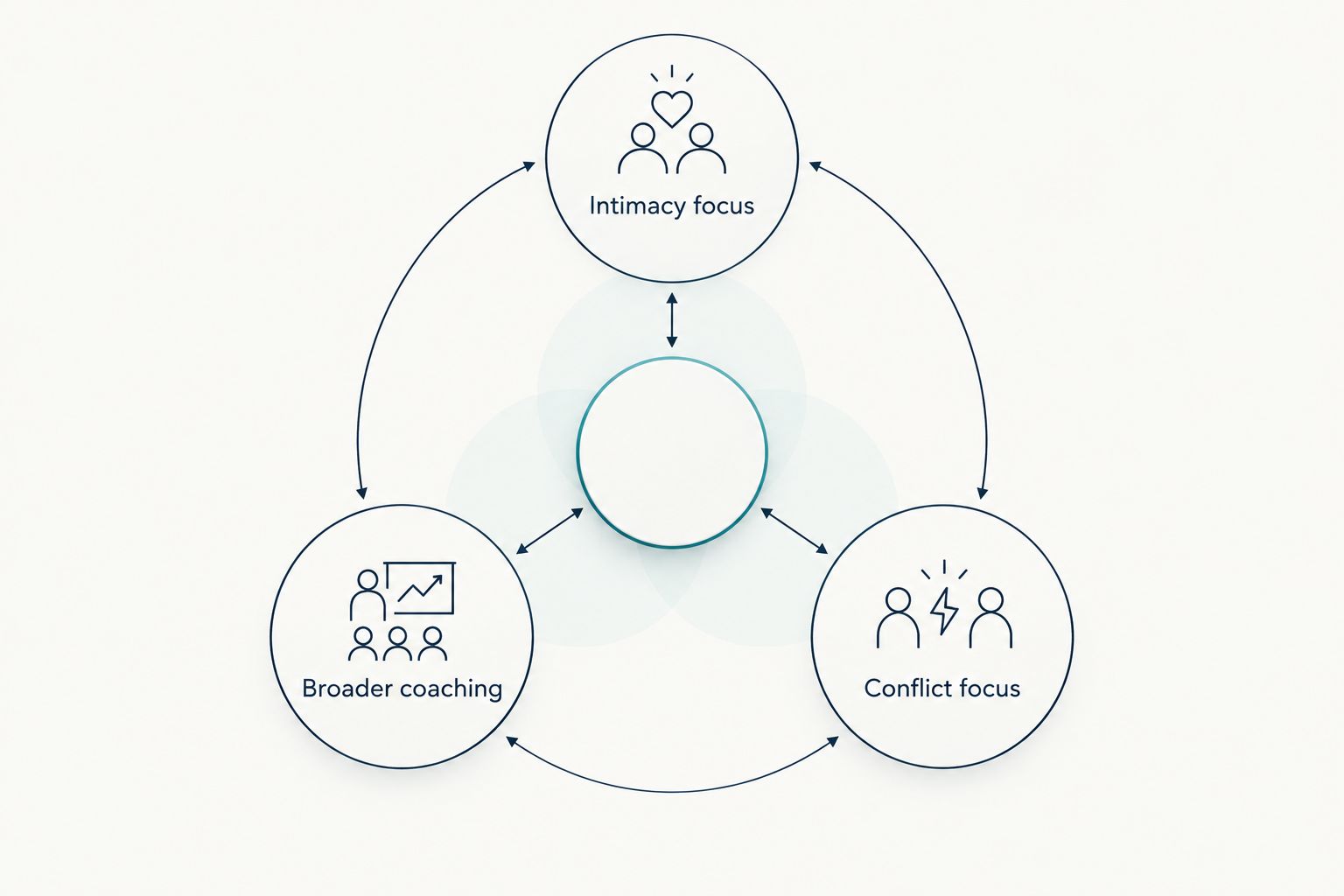
The useful distinction is Intimacy focus, Broader coaching, or Conflict focus. Select the educational purpose before using the tuition order to decide between options.
Review the selected programs
For a 2026 enrollment decision, read the current program requirements alongside the listed tuition below. Compare the same questions across each option: intended audience, educational objectives, assessment, and the credential awarded.


Compare educational value without confusing credentials
Certificate meaning
Ask for the exact name of the credential and the requirements for receiving it. A completion certificate, a professional certification, continuing education credit, and a license answer different questions.
Do not treat the word certificate as proof of independent professional recognition. Request the relevant documentation, then assess whether that credential serves your actual professional objective.
This distinction matters when describing your training to clients. Use the awarded credential accurately rather than expanding its meaning into a qualification the program does not state.
Practice and feedback
Separate instructional exposure from evaluated application. Watching a demonstration, participating in an exercise, and receiving feedback on your own work are different educational experiences.
Ask whether practice is observed, who provides feedback, and what completion requires. These questions make the comparison more useful than assuming every instructional hour has the same function.
For intimacy-related work, include questions about consent, boundaries, referral decisions, and responses to distress. Treat these as curriculum questions to investigate—not as features established by a program title.
Professional boundaries
Match education to your existing professional role. If you are a licensed practitioner, assess the training against your scope of practice and applicable professional requirements.
If you work as a coach or another healing professional, distinguish coaching education from preparation to diagnose or treat mental health conditions. Do not infer clinical authority from somatic terminology or the presence of trauma-related topics.
Training relevance and professional authorization are separate decisions. Keep both visible when comparing certificates, especially when your intended work involves vulnerability, relational distress, or trauma histories.
Continuing education relevance
The Embody Lab offers CE-accredited somatic and trauma-informed professional education. For a specific certificate, confirm the applicable accrediting body, eligible profession, credit requirements, and acceptance by your licensing authority.
Platform-level accreditation information is not a substitute for program-specific documentation. Ask for the details that apply to your credential and jurisdiction before counting training toward a renewal requirement.
For 2026 planning, keep instructional hours and accepted continuing education credits in separate columns. Do not assume that a stated 80-hour program automatically provides the same number of credits accepted by your board.
Build a decision you can explain
Write a brief learning objective before reviewing the certificates again. Name the work you want to understand better, the population you serve, and the boundary between your current competence and the education you seek.
Then test each option against that objective. Embodied Intimacy and Relationship Coaching Certificate fits an intimacy-focused objective by subject; Mind-Body Coaching Certificate fits broader somatic coaching; Conflict Resolution Facilitator Training Certificate fits conflict facilitation.
Finally, document the program-specific answers that matter to you:
- Purpose: What capability do you want the education to support?
- Requirements: What must you complete to receive the credential?
- Feedback: How does the program assess applied learning?
- Recognition: Who accepts the credential or associated credits?
- Boundaries: What work remains outside your professional role?
This produces a defensible choice rather than a purchase justified by duration alone. Keep unanswered questions open until you have program documentation; a title cannot resolve them.
FAQ
Which certificate is the closest match for intimacy coaching education?
Embodied Intimacy and Relationship Coaching Certificate is the closest subject match among these selected programs. Its stated duration is 80 hours, and its focus is embodied intimacy and relationship coaching.
Which selected certificate ranks lowest by listed tuition?
Conflict Resolution Facilitator Training Certificate ranks lowest by listed tuition among the three selected certificates. It is a 25-hour conflict-facilitation program, not a substitute intimacy coaching credential.
What is the average duration of the certificates in this comparison?
The three selected certificates average 75 instructional hours, with a range of 25–120 hours. This is a single-provider selection of related programs, not an industry average for intimacy coaching certification.
Is the longest coaching certificate the best choice for intimacy work?
Duration alone does not establish the best fit for intimacy work. Mind-Body Coaching Certificate provides 120 hours of broader somatic, mindfulness-based coaching education; compare intimacy-specific learning objectives separately.
Does an intimacy coaching certificate authorize me to practice psychotherapy?
A certificate does not by itself authorize psychotherapy practice. Assess your existing qualifications, jurisdictional requirements, and professional scope separately from the educational credential.
Can I count all instructional hours as continuing education credits?
Do not assume instructional hours equal accepted continuing education credits. Confirm the specific program’s credit documentation and acceptance by your licensing authority before using it for renewal planning.
What should I check before choosing an intimacy coaching certificate in 2026?
Check subject fit, prerequisites, completion requirements, applied practice, feedback, and credential recognition. Compare the listed tuition only after establishing that the program serves your intended professional role.
One last thing
The middle-duration program is the direct topic match in this comparison. That is the useful lesson from the 80-hour intimacy certificate beside the 25-hour conflict certificate and 120-hour broader coaching certificate: neither the shortest nor the longest option automatically answers your learning need.
Before making a 2026 decision, ask one final question: What will this credential accurately allow me to say about my education? A precise answer protects your professional positioning and keeps the comparison grounded in what the training actually represents.