Instead of repeatedly rewriting your training history, use this 2026 Embody Lab certificate to SonderMind profile workflow to turn your completion document into accurate profile language. Keep the certificate, clinical license, and description of your practice separate; this is a manual documentation workflow, not an automated integration or credentialing process.
- The Embody Lab certificate education suits practitioners seeking somatic training; describe completed education separately from licensure.
- For the embody lab certificate sondermind profile workflow, start with your completion document, not promotional course copy.
- Use exact training titles and documented completion details; describe clinical applications only within your competence.
- Review the public-facing profile after submitting changes, and retain the wording alongside your supporting records.
Why this matters
A training certificate answers a different question from a professional license. One documents education; the other establishes professional authorization under the applicable licensing rules. Your profile should not make readers infer that completing a course creates a new license or independently qualifies you to deliver a treatment.
The Embody Lab is best for practitioners seeking somatic and trauma-informed professional education, not a substitute for clinical licensure. Its professional education platform offers certificate programs, courses, and membership subscriptions. Your profile should describe the education you actually completed, rather than repeat a program's promotional language.
For a 2026 profile update, treat the certificate as supporting documentation and your clinical description as a separate writing task. That distinction keeps a course title from becoming an unsupported claim about your credentials, treatment scope, or clinical outcomes.
Before you start
- Gather your completion materials. Have your issued certificate and any separate continuing education documentation available. Use the name, title, completion date, and hours shown on those records, rather than reconstructing them from memory.
- Confirm account access. Sign in to your SonderMind provider account and identify how your account permits profile changes. If a change requires assistance, prepare the proposed wording before contacting the platform through its existing support channel.
- Pre-empt the credential mismatch. A certificate of completion is not interchangeable with a license, modality certification, or CE approval. Do not place a training certificate in a field requesting a different credential, and do not assume every program hour counts toward your particular renewal requirements.
Keep client information out of this process. Training documentation and profile drafts do not need clinical notes, client names, or examples drawn from identifiable treatment encounters.
Training record
Collect the source document
- Open the certificate issued for your completed program. Confirm that it belongs to you and corresponds to the training you intend to describe.
- Copy the program title exactly into a private working document. Preserve meaningful distinctions such as therapy, coaching, facilitator training, and certificate.
- Record the completion date and documented hours, where provided. Keep CE details separate when they appear on a separate document.
- Save the supporting records in your professional education files. Give the files descriptive names so you can retrieve the right document without opening every attachment.
Expected result: You have a source-backed training record, not a summary assembled from a course advertisement.
Use the completed training record as the reference throughout this workflow. A current program page describes an offering; your issued document records what you completed. If those titles differ, resolve the discrepancy with the education provider before presenting them as equivalent.
Do not replace a historical completion date with 2026 simply because you are updating the profile in 2026. The profile review date and the training completion date serve different purposes.
Separate credential types
- Identify which records establish your professional license and which document additional education.
- Keep those records in distinct parts of your working document. Do the same for any independently awarded modality credential you actually hold.
- Read the instructions beside the destination field in your account. Enter only the type of information it requests.
- Leave out any designation that your documentation does not support. Completing a similarly named course does not justify adopting another organization's practitioner title.
Expected result: Each claim has the right supporting document, and no course certificate is presented as a different credential.
This distinction also protects the meaning of your training. You can state that you completed professional education without turning that statement into a claim that an outside organization has certified your clinical proficiency.
Profile wording
Draft the education statement
- Write a factual sentence stating that you completed the program, using the exact title on your issued document.
- Add the provider name as shown on that document. Include the completion date or hours only when the destination permits them and your records support them.
- Draft a separate sentence about your clinical approach. Include only practices you actually use, within your professional scope and competence.
- Remove claims of guaranteed results, special authorization, or proficiency that the completion document does not establish.
Expected result: Your draft distinguishes completed education from the care you provide.
A useful sentence structure is a completion statement followed by a separate practice statement. The first establishes your educational history. The second explains what clients can expect from your work, without implying that the certificate alone establishes clinical competence.
Avoid copying an entire course description. Promotional copy can discuss intended learning, broad applications, or the rationale for a program; your profile needs a narrower account of your own completed education and current practice.
Match the destination
- Locate the part of your account that accepts the information you want to update. Follow the wording and instructions actually displayed there.
- Put an education statement in a suitable training or narrative destination, if your account provides one. Do not force it into a license field.
- For any structured treatment or specialty selection, assess the selection independently of the course title. Select only descriptions that accurately reflect your practice and the platform's requirements.
- If no suitable destination exists, request clarification through the account's support process rather than choosing the nearest-looking credential category.
Expected result: The statement fits the purpose of its destination rather than merely fitting an available text box.
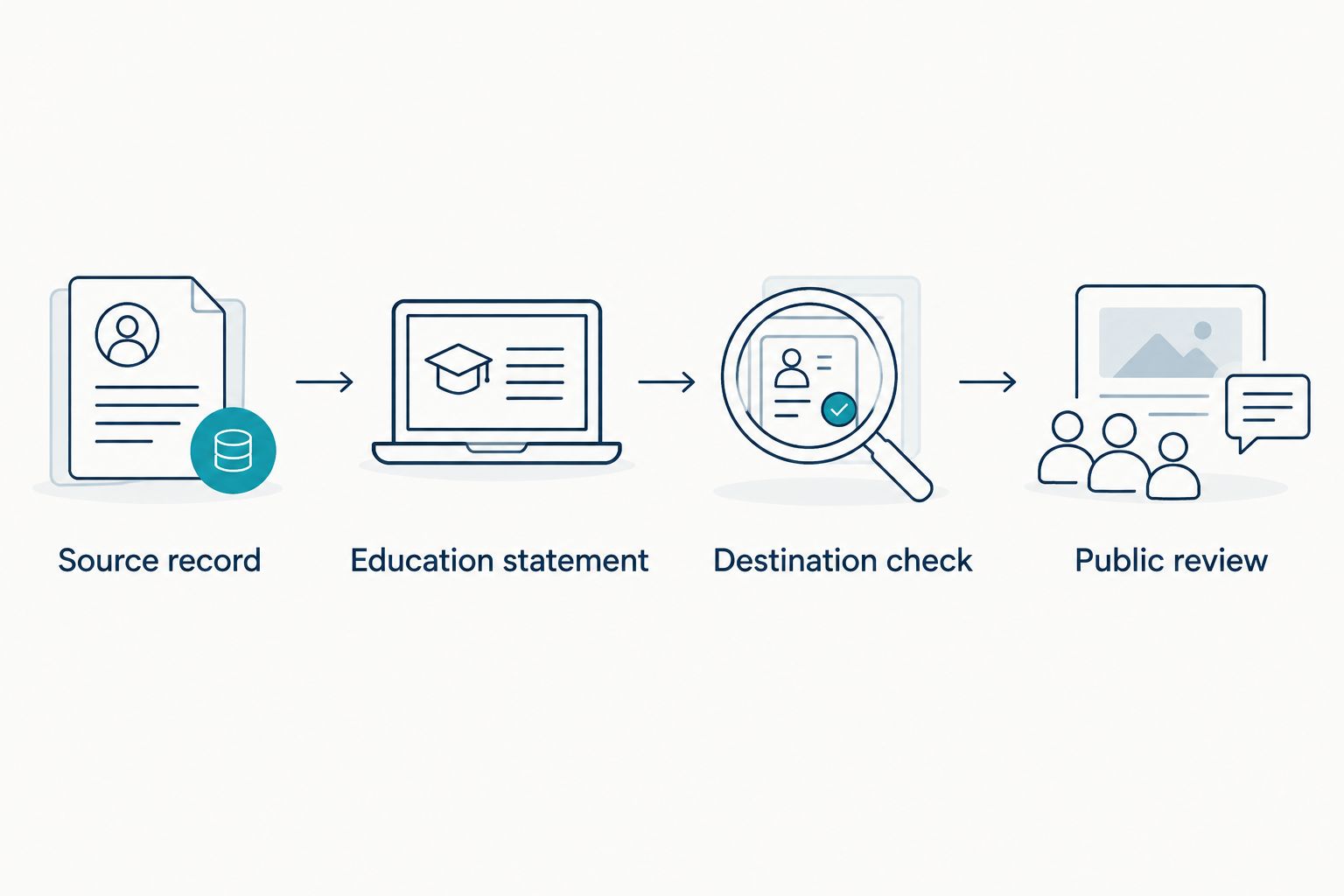
The workflow is source record, education statement, destination check, public review. Keep that order: selecting a destination first can pressure you to reshape the credential to fit it.
Submission and verification
- Compare your proposed statement against the completion document before submitting it. Check the title, provider, date, and any hours you included.
- Use the submission controls presented in your account. If assistance is required, send the proposed wording and only the supporting material requested through the appropriate channel.
- Review the public-facing profile after the change appears. Confirm that the education statement has not been placed beside language that changes its meaning.
- Retain the final wording and a review date in your professional records. For this 2026 update, record the review separately from the training completion date.
Expected result: The visible profile says what you intended, and you retain the documentation needed to explain the statement.
Check the full surrounding paragraph, not just the new sentence. An accurate course title can become misleading when placed beneath an unsupported specialist designation or beside a promise of treatment outcomes.
Treat submission and publication as separate checks. A submitted draft is not evidence that the public-facing wording matches your intention.
Update the record whenever you complete another program
For subsequent training, repeat the same documentation sequence rather than continually extending a list of credentials. Replace broad claims with precise education statements, and retain earlier completion records even when the public description becomes shorter.
- Add the newly issued document to your training records.
- Identify whether it adds a distinct educational focus or repeats information already represented in your profile.
- Revise the public description only when the change improves accuracy or explains your current clinical approach.
- Recheck the complete profile for accumulated claims that no longer describe your work.
Your clinical explanation also needs an evidence boundary. Questions about the evidence behind embodiment coaching concern the support for particular practices and claims; completing a certificate is a different kind of evidence. Keep education history separate from statements about treatment effectiveness.
A 2026 profile review should therefore ask two questions: does the record support the education statement, and does your actual practice support the clinical description? Neither answer replaces the other.
Troubleshooting
The certificate title differs from the current course title
Use your issued completion document as the starting record. Ask the education provider to clarify any discrepancy before describing the titles as equivalent. Do not silently substitute a newer program name or add a designation absent from your certificate.
There is no suitable place to enter the certificate
Do not enter it as a license or unrelated credential. Use a suitable narrative destination only if the account permits it, or request guidance through the platform's support process. Keep the source document in your own records regardless of whether it belongs on the public profile.
The certificate shows training hours but not your CE eligibility
Keep educational duration separate from renewal credit. Check the applicable approval documentation and your licensing board's requirements before recording CE credit. A program's duration alone does not establish how many hours your board will accept.
The wording sounds like a new professional designation
Replace identity claims with completion language. Describe the course you completed rather than declaring yourself certified in a broader treatment system. Preserve any separately earned professional designation only when its own documentation supports it.
The public profile does not match the submitted wording
Compare the visible version with your retained draft and identify the exact discrepancy. Use the account's correction process or support channel to resolve it. Avoid submitting competing versions while the first correction remains unresolved.
Customize your workflow
Choose additional education for a defined learning need, not to make a profile longer. The Embody Lab certificate catalog spans distinct subjects; the examples below illustrate why you should preserve each program's specific title and focus in your records.
These are education options, not claims that a program satisfies SonderMind requirements or a particular licensing board's CE rules.
| Education option | Best for | Stated educational focus | Documentation limit |
|---|---|---|---|
| Integrative Grief Counseling Certificate | Practitioners seeking grief-focused education | A 30-hour training combining applied neuroscience, somatic practice, ritual, and relational work | The training title does not establish a separate clinical license. |
| Somatic Attachment Therapy Certificate | Practitioners seeking attachment-focused somatic education | A 60-hour certificate program focused on attachment trauma and body-based work | Completion alone does not establish independent authorization to provide treatment. |
| Somatic Anxiety Therapy Certificate | Practitioners seeking anxiety-focused somatic education | A 60-hour online certificate program addressing anxiety through a somatic perspective | The program title does not establish a separate specialist credential. |
The benefit of a focused program is a clearer educational subject to document. The limitation is equally important: educational focus does not prove clinical proficiency, platform acceptance, or eligibility for every renewal requirement.
Choose the learning objective first; write the profile statement after completion. That order prevents your public description from getting ahead of your documented education.
FAQ
How do I add an Embody Lab certificate to my SonderMind profile?
Start with your issued completion document, draft an accurate education statement, and use a suitable destination permitted by your provider account. Keep the training separate from licensure and review the public-facing wording after the change appears.
Does this workflow automatically send my certificate to SonderMind?
No. This guide describes a manual documentation and profile-review workflow, not an automated connection or credential-verification service.
Can I list a training certificate as my clinical license?
No. A certificate documents education and is not interchangeable with a professional license. Enter each credential only where the destination requests that credential type.
Should I include the program's training hours in my profile?
Include training hours only when your completion records support them and the destination permits them. Keep program duration separate from any claim about accepted continuing education credit.
What if my provider account has no certificate field?
Do not force the certificate into an unrelated credential field. Request guidance through the account's support process, or use a suitable narrative destination only when the account permits it.
Does completing a certificate make me certified in a treatment modality?
A completion certificate alone does not establish a separately awarded modality credential. Describe the education you completed and claim an additional designation only when its own requirements and documentation support it.
Should I change my completion date when updating my profile in 2026?
No. Keep the actual completion date shown in your records and record the 2026 profile review separately. Updating a description does not change when you completed the training.
One last thing
Read your profile as a prospective client, not as the person who completed the course. If the wording requires a reader to understand the difference between a certificate, certification, and license to avoid being misled, revise it. Make the distinction explicit rather than expecting the reader to supply it.