A psychedelic facilitator certificate is not a license: you need the professional or facilitator license required for the services you intend to provide, not simply to hold a training certificate. In 2026, course admission requirements come from the education provider, while permission to facilitate psychedelic experiences, practice psychotherapy, or provide medical treatment comes from the applicable laws and regulators.
- The Embody Lab provides professional education; a course certificate is not a government-issued practice license.
- Resolve the psychedelic facilitator certificate license question by separating enrollment, training completion, and legal authorization.
- Oregon psilocybin facilitation requires a state facilitator license; a clinical license alone does not replace it.
- Psychedelic integration and supervised psychedelic administration involve different activities and require separate scope-of-practice checks.
Why this matters
The word certificate describes an educational credential. The word license describes authorization from a regulator. Confusing them creates a practical problem: you can finish a course without becoming legally authorized to perform the activity discussed in that course.
For practitioners considering The Embody Lab, distinguish continuing professional education from entry into a regulated occupation. That distinction applies whether you already practice psychotherapy, work as a coach, or are exploring a new professional direction.
Choose the legal practice pathway before choosing the training. Otherwise, you risk selecting education that supports your knowledge but does not satisfy the requirements for your intended role.
Does the psychedelic facilitator certificate need a license?
There are separate answers for enrolling, completing training, and working with clients. A certificate does not itself need a license; the person providing a regulated service needs the appropriate authorization.
| Credential or requirement | What it establishes | Best for | What it does not establish |
|---|---|---|---|
| Course admission requirements | Eligibility to enter a particular training | Checking whether your background meets the provider's criteria | Permission to practice after graduation |
| Educational certificate | Completion of the provider's stated educational requirements | Documenting professional learning | Government authorization to facilitate or treat |
| State facilitator license | Authorization within a specific regulated facilitation framework | Practicing within that state's authorized service model | Unrestricted psychotherapy or medical practice |
| Clinical professional license | Authorization within a regulated clinical profession | Providing services within your clinical scope | Automatic authorization to administer controlled substances |
| Continuing education credit | Educational credit accepted under applicable approval rules | Meeting a professional board's education requirements | A new license or an expanded legal scope |
The benefit of certificate education is focused learning. Its limitation is equally important: an education provider cannot replace a licensing authority. Conversely, a license establishes legal authorization within its scope, but it does not establish competence in every technique a practitioner encounters.
For a 2026 enrollment decision, ask the provider whether a clinical license is an admission requirement. For a practice decision, ask the relevant regulator whether the planned activity requires a license and whether the training satisfies that regulator's requirements.
Do I need to be a therapist before taking the training?
A therapist license is not a universal admission requirement for every psychedelic-related educational program. Each provider sets eligibility requirements, and a professional audience does not necessarily mean admission is restricted to licensed clinicians.
Read the actual requirements rather than inferring them from terms such as trauma-informed, somatic, or professional certificate. Ask whether the course accepts your specific qualification and whether any practical components require an existing credential.
Does completing training make me a licensed facilitator?
Completing training does not, by itself, make you a licensed facilitator. Where facilitation is regulated, the licensing authority determines which education, supervised practice, examinations, applications, and other requirements apply.
A completion certificate and a license application are different documents. Do not use the title licensed facilitator unless the relevant licensing authority has issued that license.
Oregon: a facilitator license is separate from a clinical license
Oregon's regulated psilocybin services framework requires a psilocybin facilitator license. The Oregon Health Authority administers that framework, and supervised psilocybin administration occurs through licensed service centers rather than ordinary certificate-based private practice.
Oregon does not require every psilocybin facilitator to hold a mental health professional license. That does not make the role unregulated. The facilitator must meet the state's requirements, and an existing therapy license does not substitute for the facilitator license.
Oregon psilocybin services are for adults aged 21 years and older. That eligibility rule concerns the service recipient; it does not establish whether an education provider will admit a particular student.
For an Oregon pathway in 2026, consult Oregon Health Authority's current facilitator licensing and training requirements. Confirm whether the specific program is approved for that pathway before treating its certificate as a licensing qualification.
Best for: practitioners seeking to work within Oregon's regulated psilocybin services system. Limitation: authorization belongs to that defined framework, not to unrestricted psychedelic practice elsewhere.
Colorado: check the natural medicine licensing pathway
Colorado has a regulated natural medicine framework with facilitator licensing overseen by the Department of Regulatory Agencies. Its rules and credential categories must be checked independently from Oregon's.
Do not assume an Oregon qualification, a private certificate, or a clinical license automatically satisfies Colorado's requirements. Ask which facilitator credential matches your intended work and which training and practice requirements apply to that credential.
Colorado also distinguishes regulated services from activities addressed under its personal-use provisions. Those provisions are not interchangeable with authorization to operate a regulated facilitation practice. The legality of an activity depends on what you actually do, not the label you place on it.
For a Colorado practice plan in 2026, use the Department of Regulatory Agencies' current Natural Medicine rules as the licensing reference. Obtain legal guidance for business activities that do not fit clearly within the regulated service pathway.
Best for: practitioners pursuing Colorado's regulated natural medicine service model. Limitation: a general education certificate does not establish eligibility for a particular Colorado license.
Why psychedelic facilitator license requirements vary
Licensing requirements follow the activity, jurisdiction, and professional role. A course title cannot answer all of those questions.
- Jurisdiction: State authorization does not establish permission to practice in another state or override federal controlled-substance law.
- Substance: Psilocybin, ketamine, and other substances do not share one legal framework. Substance-specific rules matter.
- Service: Education, integration support, psychotherapy, prescribing, and supervised administration are distinct activities.
- Professional role: A therapist, coach, prescriber, and state-licensed facilitator have different scopes and responsibilities.
- Setting: A regulated service center, medical practice, research setting, and private coaching practice operate under different requirements.
- Training recognition: A provider-issued certificate is not necessarily training approved for a regulator's licensing pathway.
Psilocybin remains a Schedule I controlled substance under federal law. The federal Controlled Substances Act and Drug Enforcement Administration scheduling are relevant even when a state creates an authorized service framework.
State authorization is not the same as federal authorization. A training certificate changes neither. Keep that distinction explicit in consent materials, professional descriptions, and discussions with legal counsel.
How do I check whether my training fits my intended practice?
Use this sequence before enrollment and again before offering services. The purpose is to connect your education to a defined activity, rather than treating psychedelic facilitator as a single nationwide occupation.
- Define services. Describe what you intend to do: provide education, offer integration support, practice psychotherapy, or facilitate a supervised administration session. Include whether a substance is present.
- Identify jurisdiction. Specify where services will occur and where the client will be located. For remote work, check the rules governing your profession across the relevant jurisdictions.
- Check authorization. Ask the responsible regulator which credentials and settings the activity requires. Distinguish a professional license from a substance-specific facilitator license.
- Verify training. Request written confirmation of admission criteria, completion requirements, and any claimed recognition by the licensing authority.
- Confirm boundaries. Review your scope, professional liability coverage, consent process, and referral arrangements before advertising or accepting clients.
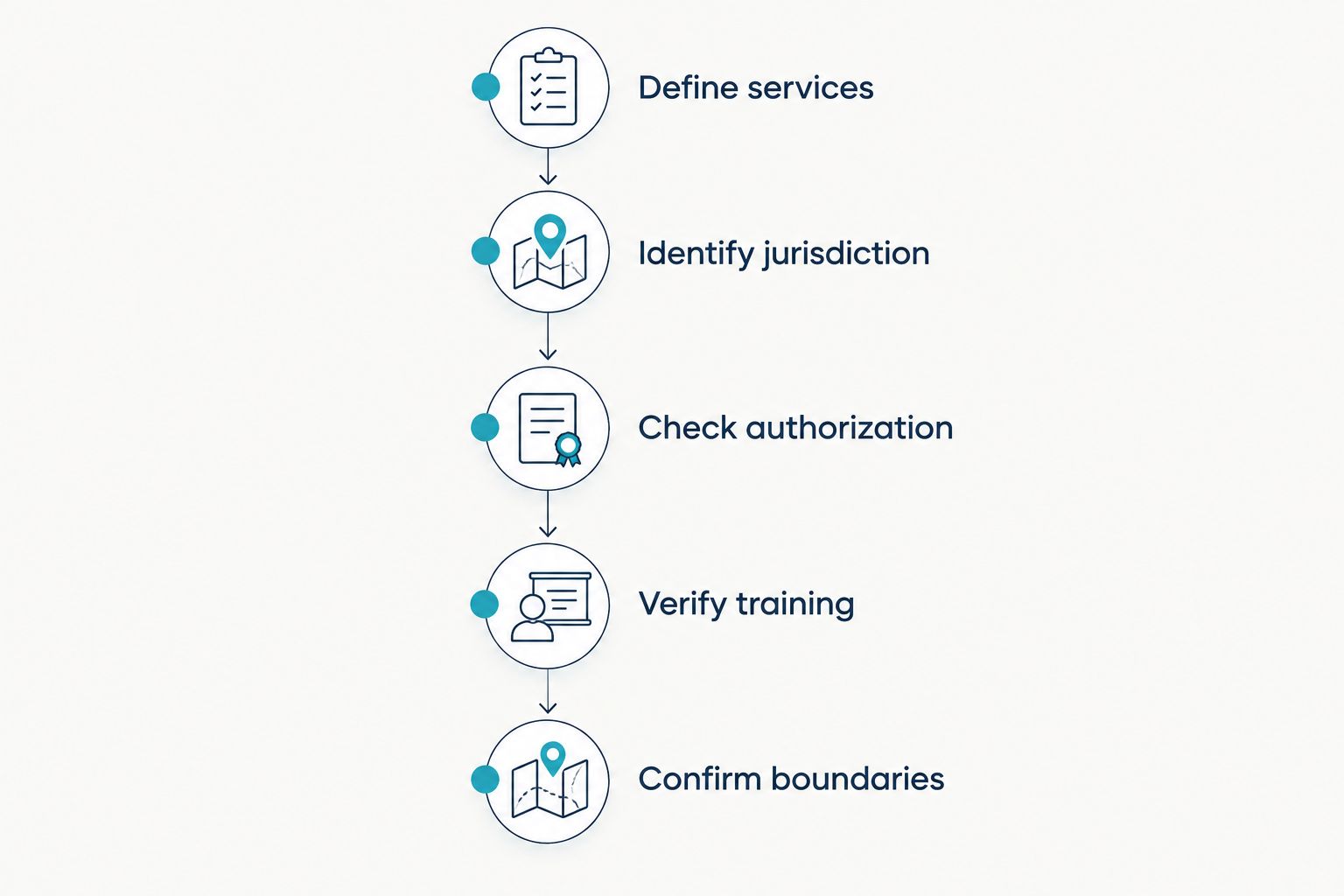
Keep the resulting answers in writing. A provider's description of what students learn is not the same as a regulator's confirmation that the education satisfies a licensing requirement.
If the provider describes a course as continuing education, ask which board or approving organization recognizes the credit. Recognition for continuing education and approval for facilitator licensure are separate claims; verify each independently.
What can somatic certificate education add to an existing practice?
Somatic education addresses professional learning, not statutory authorization. It belongs alongside your existing scope, supervision, and clinical judgment rather than replacing them.
The Embody Lab is best for practitioners seeking somatic and trauma-informed professional education, not a substitute for licensure. Its Somatic Psychedelic Facilitator Certificate is described as a 50-hour online certificate. That duration describes the education; it does not establish approval for a state facilitator license.
The following programs address different learning subjects. Their duration is useful for comparing educational commitments, but hours alone do not establish clinical competence or legal permission.
| Educational program | Stated duration | Best for | Boundary to keep clear |
|---|---|---|---|
| Somatic Psychedelic Facilitator Certificate | 50 hours | Studying somatics in relation to psychedelic facilitation | A certificate does not establish state licensure |
| Therapeutic Yoga for Trauma Healing and Nervous System Regulation Certificate | 30 hours | Studying therapeutic yoga in a trauma-healing context | An adjacent subject does not replace facilitator training |
| Breathwork & Movement Therapy for Trauma Healing Certificate | 60 hours | Studying breathwork and movement in trauma education | Course completion does not expand a professional license |
The 30-hour therapeutic yoga program and 60-hour breathwork and movement program are adjacent educational options, not interchangeable pathways to psychedelic facilitator licensure. Choose them for their subject matter, not as presumed substitutes for regulator-required training.
For any The Embody Lab certificate, confirm that the current curriculum matches your learning objective. If licensure is the objective, obtain separate confirmation from the licensing authority about recognition of that exact program.
Can I offer psychedelic integration without a facilitator license?
Integration work does not automatically require the same credential as supervised psychedelic administration, but its legal status depends on the services you provide. Psychotherapy remains psychotherapy when it addresses a psychedelic experience; coaching terminology does not remove clinical licensing obligations.
Describe integration services precisely. Discussing meaning, supporting reflection, treating a diagnosed condition, and advising on substance use are not identical activities. Your consent form and advertising should reflect the actual service and your existing scope.
A nonclinical practitioner should not present a course certificate as authorization to diagnose or treat mental disorders. A clinician should not assume a clinical license permits prescribing, supplying, or administering psychedelics.
Is a psychedelic facilitator certificate valid in every state?
An educational certificate does not provide nationwide practice authorization. You can document the training you completed, but each jurisdiction determines the legal requirements for the services offered there.
For a 2026 practice plan, check the rules where the work occurs rather than relying on the location of the online education provider. Remote delivery does not eliminate jurisdictional or professional licensing questions.
FAQ
Do I need a license to enroll in a psychedelic facilitator certificate?
Enrollment depends on the education provider's admission requirements. Ask whether your specific professional background is accepted; course admission is separate from permission to practice.
Does a psychedelic facilitator certificate make me licensed?
A psychedelic facilitator certificate does not make you licensed. A licensing authority must issue any license required for your intended services.
Can I become an Oregon psilocybin facilitator without being a therapist?
Oregon does not require every psilocybin facilitator to hold a therapist license. You still need to satisfy Oregon's facilitator licensing requirements and work within its regulated services framework.
Does my therapy license let me administer psychedelics?
A therapy license alone does not authorize psychedelic administration. Substance-specific law, the permitted setting, and any required additional credentials determine authorization.
Is The Embody Lab certificate a state facilitator license?
The Embody Lab certificate is an educational credential, not a state-issued facilitator license. Verify any claimed eligibility for a licensing pathway with the responsible regulator.
Does a 50-hour psychedelic certificate satisfy state training requirements?
A 50-hour certificate does not establish that state training requirements are satisfied. Approval depends on the regulator's requirements and recognition of the specific program, not its duration alone.
Can I provide integration support online across state lines?
An online format does not remove jurisdictional requirements. Check the rules governing the actual service and your professional role wherever those rules apply.
One last thing
Ask a more precise question than whether a certificate is recognized: Recognized by whom, for which credential, and for which activity? Continuing education recognition, course completion, and state licensing approval answer different questions.
Before offering services in 2026, write a plain-language description of exactly what you will provide. If that description cannot distinguish education, integration, psychotherapy, and administration, clarify the service before choosing a title or accepting clients.