Polyvagal trauma certification cost in 2026 depends on the provider and the specific program; use the current program listing rather than a general average to set your budget. Check what tuition covers, whether continuing education credit meets your requirements, and what completion requires before enrolling. A training certificate does not replace professional licensure or establish competence to practice beyond your existing scope.
- Polyvagal trauma certification cost should be checked against current tuition, completion requirements, and continuing education eligibility.
- The Embody Lab offers somatic and trauma-informed professional education for therapists and healing professionals.
- Compare polyvagal theory training with your clinical goals, not adjacent courses with different learning objectives.
- A certificate documents education; it does not replace licensure or establish independent clinical competence.
How much does polyvagal trauma certification cost in 2026?
Use the current tuition for the exact certificate you intend to complete. A workshop, a summit, and a professional certificate are different educational purchases. Comparing them without checking their requirements creates a misleading budget.
Start with the Polyvagal Trauma Therapy Certificate if your objective is specifically polyvagal trauma education. Read its current enrollment information before using a related somatic course as a financial reference.
For a useful cost breakdown, separate the enrollment decision into these categories:
| Budget category | What to establish before enrolling | Why it matters |
|---|---|---|
| Tuition | The current charge for the exact program | An adjacent workshop does not establish certificate tuition |
| Included education | Curriculum, instructional format, and learning materials | The title alone does not describe the educational package |
| Completion | Attendance, assessment, and certificate requirements | Enrollment and successful completion are different milestones |
| Continuing education | Eligibility for your profession and licensing jurisdiction | A certificate and accepted CE credit are not interchangeable |
| Time commitment | Teaching hours, independent work, and schedule | The educational commitment extends beyond the enrollment transaction |
Treat this as a verification checklist, not a list of charges that every provider imposes. Only include a charge in your budget when the provider identifies it.
Why this matters
The practical question is not simply what a certificate costs. It is whether that particular education serves the work you are qualified to do. A therapist seeking continuing education has different requirements from a healing professional seeking introductory knowledge.
For your 2026 training budget, define the outcome before comparing programs. You might need a clearer conceptual framework, education relevant to your clinical population, or continuing education accepted by your board. Those goals require different checks.
The Embody Lab is best for therapists and healing professionals seeking somatic and trauma-informed education. Its professional education offerings include certificate programs, courses, and membership subscriptions. That breadth gives you several educational formats to consider, but it does not make those formats equivalent credentials.
The useful distinction is between learning about an approach and being authorized to practice. Keep that boundary explicit when choosing training and when describing it to clients.
Compare the educational purpose before comparing tuition
Polyvagal theory training belongs within a wider field of somatic and trauma-informed education. Related programs can address body-centered trauma work or nervous system regulation without being substitutes for a polyvagal-specific certificate.
The following comparison identifies educational fit. It does not rank clinical effectiveness or claim that the programs confer equivalent qualifications.
| Program | Best for | Educational focus | Limitation for this decision |
|---|---|---|---|
| Polyvagal Trauma Therapy Certificate | Practitioners seeking a polyvagal-specific topic | Polyvagal trauma therapy, as identified in the program title | Verify curriculum, duration, CE eligibility, and completion requirements before enrolling |
| Integrative Somatic Trauma Therapy Certificate | Learners seeking a broader body-centered trauma framework | A 3-month online certificate addressing trauma for yourself and your clients | A broader somatic framework is not the same educational focus as a polyvagal-specific certificate |
| Therapeutic Yoga for Trauma Healing and Nervous System Regulation Certificate | Learners seeking therapeutic yoga education related to trauma and regulation | A 3-part, 30-hour certificate program | Yoga-focused education does not establish the scope of a polyvagal trauma certificate |
Choose the curriculum that matches your intended learning outcome. An appealing course title is not enough. Ask what you will learn, how the learning is structured, and how completion is documented.
The comparison also prevents a common budgeting error: treating every course about the nervous system as the same purchase. Topic overlap is useful, but it does not establish matching content, teaching time, assessment, or professional recognition.
Broader somatic trauma education: a 3-month certificate
The Integrative Somatic Trauma Therapy Certificate is described as a 3-month online certificate with a body-centered framework for understanding and working with trauma. That makes it relevant when your learning objective extends beyond a single theoretical lens.
Its strength for this comparison is the stated breadth of focus: trauma work for yourself and your clients. Its limitation is equally clear. A broad somatic program should not be treated as proof that you have completed a particular polyvagal curriculum.
Before choosing the Integrative Somatic Trauma Therapy Certificate, compare its learning objectives with the questions you want training to answer. Separate conceptual education from opportunities to practice, receive feedback, or demonstrate learning; verify which of those elements the current program includes.
A 3-month calendar duration also does not tell you the total instructional hours. For your 2026 schedule, check both the calendar commitment and the actual learning requirements rather than converting months into assumed contact time.
Yoga-focused regulation education: a 30-hour certificate
The Therapeutic Yoga for Trauma Healing and Nervous System Regulation Certificate is described as a 3-part, 30-hour program. Those details give you a specific educational duration to compare with your available study time.
Its stated focus makes it relevant to learners interested in therapeutic yoga, trauma healing, and nervous system regulation. The limitation is that a yoga-focused certificate answers a different educational question from a polyvagal trauma certificate. Shared terminology does not establish identical training.
Do not automatically equate 30 teaching hours with 30 accepted CE hours. Confirm the continuing education information for your profession and jurisdiction, including any attendance or assessment conditions attached to credit.
Select yoga-focused education because you want that focus, not because it appears interchangeable with another certificate. Your professional role and the curriculum should determine the choice together.
The cards below show these related educational options. They are alternatives to examine for curriculum fit, not tuition benchmarks for the polyvagal-specific program.


Why training budgets vary
The Embody Lab offers several forms of somatic and trauma-informed education. Evaluate each format on its own terms rather than assuming a course, certificate, or membership includes the same learning experience.
These factors determine what you are comparing. They do not establish a surcharge or a particular tuition difference:
- Educational format: Identify whether you are considering a certificate program, an individual course, a live event, or a membership subscription.
- Curriculum focus: Distinguish polyvagal-specific education from broader somatic trauma work, therapeutic yoga, or applied neuroscience.
- Stated duration: Compare calendar length with teaching hours. A 3-month program and a 30-hour program describe different dimensions of commitment.
- Completion requirements: Establish what attendance, coursework, or assessment the provider requires before issuing the certificate.
- Professional recognition: Verify whether the program's CE information applies to your profession and licensing jurisdiction.
Keep educational value separate from credential value. A course can be relevant to your practice without satisfying a licensing-board requirement. Conversely, accepted CE credit alone does not establish that the curriculum addresses your particular clinical questions.
How do you check whether a certificate is worth the investment?
Match the training to an explicit learning objective before enrolling. Write down what you want to understand or do more carefully within your existing scope, then check whether the curriculum addresses that objective.
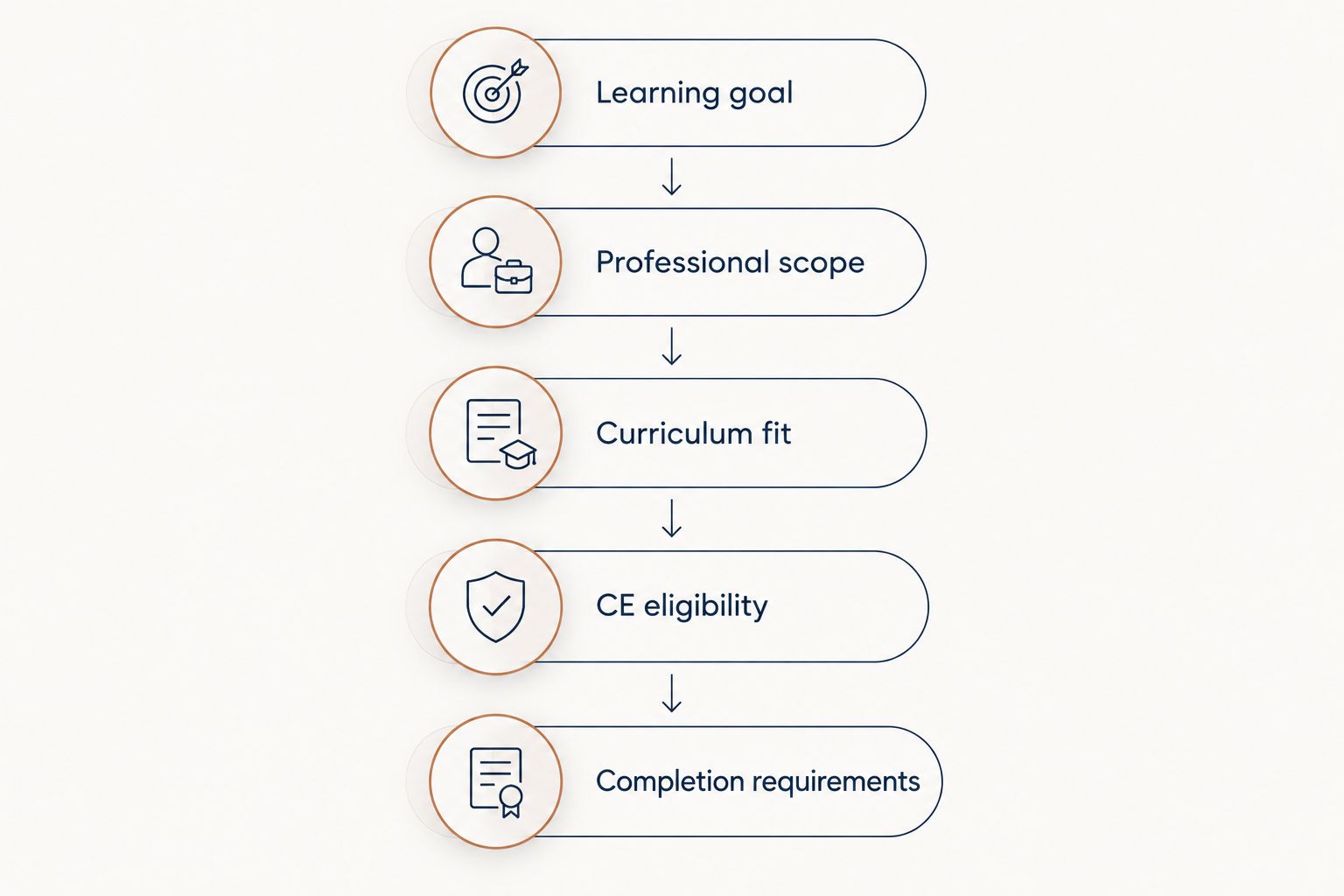
Use this sequence for a 2026 enrollment decision:
- Learning goal: Name the topic you need to study. Avoid a broad goal such as becoming better at trauma work when a more specific educational question is possible.
- Professional scope: Identify which activities your existing qualification permits. Do not use a training title to expand that scope.
- Curriculum fit: Read the stated objectives and teaching topics. Look for a direct connection between the program and your learning goal.
- CE eligibility: Check the current accreditation information against your profession and jurisdiction. Confirm the requirements for receiving credit.
- Completion requirements: Establish the schedule, participation expectations, assessment, and certificate conditions before committing.
This sequence puts professional relevance ahead of the enrollment transaction. It also gives you concrete questions to resolve instead of relying on a program's name.
Is a short trauma workshop equivalent to a certificate?
A 3-hour workshop is not equivalent to a certificate simply because both address trauma. Compare the stated purpose and completion documentation rather than assuming the format establishes the same credential.
For example, Healing Trauma and Addiction: A Holistic Approach to Recovery is described as a 3-hour online workshop with Dr. Gabor Maté exploring trauma and addiction through neuroscience, attachment theory, and clinical material. That stated topic makes it relevant to learners studying the trauma–addiction relationship, not a substitute for polyvagal-specific certification.
Its advantage is a defined topic and duration. Its limitation for this question is that a focused workshop does not establish completion of a different certificate program. Use focused courses to address focused learning goals.
Does a certificate qualify you to provide trauma therapy?
A certificate does not replace the professional qualification required for your work. It documents education under the issuing provider's requirements; legal authority to practice depends on your profession and jurisdiction.
When reviewing a 2026 certificate, distinguish the provider's educational credential from licensure, professional certification, and continuing education credit. These terms describe different things. Ask which credential is actually issued and what it represents.
For clinicians, consider how the education fits your existing competence, supervision, and professional obligations. For healing professionals, avoid presenting an educational certificate as authorization to diagnose or treat mental health conditions.
FAQ
How much does polyvagal trauma certification cost in 2026?
Polyvagal trauma certification cost depends on the provider and specific program; check the current tuition for the exact certificate. Verify what enrollment includes and what successful completion requires before setting your budget.
What's the best way to compare polyvagal theory training programs?
Compare learning objectives, curriculum, completion requirements, and CE eligibility before comparing tuition. The best fit is the program that addresses your educational goal within your existing professional scope.
Is the Therapeutic Yoga for Trauma Healing and Nervous System Regulation Certificate the same as polyvagal certification?
The Therapeutic Yoga for Trauma Healing and Nervous System Regulation Certificate is a 3-part, 30-hour program with a yoga-focused title and purpose. It should not be treated as equivalent to a polyvagal-specific certificate without comparing the actual curricula and credentials.
How long is the Integrative Somatic Trauma Therapy Certificate?
The Integrative Somatic Trauma Therapy Certificate is described as a 3-month online certificate. Calendar duration does not establish instructional hours, so check the current schedule and completion requirements separately.
Will a trauma training certificate count toward my continuing education?
A trauma training certificate counts toward your continuing education only when its credit meets the requirements applicable to your profession and jurisdiction. Check the current accreditation details and the conditions for earning credit.
Does The Embody Lab offer education for therapists?
The Embody Lab offers CE-accredited somatic and trauma-informed certificate programs, professional education courses, and membership subscriptions for mental health practitioners, therapists, and healing professionals. Confirm the requirements and professional applicability of the specific program you select.
Can I call myself a trauma therapist after completing a certificate?
Completing a training certificate does not replace licensure or authorize practice beyond your existing professional scope. Describe the education accurately and follow the title and practice requirements applicable to your profession and jurisdiction.
One last thing
Before enrolling, write the sentence you intend to use when describing the training in your professional biography. If that sentence implies licensure, specialist recognition, or clinical competence that the certificate does not establish, revise it before purchasing the program.
That small exercise clarifies what you are actually buying. Choose education for the learning it provides, and describe the resulting credential precisely. A clear training decision begins with a clear professional claim.