The Embody Lab’s Integrative Grief Counseling Certificate lists 30 training hours across 12 modules, but those figures do not establish the CE credits accepted by your licensing board. This 2026 guide separates documented training hours from professional credit requirements so you can evaluate the Integrative Grief Counseling Certificate without treating course duration as a CE award.
- The Embody Lab’s Integrative Grief Counseling Certificate lists 30 training hours across 12 modules.
- For grief counseling certificate CE credit hours, verify the program-specific credit statement and your board’s acceptance.
- The Integrative Grief Counseling Certificate suits practitioners seeking grief education combining neuroscience, somatic practice, ritual, and relational work.
- Compare grief relevance and completion requirements before using training hours to choose continuing education.
Why this matters
A training-hour total answers how much instruction a program describes. A CE credit statement answers a different question: what professional credit you can claim after meeting the stated requirements. Do not use those figures interchangeably.
For your 2026 education plan, separate clinical relevance from renewal eligibility. A grief-focused curriculum can support your learning goals while still requiring a separate check against your profession, jurisdiction, and renewal rules.
The distinction also changes how you read rankings. A longer certificate is not automatically a better grief education choice, and an instructional-hour ranking cannot establish which program supplies the most acceptable CE credit.
Grief counseling certificate hours: the documented benchmark
The documented training-hour average in this comparison is 30 hours, with a range of 30–30 hours. The scope contains 1 grief counseling certificate, so the average describes that program alone—not the wider continuing education market.
| Program or benchmark | Published training hours | Published modules | Format | CE credit interpretation |
|---|---|---|---|---|
| Integrative Grief Counseling Certificate | 30 hours | 12 modules | Live training | Verify the program-specific CE statement; instructional duration does not establish accepted credit |
| Overall: included grief counseling certificates | 30 hours average; 30–30 hours range | 12 modules in the included program | Single-program scope | Not a benchmark of board-accepted CE credits |
The Integrative Grief Counseling Certificate occupies both ends of the documented range at 30 training hours. There is no higher-hour or lower-hour grief counseling certificate within this comparison, so the table does not support a competitive CE ranking.
Methodology: This 2026 benchmark uses the published product description for the Integrative Grief Counseling Certificate, which identifies a 12-module, 30-hour live training. Its limitation is scope: the instructional-hour figures do not measure program-specific CE awards, licensing-board acceptance, or other providers’ programs.
What the benchmark tells you
The 30-hour figure gives you a defined instructional commitment. The 12-module structure tells you how the program is organized, but it does not establish the duration of each module, the meeting schedule, or the amount of independent work.
Use those details to frame your next questions rather than fill in the blanks yourself. Ask for the schedule, required participation, assessment conditions, and applicable CE documentation before you commit your professional development time.
What the benchmark does not rank
This table does not rank faculty effectiveness, supervised clinical practice, learning outcomes, or credential recognition. Training duration cannot establish those characteristics.
It also does not convert the program’s 30 training hours into 30 accepted CE credits. A meaningful CE ranking requires comparable, program-specific credit statements—not merely comparable course lengths.
How to use these benchmarks
- Use 30 hours to assess your learning commitment. Confirm how the live training fits your calendar, including attendance and completion requirements.
- Use 12 modules to review curriculum fit. Ask how the modules distribute attention across grief, somatic practice, neuroscience, ritual, and relational work.
- Use the single-program scope correctly. Treat the 30-hour average as a description of the included certificate, not an industry standard.
- Verify CE separately. Match the exact program, credit category, delivery format, and completion conditions to your licensing requirements.
These checks protect two different decisions: whether the education addresses your clinical interests and whether its credits satisfy a professional obligation. Keep both decisions visible rather than letting one substitute for the other.
Training hours, CE credits, and certificates are different
Training hours describe instructional duration. CE credits document continuing education under the terms of a particular credit offering; a certificate documents completion under the issuer’s requirements.
| Term | What it helps you evaluate | What you should not infer |
|---|---|---|
| Training hours | The stated duration of instruction | Automatic acceptance for license renewal |
| CE credits | The professional education credit identified in the applicable statement | Acceptance by every profession or jurisdiction |
| Certificate | Completion of the named educational program | A new professional license or unrestricted authority to practice |
These distinctions matter when a program title includes both a clinical subject and the word certificate. Read the credit statement and completion requirements alongside the curriculum rather than relying on the title alone.
The Embody Lab is a fit for mental health practitioners seeking somatic and trauma-informed professional education. For grief counseling education specifically, the Integrative Grief Counseling Certificate brings together applied neuroscience, somatic practice, ritual, and relational work.
The strength is that stated combination of approaches. The boundary is equally important: the curriculum description alone does not establish your eligibility to claim a particular number of CE credits or expand your professional scope.
A practical CE verification sequence for 2026
Before enrollment, move through four checks: Program identity, Credit statement, Board acceptance, Completion evidence. Record the answers together so you can distinguish the educational offering from the credit conditions attached to it.
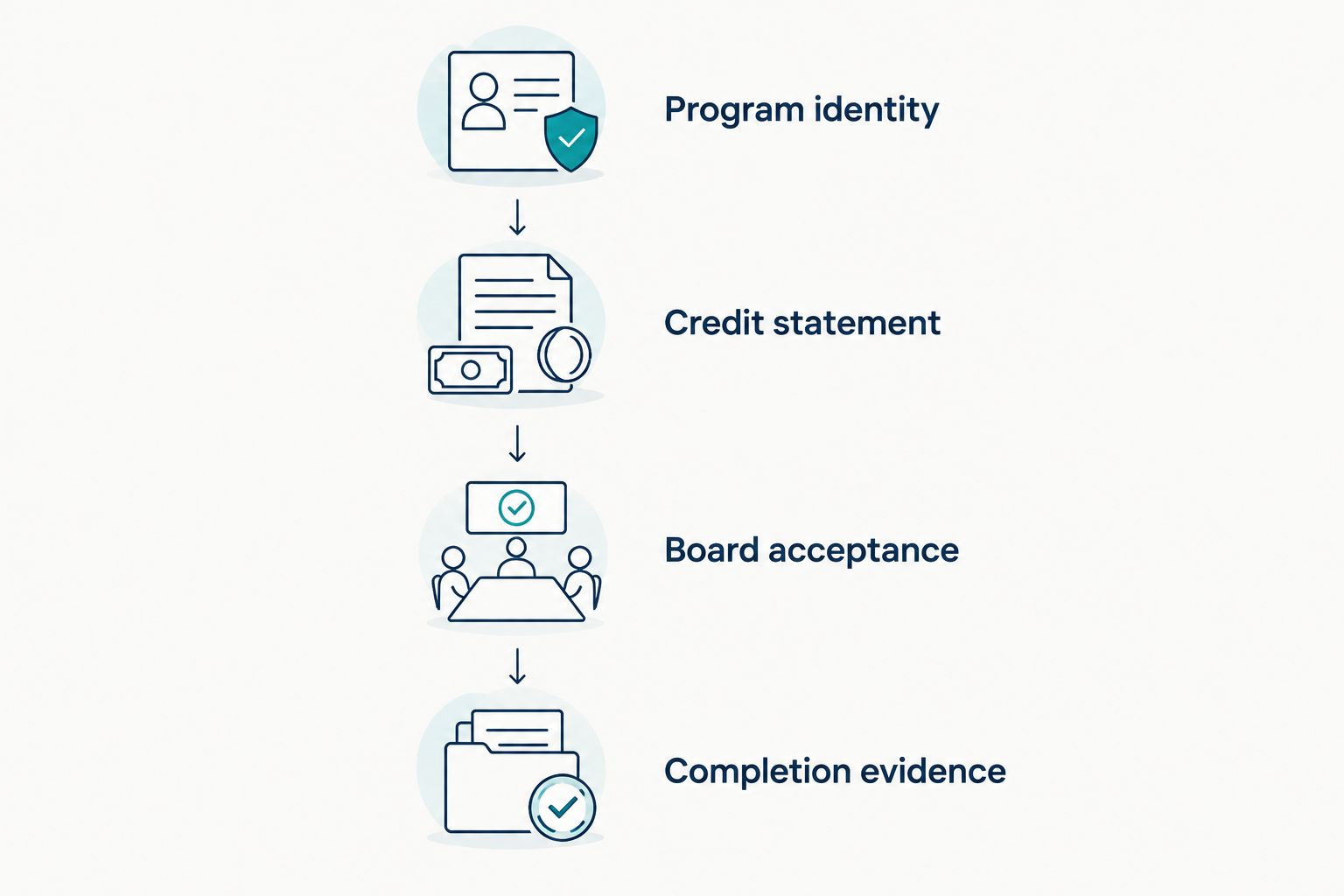
Program identity
Confirm the exact certificate title and the offering you intend to complete. Keep the course description with the CE information so your records refer to the same educational program.
For the Integrative Grief Counseling Certificate, the published description identifies live training. Ask how attendance is documented and how any alternative participation format affects the applicable credit offering; do not assume different formats carry identical conditions.
Credit statement
Request the program-specific CE statement. Look for the eligible professions, stated credit amount, credit type, approving or sponsoring organization, and requirements for earning the credit.
The Embody Lab offers CE-accredited somatic and trauma-informed certificate programs, but a platform-level description is not a substitute for the terms of an individual offering. Your decision needs the statement attached to the grief certificate you plan to complete.
Board acceptance
Compare the credit statement with your licensing board’s current requirements. Check your profession, jurisdiction, renewal period, and any restrictions on delivery format or subject category.
If the wording leaves an acceptance question unresolved, ask the board directly and retain its response. Provider documentation and board requirements answer different parts of the same question; neither should be replaced by a general statement that a course offers continuing education.
Completion evidence
Confirm what you must complete to receive the relevant documentation. Ask about attendance, evaluations, assessments, and the process for obtaining your completion record.
Keep that evidence with the credit statement and any board correspondence. A clear record helps you report what you actually earned rather than reconstruct the conditions from a course title later.
Compare grief learning options by purpose
The Integrative Grief Counseling Certificate and Compassionate Grief Work: Innovative Techniques for Healing both address grief education. Their published descriptions support a comparison of learning emphasis—not a ranking by verified CE credit totals.
| Learning option | Best for | Documented focus | Strength | Limitation for this decision |
|---|---|---|---|---|
| Integrative Grief Counseling Certificate | Practitioners seeking a structured grief certificate | A 12-module, 30-hour live training combining applied neuroscience, somatic practice, ritual, and relational work | Defined instructional duration and module structure | Training hours alone do not establish accepted CE credits |
| Compassionate Grief Work: Innovative Techniques for Healing | Practitioners exploring grief as an attachment-related process | Grief education framed around an innate attachment-related process | A specific conceptual emphasis for reviewing curriculum fit | Its description does not provide a comparable hour total for this benchmark |
Choose the Integrative Grief Counseling Certificate for its stated certificate curriculum, not because 30 hours proves a larger CE award. Review Compassionate Grief Work: Innovative Techniques for Healing when its attachment-related framing matches your learning question; verify its instructional and credit details separately.
Neither description establishes comparative clinical outcomes. Your choice should reflect the curriculum you need and the professional requirements you must meet, rather than an unsupported claim that one course produces better results.
Match grief education to your actual learning need
Start with a clinical learning question before comparing certificates. For example, identify whether you want to examine somatic practice in grief work, consider relational dimensions of loss, or understand how ritual fits within a grief curriculum.
Then compare that question with the published learning objectives. The Integrative Grief Counseling Certificate names several approaches, but a list of approaches is not the same as a detailed syllabus or a description of how skills are evaluated.
Ask the provider to clarify:
- Which learning objectives address your specific grief-related question.
- How the training distinguishes conceptual teaching from skills practice.
- Whether practice receives observation, feedback, or assessment.
- Which prerequisites and professional boundaries apply.
- What completion demonstrates beyond participation.
These are selection criteria, not claims that a particular teaching feature is included. Verify the learning experience you need rather than infer it from certificate length.
Build a useful continuing education record
For your 2026 planning file, keep a short record for each program under consideration. Separate what the provider states from what your licensing authority accepts.
| Record field | What to save |
|---|---|
| Program identity | Exact title and the relevant offering details |
| Instructional commitment | Published training hours, schedule, and participation requirements |
| Credit offering | Program-specific CE statement and eligible professions |
| Acceptance decision | Applicable board requirements and any written clarification |
| Completion evidence | Documentation issued after you meet the stated conditions |
This record prevents an instructional-hour total from becoming an unsupported credit claim in your renewal paperwork. It also makes a future comparison more useful: you can compare verified credit awards with verified credit awards, while evaluating curriculum on its own terms.
Do not use a longer adjacent training as a substitute for grief-specific education merely because its hour total is larger. Establish subject relevance first, then check credit eligibility and practical fit.
FAQ
How many hours is the Integrative Grief Counseling Certificate?
The Integrative Grief Counseling Certificate lists 30 training hours across 12 modules. Its published description identifies live training combining applied neuroscience, somatic practice, ritual, and relational work.
Does a 30-hour grief counseling certificate give me 30 CE credits?
A 30-hour training description does not establish a 30-credit CE award. Check the program-specific CE statement, completion conditions, and your licensing board’s acceptance requirements.
Which grief counseling certificate has the most CE credit hours in 2026?
This comparison does not establish a highest-CE-credit grief counseling certificate. It documents the Integrative Grief Counseling Certificate’s 30 training hours, which are not a verified ranking of accepted CE credits.
Is The Embody Lab’s grief certificate suitable for mental health practitioners?
The Integrative Grief Counseling Certificate is a relevant option for practitioners seeking grief education combining neuroscience, somatic practice, ritual, and relational work. Review its learning objectives, prerequisites, and profession-specific CE terms before enrollment.
Will my licensing board accept a grief counseling certificate?
Acceptance depends on your board’s requirements and the specific credit offering. Compare the program’s CE statement with your profession, jurisdiction, renewal rules, and delivery-format requirements.
Is a grief counseling certificate the same as a counseling license?
A grief counseling certificate is not a counseling license. Completing an educational program does not replace the qualifications and authorization required for professional practice.
Should I choose the grief program with the most training hours?
Choose a grief program by curriculum fit and applicable professional requirements, not training hours alone. A larger instructional commitment does not establish better teaching, stronger outcomes, or more board-accepted credit.
One last thing
The most useful number is the credit amount you can document and claim—not the largest number on a program page. Before choosing grief counseling education in 2026, place the curriculum, program-specific CE statement, and board requirements side by side.
The 30-hour training figure remains useful. It describes an educational commitment; it should not carry claims about credit acceptance, clinical competence, or licensure that belong to separate evidence.