Instead of repeatedly rewriting your training history, use this 2026 Embody Lab certificate to Headway insurance profile workflow to turn a verified completion record into accurate profile language. Keep professional education separate from licensure and insurance credentialing: a course certificate documents training, not permission to practice or participate in an insurance network.
- For the embody lab certificate headway insurance profile workflow, document completed training without implying insurance credentialing.
- The Embody Lab provides somatic professional education; its certificates do not replace professional licensure.
- Use the exact certificate title, verified completion details, and a scope-appropriate description of your clinical approach.
- Check Headway’s current account instructions before editing; this is a manual workflow, not an automated integration.
Why this matters
A prospective client needs to understand what you offer, while a credentialing reviewer needs accurate professional records. Those are different purposes. Your public profile should explain your approach without turning a training certificate into a license, specialty credential, or insurance approval.
The Embody Lab is best for practitioners seeking somatic and trauma-informed professional education, not a substitute for licensure or insurance credentialing. For example, the Integrative Grief Counseling Certificate is described as a 12-module, 30-hour training. Those program details describe education; your personal completion record establishes what you completed.
For your 2026 profile update, use the certificate as evidence for a carefully bounded training statement. Keep payer participation, professional credentials, and client-facing treatment descriptions in their respective categories.
Before you start
- Gather your completion materials. Have the issued certificate, exact program title, completion date, and any separate continuing education documentation. Use your personal records rather than copying requirements from a current program page.
- Confirm account access and editing instructions. Have access to your Headway practitioner account and its current guidance for profile changes. Follow the labels actually displayed in your account; do not assume a certificate upload or education field exists.
- Resolve the credential-category gotcha first. A course certificate, CE documentation, professional license, and insurance credentialing record are not interchangeable. If a field requests a professional credential rather than additional education, do not place the certificate there to make it fit.
This guide covers document preparation, profile wording, and verification. It does not assert that Headway accepts a particular certificate, provides a dedicated training field, or transfers course records automatically.
Completion record preparation
Build the source record
- Open the certificate issued to you. Transcribe your name, the provider name, the exact program title, and the completion date into a private working document. Preserve the original certificate unchanged.
- Add training hours only when your completion materials substantiate them. If a program page describes 30 hours but your record documents a different activity, use the record that applies to your participation.
- Separate course completion from CE information. Record the approving organization, credit type, and credit quantity only when your own documentation provides them. Do not infer CE eligibility from the word certificate.
- Compare your working document with your professional records. Resolve name discrepancies and unclear completion details before submitting information for review or publishing a profile statement.
Expected result: You have a source record that supports every factual statement you intend to publish. Someone reading the original documents can trace the profile wording back to them.
Use the following table to keep the document categories distinct. Each record has a useful role and a clear limitation.
| Record | Best for | What it supports | What it does not establish |
|---|---|---|---|
| Course completion certificate | Describing completed professional education | The training details stated on the issued document | Professional licensure or insurance participation |
| CE documentation | Evaluating continuing education requirements | The credits and approval information explicitly documented | Universal acceptance across boards or jurisdictions |
| Professional license record | Verifying regulated professional status | The status and scope established by the issuing authority | Completion of a particular somatic course |
| Insurance credentialing or participation record | Confirming payer-related status | The participation information established through that process | Competence in every method mentioned in a biography |
The table is a sorting tool, not an instruction to upload every document. Submit only the materials requested through the appropriate process.
Profile language preparation
Draft the training statement
- Write a factual education statement using the exact title on your certificate. Name The Embody Lab as the education provider, and include completion details only when they help readers understand the training.
- Draft a separate description of your clinical approach. Explain how you work within your professional scope rather than listing techniques solely because they appeared in a course.
- Read both statements for credential inflation. Remove language implying that course completion makes you independently licensed, board-certified, insurance-approved, or qualified beyond your existing scope.
- Reduce the draft to 2 sentences as an editing exercise: one documenting education and one explaining its relevance to your work. Expand only when the additional detail answers a client’s practical question.
Expected result: Your draft distinguishes what you studied from what you are professionally authorized and prepared to provide.
Prefer a factual completion statement over a newly invented professional title. Completing a certificate program does not justify adding an unfamiliar designation after your name. Likewise, describe somatic or trauma-informed practice only to the extent that the description accurately represents your work.
A restrained profile can explain that you attend to bodily experience alongside thoughts and emotions, if that is genuinely part of your practice. It should not promise nervous system regulation, trauma resolution, or another treatment outcome simply because the training addresses that subject.
For a 2026 revision, make the distinction visible in the sentence itself. Education belongs in language about training; regulated status belongs in language about your license.
The sequence below keeps the profile statement connected to its evidence. Complete each stage before moving to the next.
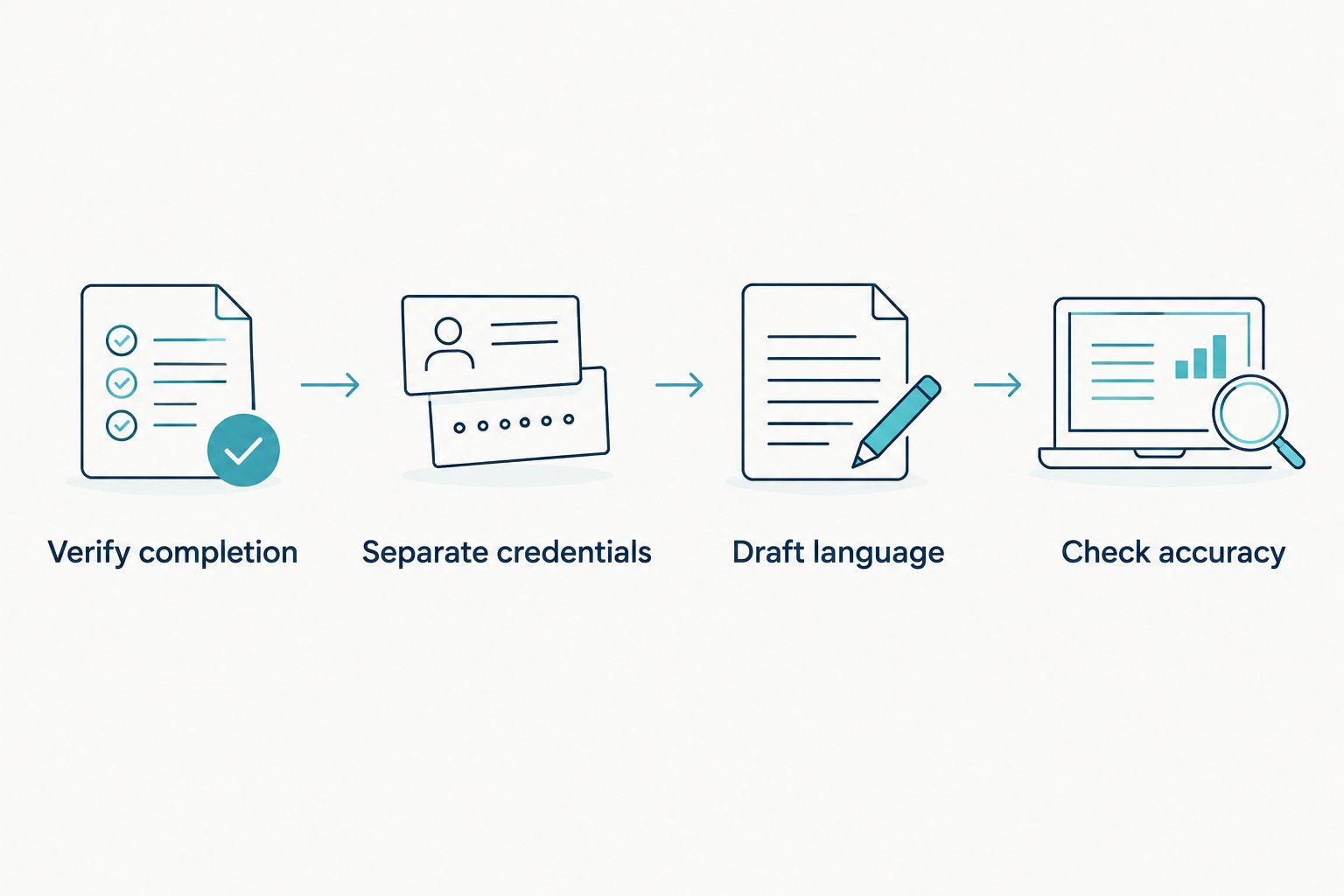
Use Verify completion, Separate credentials, Draft language, and Check accuracy as your working checkpoints. A polished biography does not compensate for an unsupported credential claim.
Headway profile update
Apply the verified wording
- Sign in to your practitioner account and consult the current profile-editing instructions. Locate the editable biography or training area only if your account provides one. Use the current interface rather than relying on an assumed menu path.
- Check the purpose of the destination field before entering text. If it requests licensure, professional designation, or payer information, keep your course completion statement out of that field. Ask Headway support where additional professional education belongs when the destination is unclear.
- Enter the verified wording in an appropriate editable area, if permitted. Follow any displayed length or formatting requirements. Attach a certificate only when the process explicitly requests or permits that document for the relevant purpose.
- Follow the account’s actual saving or submission instructions. If a review is required, wait for its outcome before treating the change as published. Inspect the public profile when the update becomes visible.
Expected result: The permitted profile area contains your accurate training statement, or you have a specific support question about where that statement belongs. Neither outcome changes your insurance participation status by itself.
Do not force the workflow through an unrelated field. A certificate that has nowhere appropriate to go is better retained in your professional records than misclassified as a license.
Treat the certificate and the insurance record as separate records. The benefit of this workflow is accurate communication, not a shortcut through credentialing.
Publication and record review
Check accuracy
- Compare the displayed profile with your source record. Check the program title, provider, completion details, and any professional designations surrounding the new wording.
- Read the full biography as a prospective client would. Confirm that the certificate statement does not make coaching, education, and licensed treatment sound interchangeable.
- Retain the final wording with the supporting documentation in your professional records. Keep client information out of this training file and out of any support request about the profile update.
- Review CE questions separately. Consult the applicable board’s requirements and the documentation for your specific activity rather than treating public profile publication as proof of CE acceptance.
Expected result: Your public wording and private documentation agree, and unresolved CE or credentialing questions remain outside the client-facing claim.
For a closer look at the distinction between a certificate and a specific credit question, read whether the grief counseling certificate qualifies for NBCC CE credit. Use that discussion alongside the documentation for your own completed activity and the requirements that apply to you.
Update the profile after additional training
A second workflow applies when you complete another program or receive corrected documentation. Start with the new evidence rather than adding another certificate title to the existing biography automatically.
- Verify the new completion record against the issued materials.
- Identify what changed: additional education, a corrected title, a completion date, or documented CE information.
- Revise only the affected profile language. Keep licensure and insurance details unchanged unless those records have independently changed.
- Repeat the publication check through the account’s current editing process.
For your 2026 update cycle, distinguish completed education from training still in progress. Do not describe enrollment, attendance, or partial participation as completion unless the issued documentation supports that description.
Best for ongoing learners: Maintain a detailed private education record and a selective public biography. The advantage is clarity; the limitation is that your profile will not display every course you have taken.
Choose relevance over volume. A training statement earns space when it helps a prospective client understand your actual approach, not merely because it adds another title.
Troubleshooting
There is no suitable certificate field
Do not use an unrelated credential field. Check the current account guidance or ask support whether additional education can appear in a biography or another appropriate area. Keep the certificate in your records while you clarify placement.
The certificate title sounds like a professional designation
Describe completion of the program rather than adopting the title as a credential. Preserve the exact program name, but make its educational role explicit in the surrounding sentence.
The program page and your documents show different details
Use the documents issued for your participation as the starting point. Ask the education provider to clarify discrepancies before publishing hours, completion status, or credit information. A current program description is not a replacement for your completion record.
The profile change is not publicly visible
Check the submission status and the account’s current instructions. Contact support if you cannot determine whether the change was saved, submitted, or requires further action. Do not repeatedly re-enter different credential wording to bypass the process.
You are unsure whether the course counts toward CE requirements
Separate that question from the profile edit. Review the activity’s CE documentation and the rules of the relevant licensing authority. A certificate appearing in a biography does not establish that a board accepts its credits.
Customize your workflow
Keep an education register with the exact course title, provider, completion date, supporting document, and any separately verified CE details. This reduces repeated transcription and gives you a clear basis for future profile revisions.
Use the same factual source record when reviewing your practice biography elsewhere. Adapt the explanation to each destination, but do not change the underlying credential claim to satisfy a field that requests something different.
The Embody Lab’s somatic professional education can inform how you describe your learning. Your scope, competence, and professional obligations determine how you describe your services. The certificate supports the education statement; it does not replace that judgment.
FAQ
Can I add an Embody Lab certificate to my Headway profile?
Use a permitted profile area for an accurate description of completed education, subject to Headway’s current account guidance. Do not assume a dedicated certificate field or upload process exists; ask support when placement is unclear.
Does an Embody Lab certificate qualify me to accept insurance?
A course certificate does not establish insurance participation. Professional licensure and payer credentialing are separate from completing somatic or trauma-informed education.
Is there an automatic Embody Lab to Headway integration?
This guide describes a manual document-to-profile workflow, not an automatic integration. Verify any proposed transfer method through the relevant providers before sharing account access or documents.
Should I list training hours in my therapist biography?
List hours only when your completion documentation supports them and the detail helps the reader. Do not substitute a current program’s advertised duration for the education you personally completed.
Can I call myself certified after completing a certificate program?
Describe the certificate you completed without implying a broader professional certification. Any designation you use should match the issued documentation and the professional rules that apply to you.
Does CE-accredited training count for every licensing board?
Do not assume universal acceptance of CE-accredited training. Match the activity’s documented approval and credit information to your licensing authority’s requirements.
What should I do if Headway has nowhere to upload my certificate?
Keep the certificate in your professional records and ask support whether additional education has an appropriate profile destination. Do not upload it as a license or another credential it does not represent.
One last thing
A profile can become less clear as the education list grows. For your final 2026 review, remove any training detail that obscures what clients need to know: your professional role, the care you provide, and how your approach fits their needs.
Keep the full education history in your records; publish the clearest accurate account of your practice.