Instead of repeatedly rewriting your training history for an Alma profile, create a verified education record, turn it into accurate profile language, and keep insurance credentialing documents separate. This 2026 workflow shows how to describe a certificate from The Embody Lab without presenting professional education as a license or an insurance-network approval.
- For the embody lab certificate alma insurance profile workflow, document completed education separately from licensure and insurance credentialing.
- The Embody Lab is best for practitioners seeking somatic and trauma-informed professional education, not a substitute for licensure.
- Use the exact certificate title and completed status; include continuing education hours only when your documentation supports them.
- Review profile language and credentialing submissions separately before sending either.
Why this matters
A certificate answers an education question: what training have you completed? A professional license answers an authorization question. Insurance credentialing evaluates a different set of qualifications and documents; an educational certificate does not itself confer network participation.
The Embody Lab is best for practitioners seeking somatic and trauma-informed professional education, not a substitute for licensure. Its certificate programs can inform how you describe your training. Your license, scope of practice, and actual clinical competence still govern the services you offer.
The central task in 2026 is accurate representation, not moving a file between platforms. A useful profile tells prospective clients what you studied without suggesting that a course certificate establishes a regulated professional title or guarantees insurance reimbursement.
Keep those distinctions visible throughout the workflow. A polished biography cannot correct an unsupported credential claim.
Before you start
- Gather your education evidence. Have your issued certificate, the exact program title, completion date, and any separate continuing education documentation. Keep the program description available for checking terminology, but use your completion record to substantiate your own achievement.
- Prepare your profile access and professional records. You need access to the Alma account you intend to update and your current professional credential information. Work from your own account rather than sharing account credentials with someone drafting your biography.
- Separate program hours from approved CE credit. A program's advertised duration is not automatically the number of CE credits you personally earned or the amount your licensing board accepts. Resolve that distinction before entering an hours figure in a professional record.
Do not begin with the assumption that a certificate belongs in an insurance credentialing field. First identify whether you are updating public-facing education language, supplying requested supporting documentation, or changing a regulated credential. Those are separate tasks.
Education record
- Collect the certificate issued to you and retain an unchanged copy. Use the issued document, not an enrollment confirmation or a screenshot of the course listing, as evidence of completion.
- Create a private education record containing the provider, exact certificate title, completion date, and status. Add hours only when an appropriate document specifies them.
- Record CE information separately. Include the credit type, documented amount, and any approval information shown on your CE record rather than inferring them from the program's marketing description.
- Check the name on your certificate against your professional records. Resolve a mismatch with the issuing provider before relying on that document for an administrative submission.
Expected result: You have an evidence-backed education entry that can support profile wording without changing the underlying certificate.
For The Embody Lab somatic education, preserve the distinction between the name of the program and the professional title you use. Completing a certificate program supports a statement about completed training. It does not, by itself, establish a new license, board certification, or protected designation.
Keep your working notes outside the certificate file. Editing the certificate to shorten a title, change a name, or add a professional suffix compromises the document you are using as evidence.
For your 2026 records, use the actual completion date. Do not replace an earlier completion date with the current year merely because you are updating your profile now.
Profile wording
- Draft a short statement using the exact program title and provider. Describe completion only after the certificate has been issued and the stated requirements have been met.
- Add a separate sentence explaining the clinical relevance of the education. Limit this sentence to approaches you actually use within your professional scope and competence.
- Open the profile-editing area available in your Alma account. Place the statement in an appropriate education, training, or biography area if one is available; do not force it into a license or credentialing category.
- Review the draft for implied qualifications. Remove language that turns course completion into specialist certification, authorization to practice, or insurance acceptance.
Expected result: Your profile describes education and practice clearly while keeping your regulated professional credentials distinct.
A conditional example illustrates the structure: if you completed the Integrative Somatic Trauma Therapy Certificate, you can describe that completion using the exact program name. If you also use body-centered approaches in your licensed practice, describe that work separately and accurately.
Prefer a narrow, substantiated statement over an expansive credential claim. Completed training in an approach and independently verified qualification in that approach are not interchangeable descriptions.
Do not copy claims about a program's intended learning outcomes into your biography as claims about your treatment results. Education can explain your preparation; it does not establish that every client will experience a particular outcome.
If your account does not offer an appropriate place for the information, ask Alma where completed professional education belongs. Use the controls and instructions actually presented in your account rather than assuming a particular field or upload option exists.
Separate credentials
- Identify the purpose of each requested document. Distinguish a public profile update from a license verification request, CE record, or insurance credentialing submission.
- Supply the document that answers the specific request. A completion certificate belongs with education evidence; a request for a professional license requires the relevant license documentation.
- Check whether supporting education materials have actually been requested. Do not submit an unrelated course certificate as a replacement for required credentialing evidence.
- Ask Alma for clarification when a request is ambiguous. Describe the document you hold and the requirement you are trying to satisfy without sending unnecessary personal information.
Expected result: Each document supports the correct administrative purpose, and no education entry is being treated as proof of insurance-network participation.
A certificate from an education provider should not become a new credentialing category simply because it has the word certificate in its title. Certification, licensure, CE credit, and course completion have different meanings.
For a 2026 submission, follow the instructions attached to that submission. A previously accepted biography statement does not establish that a document meets a separate payer or credentialing requirement.
Keep client information out of education records and profile-support materials. There is no reason to include clinical notes, case details, or identifiable client examples to demonstrate that you completed a course.
Final review
- Compare the profile draft with your issued certificate. Check spelling, program title, provider name, completion status, and every hours figure you included.
- Read the education statement alongside your professional title and insurance language. Confirm that the combined presentation does not imply a qualification the certificate does not establish.
- Use the available review and submission controls in your account. Follow any review instructions presented there rather than assuming that a saved draft is already public.
- Keep a dated copy of the wording you submitted. Inspect the displayed profile when it becomes available and correct any discrepancy through the appropriate account process.
Expected result: You retain a traceable record of the change and can verify that the displayed wording matches the evidence.
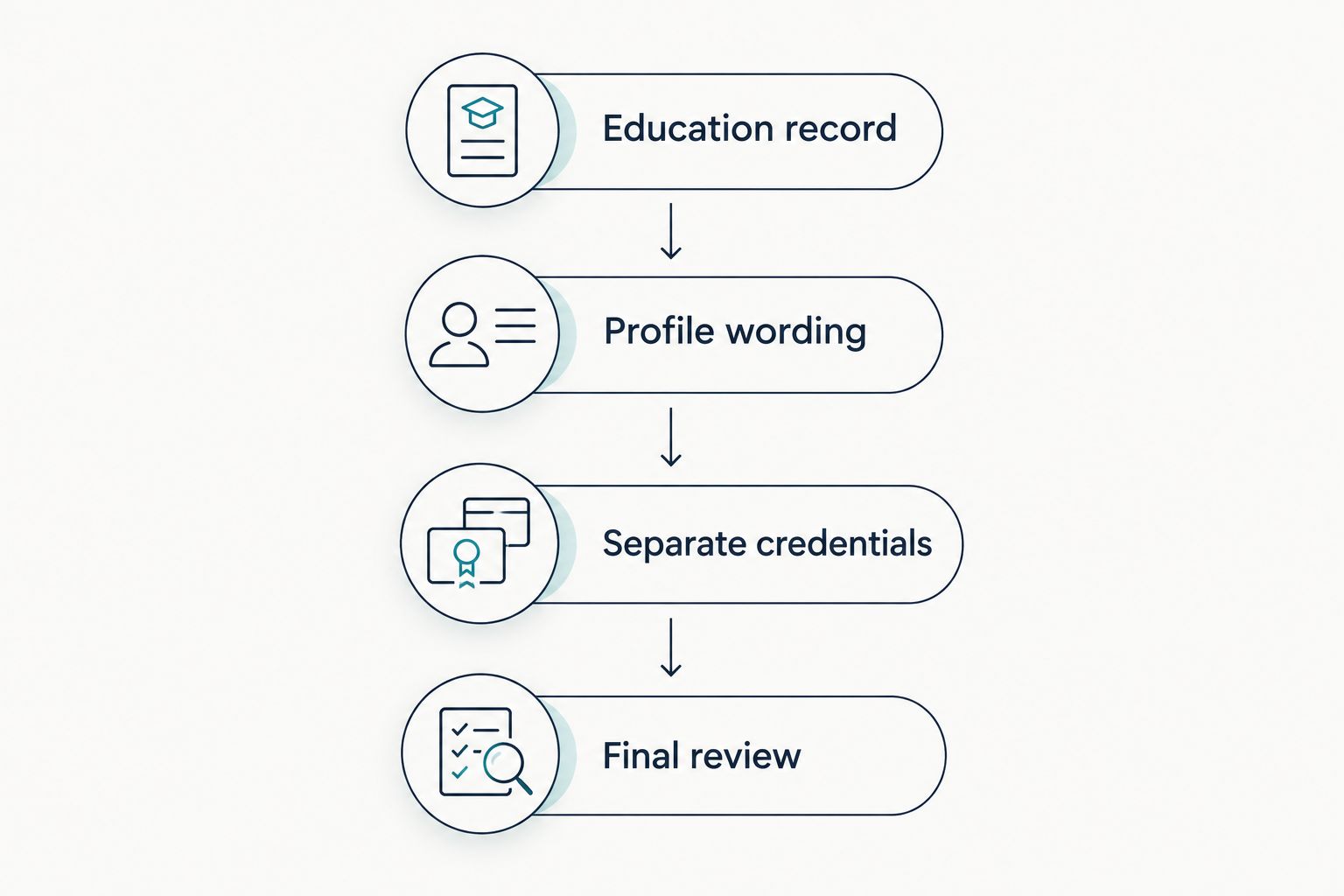
The workflow has four distinct checkpoints: Education record, Profile wording, Separate credentials, and Final review. Complete them in that order so that evidence drives the wording, not the other way around.
Update the profile when training changes
Use the same workflow when you complete another program, receive corrected documentation, or discover that an existing education statement is inaccurate. The trigger is a documented change—not enrollment, attendance alone, or a planned completion date.
For ongoing training, describe participation without implying completion. Once you receive the relevant completion evidence, replace the participation statement with an accurate completed-training statement.
A corrected certificate requires a document review before a profile edit. Compare the new document with your existing wording and update only the details that changed.
For your 2026 profile review, distinguish education changes from license changes. If your professional license information changes, handle that through the applicable credential-update process rather than relying on a biography edit to communicate it.
Keep a single verified education record as your reference. This reduces conflicting titles and dates across professional profiles, CVs, and administrative submissions.
Choose the education that matches your practice
Choose further training for its clinical relevance, not because you expect a certificate title to change insurance eligibility. The Embody Lab somatic education catalog includes programs with different subject matter and structures; those differences help you select education, not determine credentialing status.
The supplied program descriptions identify the Integrative Somatic Trauma Therapy Certificate as a 3-month online certificate and the Integrative Grief Counseling Certificate as a 12-module, 30-hour live training. These figures describe the programs, not a particular graduate's earned CE credits.
| Program | Best for | Educational focus | Limitation for this workflow |
|---|---|---|---|
| Integrative Somatic Trauma Therapy Certificate | Practitioners seeking body-centered trauma education | A framework for understanding and working with trauma | Program completion is education evidence, not proof of insurance credentialing |
| Integrative Grief Counseling Certificate | Practitioners seeking grief-focused education | Applied neuroscience, somatic practice, ritual, and relational work | Advertised training hours do not establish your personally earned CE credit |
Both programs provide a defined subject area you can name in an education history. Neither program description establishes that Alma or an insurer accepts the certificate for a particular administrative requirement.
Select training that addresses a real gap in your practice. Then document what you completed and describe its relevance without expanding the credential beyond its stated meaning.
Troubleshooting
The certificate title does not fit the profile space
Keep the full title in your private education record. Use a concise, accurate description in the public profile if space is restricted, without inventing an abbreviation that resembles a professional designation.
The requested field asks for a license
Provide license information, not a course certificate. Ask Alma for the correct location for additional education if you want that training represented elsewhere.
The CE document and program listing show different hours
Use the issued CE record for your earned-credit statement. Keep the advertised program duration separate and check discrepancies with the issuing provider before submitting the record to another organization.
The profile wording suggests independent certification
Replace the implied designation with a statement of completed education. Name the program rather than adding an unsupported professional title after your name.
A profile edit appears to change insurance status
Check the actual credentialing or network-participation record separately. Do not interpret a visible biography change as confirmation of approval, participation, or reimbursement eligibility.
Customize your workflow
Extend the education record to your CV, practice biography, and other professional directories. Keep the title and completion date consistent, but adapt the explanation of clinical relevance to each audience.
A prospective client needs a clear account of your preparation and approach. An administrator needs the exact document that satisfies the request. Avoid sending either audience the other's material.
Keep separate records for licensure, completed education, CE credit, and administrative correspondence. This organization makes future updates easier without creating a false equivalence between those categories.
FAQ
Can I add an Embody Lab certificate to my Alma profile?
Describe a completed certificate as professional education in an appropriate profile area, following the options and instructions available in your account. Confirm placement with Alma if the available categories are unclear.
Does an Embody Lab certificate qualify me to accept insurance through Alma?
A course certificate does not itself confer licensure or insurance-network participation. Alma and the relevant payer determine their applicable eligibility and credentialing requirements.
Should I upload my certificate as a professional license?
No. A course-completion certificate is education evidence, not a professional license; supply the document that matches the specific request.
Can I list program hours as continuing education credits?
Use your issued CE documentation for an earned-credit claim. Advertised program hours alone do not establish the credit amount you earned or your licensing board's acceptance.
Can I describe training before I finish the certificate?
Describe it as ongoing training rather than completed education. Update the statement after you meet the requirements and receive completion evidence.
Is this an automatic integration between the two platforms?
This guide describes a manual documentation and profile-review workflow. It does not require an automated connection between an education account and an Alma account.
What should I check before submitting my profile update?
Check the exact program title, completion status, dates, and any documented hours. Read the statement alongside your professional title to remove any unsupported implication of licensure, specialist certification, or insurance approval.
One last thing
Read your profile as if you had never seen the certificate. A technically accurate sentence can still mislead when it sits beside a professional title or insurance statement. Check the meaning of the complete presentation—not just the accuracy of individual words.