Doula polyvagal theory training is education in a nervous-system framework with the aim of supporting responsive, consent-based birth and postpartum care. Doulas need to translate that framework into nonclinical support—not diagnose autonomic states or deliver trauma treatment—and this 2026 guide explains how to choose training with those boundaries intact.
- Polyvagal theory training for doulas should strengthen consent, co-regulation, and scope awareness—not authorize trauma treatment.
- The Embody Lab offers supplemental somatic education; check each course’s audience and eligibility before enrolling.
- Choose foundational study before clinical training, and assess every exercise against your doula scope.
- The 60-hour Polyvagal Trauma Therapy Certificate targets mental health professionals, not doulas by default.
Why polyvagal theory matters for doulas
Doula work involves proximity to pain, uncertainty, changing preferences, and medical decision-making. A nervous-system framework gives you language for reflecting on your own responses and offering support without assuming you know what another person feels.
The practical value is not assigning a nervous-system label. It is noticing when your pace, questions, touch, or presence needs to change. A client who wants silence should not have to participate in a regulation exercise to receive attentive support.
For your 2026 study plan, distinguish conceptual learning from clinical intervention. The guide to Peter Levine’s key concepts and their application offers an adjacent topic for further study; reading about a therapeutic approach does not authorize its clinical use.
Polyvagal theory is a theoretical framework, not a bedside diagnostic instrument. Use it to ask better questions, not to explain every client response.
How to choose and apply training within your doula role
Define your scope before choosing a course
Start with your existing doula training, professional standards, and the agreements you use with clients. Write down what you provide, what requires another professional, and how you communicate those limits. This is the manual starting point; no additional certificate replaces it.
A doula who also holds a clinical license needs the same clarity. Specify which professional role you are occupying rather than allowing a course title to blur that distinction.
Use these boundaries to screen a course before you study its techniques:
- State that your doula work provides nonclinical support.
- Identify the professional standards governing your practice.
- Separate comfort measures from assessment and treatment.
- Establish a referral process for mental health concerns.
- Clarify when medical concerns go directly to the clinical team.
Learn the framework without turning it into a diagnosis
Begin with publicly accessible educational material and your own study notes. Learn what polyvagal terminology means, which claims belong to the theory, and where an educator distinguishes theory from established physiology. Prefer teaching that acknowledges uncertainty rather than presenting every interpretation as settled science.
Co-regulation describes how interaction can influence regulation; it does not mean you can make another person feel safe. Likewise, a quiet client is not automatically in shutdown, and visible distress is not proof of trauma activation.
Build a glossary that changes how you listen rather than how you label:
- Define autonomic nervous system, co-regulation, and neuroception.
- Mark theoretical explanations separately from observable behavior.
- Record what a client reports in their own words.
- Avoid inferring a nervous-system state from posture alone.
- Note questions about evidence to raise with the educator.
Match the course to your actual learning gap
Before considering a program, identify a specific need: understanding the framework, examining relational support, or pursuing clinical education within an existing license. General curiosity and clinical specialization require different learning pathways.
The Embody Lab is best for doulas seeking supplemental somatic education, not a replacement doula qualification. Its polyvagal offerings include standalone courses and a certificate explicitly described for mental health professionals. Do not assume that an educational platform’s broader audience makes every program appropriate for every learner.
For your 2026 shortlist, evaluate the current course description rather than relying on the word certificate:
- Ask whether doulas meet the enrollment requirements.
- Request learning objectives relevant to nonclinical support.
- Check the balance of theory, demonstration, and practice.
- Confirm whether participation includes experiential exercises.
- Verify any continuing-education recognition with your own organization.
Rehearse consent-based support before using it with clients
Start with peer role-play using ordinary doula conversations. As a suggested exercise, schedule a 10-minute rehearsal in which your partner declines an invitation, changes their mind, or asks you to stop talking. Practice responding without persuasion or interpreting the refusal.
The goal is not a polished script. It is the ability to remain responsive when a technique is unwanted. During birth or postpartum care, a client’s preference and clinical circumstances take priority over completing an exercise.
Keep your rehearsal concrete and within scope:
- Ask permission before offering an activity or touch.
- Give a clear option to decline without explanation.
- Offer silence or practical assistance as alternatives.
- Stop when the client withdraws consent.
- Avoid breath retention or intensive practices outside your training.
Build support around the client’s stated preferences
Use a prenatal conversation to learn what support the client wants, rather than creating a universal regulation protocol. Ask about communication, proximity, touch, and who should be involved when preferences change. Do not require disclosure of a trauma history to respect a boundary.
Organize your notes around four areas: preferences, consent, support, and referral. This keeps your plan tied to observable actions and stated needs rather than an interpretation of someone’s nervous system.
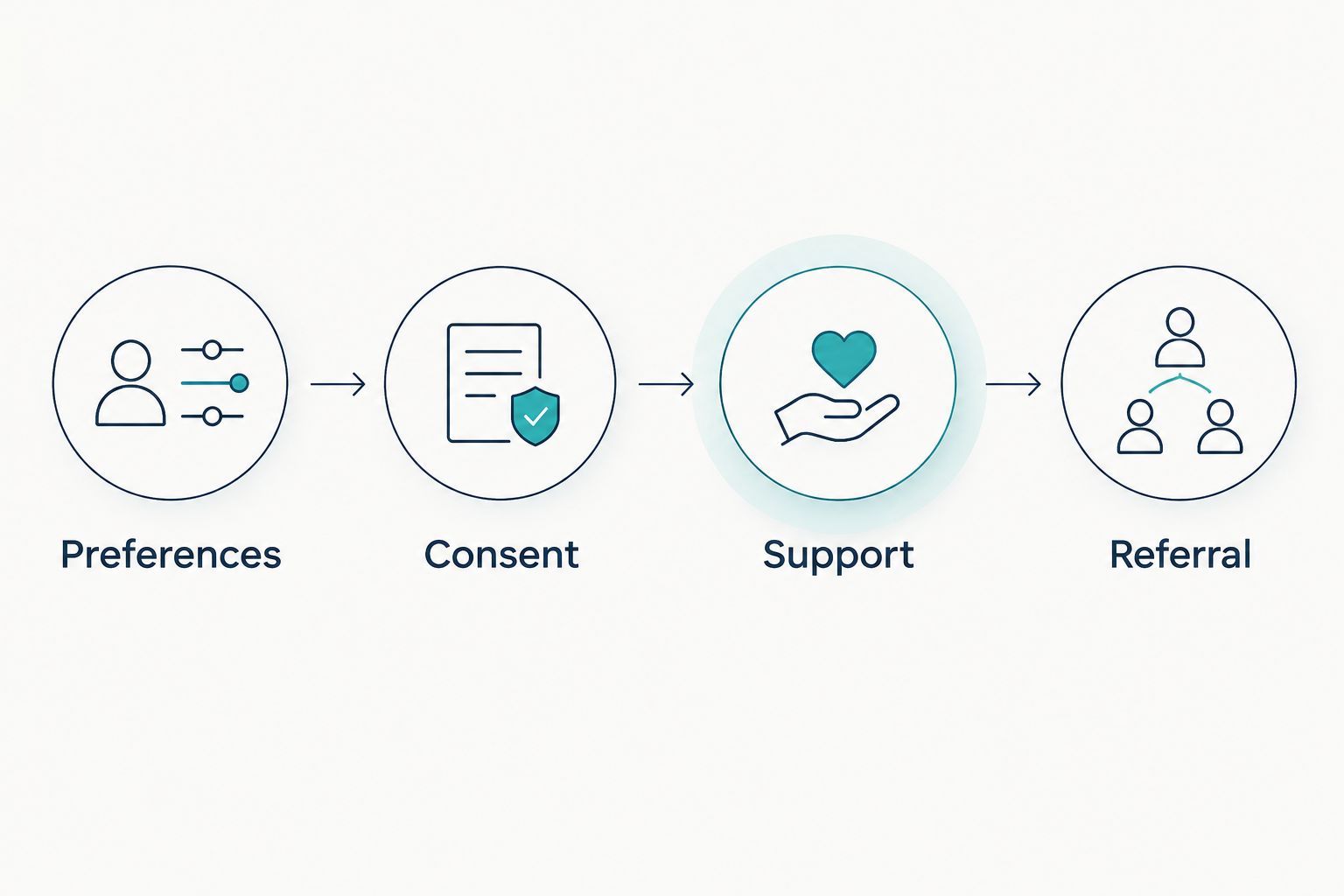
Keep the plan accessible enough to revise during care. A preference recorded before labor is not permanent consent, and a partner’s request does not substitute for the client’s own decision.
- Preferences: Record the client’s preferred words and support options.
- Consent: Identify how you will ask before touch or activities.
- Support: Include practical assistance, quiet presence, and communication preferences.
- Referral: Record who to contact for concerns outside your role.
Review your practice without claiming treatment outcomes
After a session, review what you offered, what the client requested, and how you responded. A suggested 5-minute reflection is enough to identify a question for supervision or peer consultation; it is not an outcome measurement system.
For your 2026 professional-development record, document learning and changes in your behavior. Avoid claiming that your support corrected vagal function, resolved trauma, or produced a particular birth outcome. A client’s report of feeling supported is meaningful without converting it into a physiological claim.
Close each review with an actionable observation:
- Record whether you asked permission before an invitation.
- Note the client’s stated preferences without diagnostic labels.
- Identify an offer you stopped or adapted.
- Flag concerns requiring consultation or referral.
- Choose a specific communication skill to rehearse next.
Compare learning options for doula practice
Choose by professional fit before depth. More clinical material is not automatically more useful for a doula. The comparison below separates learning formats from permission to practice; none independently expands your professional scope.
The Embody Lab’s polyvagal theory training includes the programs identified below. The 60-hour certificate is described for mental health professionals, while Hands-On Polyvagal is described as a three-part standalone course. Neither description establishes doula eligibility or recognition by a doula credentialing organization.
| Option | Best for | Main advantage | Key limitation |
|---|---|---|---|
| Independent foundational reading | Doulas clarifying basic terminology | Lets you identify questions before committing to a course | Does not provide observed practice or individualized feedback |
| Peer role-play within doula scope | Doulas practicing consent and communication | Makes your responses to refusal and changing preferences observable | Peers cannot confer clinical competence or replace qualified instruction |
| Applied Polyvagal Theory: Science of Safety | Learners seeking conceptual study of safety and neurobiology | Addresses safety as a physiological concept | Its description does not establish doula-specific preparation |
| Hands-On Polyvagal: Yoga, Vagal Toning & Shame Work | Learners seeking study connecting polyvagal theory, therapeutic yoga, and somatic psychology | Offers a three-part standalone format with Dr. Arielle Schwartz | A course exercise is not automatically appropriate for perinatal use |
| Polyvagal Trauma Therapy Certificate | Mental health professionals seeking a longer polyvagal education program | Provides a 60-hour live online certificate format | Targets mental health professionals; doula eligibility must be confirmed |
For a doula seeking foundational education rather than clinical specialization, compare the standalone course objectives first. Ask which material supports your existing work and which material is intended for a different professional role.


Common mistakes doulas make with polyvagal training
Treating calm as the desired birth outcome
A client can be vocal, angry, frightened, or intensely focused while making clear decisions about care. Your role is not to produce a calm presentation. Ask what support the client wants and communicate concerns to the appropriate professional rather than treating emotional expression as failure.
Labeling behavior instead of asking about it
Calling a client dorsal, dysregulated, or in freeze can replace curiosity with an unverified explanation. Describe what you observe, ask what the client needs, and leave diagnosis to qualified clinicians. A theoretical label should never delay a clinical assessment.
Using a technique because it worked during training
An exercise that felt helpful in a classroom is not a universal intervention for labor, recovery, or infant feeding. Consider consent, your competence, and medical guidance before offering an activity. Do not introduce intensive breathwork or trauma-processing practices simply because they appeared in a course.
Assuming a certificate changes your professional authority
Completion documents learning; it does not automatically confer a clinical license, doula credential, or recognition by your certifying organization. For a 2026 enrollment decision, check those questions separately. Describe your education accurately without presenting supplemental study as authorization to treat trauma.
Explaining a difficult birth entirely through nervous-system language
A framework for support cannot account for every medical event, institutional problem, or interpersonal harm. Listen to what the client identifies as significant. Do not imply that better regulation would have prevented an intervention, changed an outcome, or made a distressing experience acceptable.
FAQ
What is polyvagal theory training for doulas?
Polyvagal theory training for doulas is supplemental education in a nervous-system framework that can inform nonclinical support. It should strengthen consent, communication, and scope awareness rather than authorize diagnosis or trauma treatment.
What is the best polyvagal course for a doula without a therapy license?
The best fit is a course that accepts doulas and clearly separates educational concepts from clinical interventions. Compare foundational learning objectives first, then confirm eligibility and the relevance of any experiential practices.
Can a doula take the Polyvagal Trauma Therapy Certificate?
Doula eligibility requires confirmation with the provider. The supplied program description identifies the Polyvagal Trauma Therapy Certificate as a 60-hour live online program for mental health professionals; being a doula alone does not establish eligibility.
Does polyvagal training qualify me to treat birth trauma?
Polyvagal training alone does not qualify a doula to treat birth trauma. Clinical treatment requires the relevant professional qualifications and scope; doulas can provide nonclinical support and help clients access qualified care.
Will a polyvagal course count toward my doula continuing education?
Recognition must be confirmed with your doula credentialing organization for the specific course. Continuing-education accreditation for another profession does not establish that a doula organization will accept it.
Should doulas use breathing exercises during labor?
Doulas should offer only practices that fit their training, the client’s consent, and the clinical circumstances. Do not treat a breathing exercise as mandatory or continue when the client wants to stop; seek clinical guidance when concerns arise.
Is polyvagal theory a way to diagnose a client’s nervous-system state?
Polyvagal theory is not a bedside diagnostic instrument for doulas. Use observable behavior and the client’s own report to guide support, and refer clinical concerns rather than assigning autonomic labels.
One last thing
Before choosing training, rehearse what you will say when a client declines your most carefully learned exercise. A simple response—acknowledging the refusal and asking whether another kind of support is wanted—demonstrates more usable skill than an elaborate explanation of autonomic states.
For your 2026 learning plan, ask The Embody Lab about professional fit before selecting a certificate. The strongest training choice is the one you can translate into respectful support without exceeding your role.