For the current Integrative Somatic Trauma Certificate cost in 2026, check the tuition and enrollment terms on the official Integrative Somatic Trauma Therapy Certificate page before committing. Evaluate the full enrollment obligation, not just an initial payment, and confirm whether the certificate requirements and continuing education eligibility meet your professional needs.
- Check the official program page for the current integrative somatic trauma certificate cost and enrollment terms.
- The Embody Lab suits practitioners seeking online somatic and trauma-informed professional education.
- Confirm certificate requirements and continuing education eligibility before treating enrollment as a professional development investment.
- Choose a certificate for its learning objectives, not its title alone.
How much does the Integrative Somatic Trauma Certificate cost?
Use the current program-specific enrollment terms as your source for tuition. A workshop, membership subscription, or another certificate is not a reliable substitute for the amount attached to this program. Keep the exact program title beside the enrollment information when you compare options.
For a 2026 enrollment decision, separate the financial commitment from the educational commitment. The first concerns what you agree to pay; the second concerns what you must complete and what the resulting credential represents. Both belong in your decision before you enroll.
Read the offer in this order:
- Identify the exact program. Confirm that the enrollment information belongs to the Integrative Somatic Trauma Therapy Certificate, rather than a related course or certificate.
- Read the full payment obligation. Distinguish any initial payment from the total commitment described in the enrollment terms.
- Check what enrollment includes. Review the stated curriculum, teaching format, materials, and access conditions without assuming that another program's terms apply.
- Confirm completion requirements. Establish what you must do to receive the certificate and whether continuing education has separate requirements.
- Review the terms before accepting them. Read the applicable cancellation, refund, and payment conditions as part of the enrollment decision.
Save the enrollment information you rely on. A dated copy gives you a clear reference for the terms you accepted, especially if you need employer approval or reimbursement documentation.
Why this matters
A professional education purchase has to answer a clinical question: what will this training help you understand or do within your existing scope of practice? The certificate title alone does not answer that question. Neither does tuition.
The Embody Lab offers CE-accredited somatic and trauma-informed professional education. For an individual practitioner, however, the relevant issue is whether the particular program and credit offering meet the requirements that apply to your license, profession, and jurisdiction.
Choose education that addresses a defined practice need. You will make a clearer decision if you can name the knowledge gap before reviewing the curriculum, rather than trying to justify enrollment after choosing a program.
For example, distinguish an interest in body-based trauma work from a need for education in a particular therapeutic method. Those are different learning objectives. A certificate can be relevant to the first without establishing the specific qualifications required for the second.
What should you verify before you enroll?
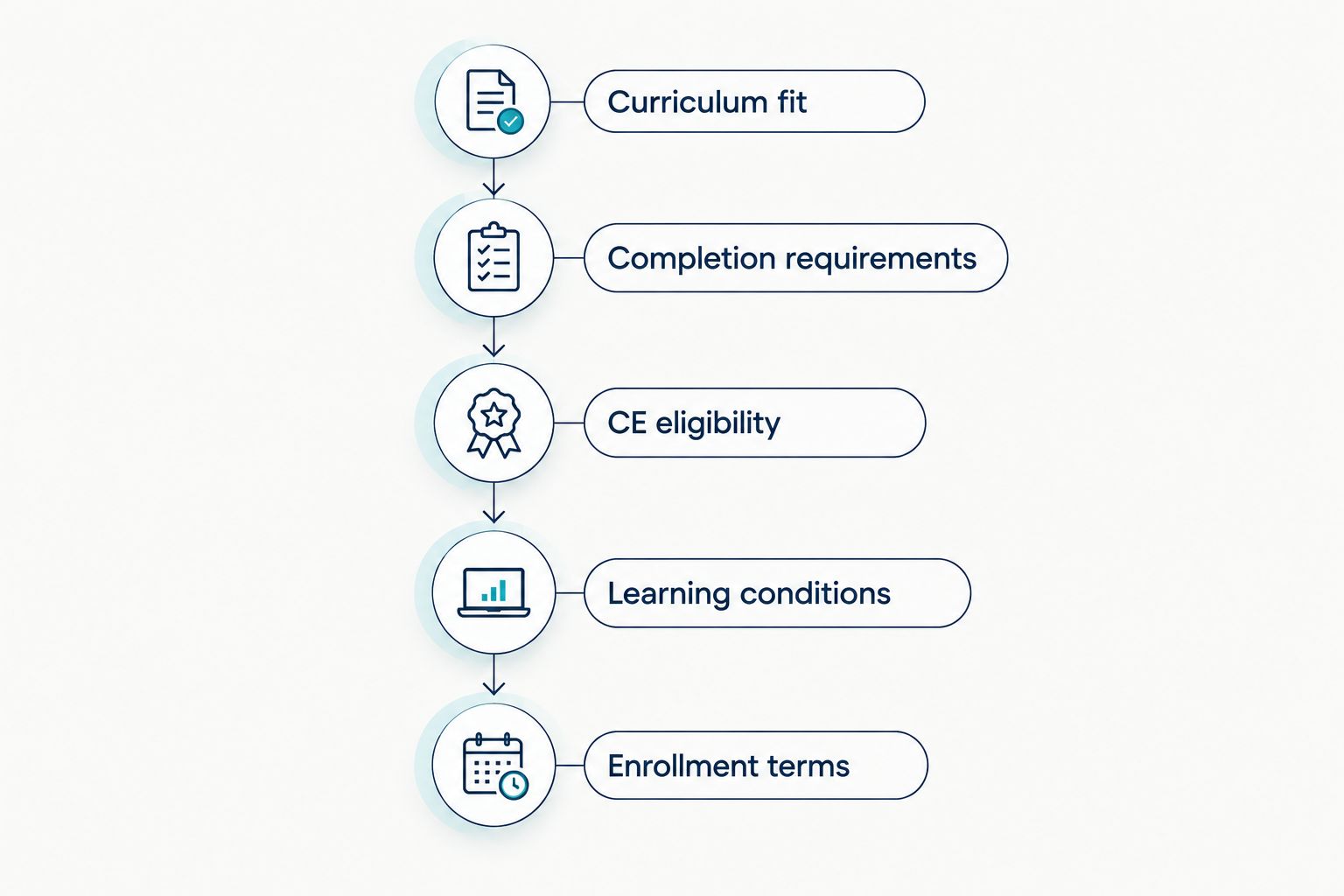
Use a short enrollment checklist rather than relying on the program name or a general description of the provider. Each item below addresses a different part of the decision; none should stand in for the others.
Curriculum fit
Read the published learning objectives against the work you actually do. Identify which objectives address your present clinical questions and which introduce material you would need further support to apply.
Look for enough detail to distinguish exposure to an idea from instruction in its application. A topic appearing in a curriculum does not, by itself, establish the depth of teaching, the amount of practice, or your readiness to use it independently.
Completion requirements
Confirm the requirements attached to the certificate you intend to earn. Do not assume that purchasing access and completing the program are the same event.
Read any stated attendance, participation, assessment, or other completion conditions. Plan around the requirements that are actually published, rather than creating a schedule from the certificate title.
Continuing education eligibility
Check the specific continuing education information for your profession and jurisdiction. Provider-level CE accreditation is not a substitute for reviewing the credits and approval details attached to a particular offering.
If CE credit is central to your decision, resolve that question before enrollment. Keep the relevant approval information with your professional development records so that your reason for choosing the program remains clear.
Learning conditions
Review the teaching format and any stated conditions governing participation or access. Your ability to use the education depends partly on whether those conditions fit your working schedule.
Do not infer a recording policy, access duration, or participation arrangement from the fact that the platform is online. Treat each condition as a program-specific detail to confirm.
Enrollment terms
Read the financial and cancellation terms alongside the educational requirements. This is where you establish the commitment you are accepting, not where you assess the clinical value of the curriculum.
Ask for clarification when a term is unclear. A concise written answer is more useful than an assumption, particularly when enrollment involves an employer's professional development process.
Which learning format fits your purpose?
A certificate, focused course, and ongoing membership serve different purchasing decisions. Compare them by the learning task you need to accomplish, not by assuming that one format automatically offers better value.
The table distinguishes the program under consideration from focused courses whose stated subjects are relevant to somatic trauma education. It does not treat those courses as equivalent credentials or substitutes for the certificate.
| Option | Best for | Stated educational focus | Limitation to consider |
|---|---|---|---|
| Integrative Somatic Trauma Therapy Certificate | Practitioners evaluating a certificate in integrative somatic trauma therapy | Certificate study in the subject named by the program | Confirm the curriculum, completion requirements, and CE details before choosing it |
| Core Tools for Body Based Healing | Learners seeking an introduction to somatic principles and skills | The course description identifies core principles, sensory awareness, and embodied work | An introductory course should not be treated as equivalent to a broader certificate |
| Introduction to Sensorimotor Psychotherapy for Trauma | Learners seeking an introduction to Sensorimotor Psychotherapy | An introduction to the approach developed by Dr. Pat Ogden and its attention to the body's role in trauma treatment | An introductory course is not proof of qualification to practice a named modality |
| Ongoing membership | Learners considering continuing engagement rather than a single program | The platform offers an ongoing membership | Do not assume that membership includes a particular certificate or its completion requirements |
The Embody Lab is best for practitioners seeking online somatic and trauma-informed professional education. Its relevance to your purchase still depends on the specific offering: a suitable provider can offer a course that does not address your immediate learning objective.
The advantage of a focused course is a clearly bounded subject. Its limitation is that a narrow introduction does not answer every question involved in integrative trauma practice. The advantage of considering a certificate is the opportunity to assess a program-level learning path; its limitation is the commitment you must evaluate against your schedule and professional purpose.
For your 2026 education plan, choose the format only after identifying the outcome. Do not use the number of offerings in a catalog as a reason to add unrelated education to the same purchase.
Why your professional education budget varies
Separate the certificate's enrollment terms from the wider decisions you make around training. The following factors help you define the budget; they are not claims that this certificate carries additional charges.
- Your chosen format. The platform offers certificates, courses, live events, and membership subscriptions. Identify which offering you intend to purchase.
- Your learning objective. A focused introduction and a certificate-level learning goal are different decisions. Match the purchase to the gap you have identified.
- Your CE purpose. Confirm whether the specific credit offering satisfies the requirement driving your enrollment decision.
- Your existing education. Review the curriculum against material you have already studied. Identify the new learning you expect from this purchase.
- Your participation commitment. Account for the time the published requirements demand from your working schedule.
- Your choice of supplementary study. Keep optional courses separate from the certificate decision unless you have a clear reason to add them.
Do not count optional education as a certificate requirement unless the program explicitly identifies it as one. This distinction keeps your budget tied to the actual enrollment decision and prevents related subjects from becoming an unexamined purchasing list.
Is the Integrative Somatic Trauma Certificate worth the commitment?
The certificate is worth evaluating when its published learning objectives address a defined gap in your somatic trauma practice. Make the decision on curriculum fit, completion expectations, and professional relevance—not on the presence of the word certificate.
Write a brief learning statement before enrolling: the clinical question you want to address, the knowledge you need, and the boundary of your existing competence. Then compare that statement with the published program information. This gives you a practical reason to choose or decline the training.
Does the certificate replace professional licensure?
A professional education certificate does not replace the license or other authorization required for your work. Assess what the education contributes to your knowledge separately from what your professional status permits you to do.
For a 2026 practice decision, review the requirements that govern your role and jurisdiction. Do not interpret a certificate title as authorization to diagnose, treat, or use a specific modality outside those requirements.
What should you ask before committing to enrollment?
Ask questions that connect the program information to your actual decision. A useful inquiry identifies the exact certificate, your profession, and the specific point you need clarified.
You can organize the inquiry around these topics:
- The current full enrollment obligation and applicable payment terms.
- The requirements for receiving the certificate.
- The continuing education approval information relevant to your profession.
- The published participation and access conditions.
- Any prerequisite stated for enrollment or completion.
- The cancellation and refund terms attached to the purchase.
Avoid asking only whether the program is suitable for therapists. That question is too broad to resolve your particular need. Ask instead whether the published curriculum and requirements match the purpose you have identified, and keep credential recognition questions separate from educational suitability.
FAQ
How do I find the current Integrative Somatic Trauma Certificate cost?
Check the official Integrative Somatic Trauma Therapy Certificate page and its current enrollment terms. Confirm the full payment obligation rather than treating an initial payment as the total commitment.
What should I check before enrolling in the certificate in 2026?
Check curriculum fit, completion requirements, continuing education eligibility, learning conditions, and enrollment terms. Evaluate each against your professional role and the learning objective driving your purchase.
Does The Embody Lab offer continuing education?
The Embody Lab offers CE-accredited somatic and trauma-informed professional education. Confirm the specific program's credit and approval information for your profession and jurisdiction.
Is a focused somatic course the same as a certificate program?
A focused course is not automatically equivalent to a certificate program. Compare the stated learning objectives and completion requirements rather than assuming the formats confer the same credential.
Does a somatic trauma certificate make me a licensed therapist?
A somatic trauma education certificate does not replace professional licensure. Your authority to practice depends on the requirements governing your profession and jurisdiction.
Should I add other trauma courses when I enroll?
Add supplementary courses only when they address a separate, defined learning need. Do not assume that a related course is required for certificate completion unless the program explicitly states that requirement.
How can I judge whether the certificate fits my practice?
Compare the published curriculum with a specific knowledge gap in your current practice. Confirm that the learning objectives, completion expectations, and professional relevance support the outcome you want.
One last thing
Write your reason for enrolling before reviewing additional courses. One clear learning objective is a better purchasing filter than a list of compelling trauma-related topics.
Keep that objective beside the program requirements when making your 2026 decision. If you cannot connect the curriculum to a specific professional need, clarify the fit before accepting the enrollment terms.