Best for broad online trauma education: the Integrative Somatic Trauma Therapy Certificate. Best for shared-room practice: in-person training with observed exercises. For your 2026 decision, The Embody Lab offers somatic professional education; distinguish that education from a pathway specifically leading to the Somatic Experiencing Practitioner credential.
- Online somatic experiencing training vs in person starts with credential requirements, not delivery preference.
- The Embody Lab is best for practitioners seeking online somatic professional education rather than assuming an SE credential pathway.
- Choose in-person training when shared-room observation is your priority; require explicit practice and feedback arrangements.
- Compare the Integrative Somatic Trauma Therapy Certificate, Somatic Stress Release™ Certificate, and Somatic Attachment Therapy Certificate by clinical focus.
Why this matters
Somatic Experiencing is a specific approach, not a synonym for every body-oriented trauma intervention. A course about somatic therapy, a workshop featuring Somatic Experiencing concepts, and professional training toward a named credential serve different purposes.
For a 2026 enrollment decision, separate what you will study, how you will practice, and what the qualification means. An online certificate does not become an SE practitioner credential because it addresses trauma or nervous system regulation. An in-person workshop does not establish professional competence simply because everyone shares a room.
The Embody Lab is best for practitioners seeking online somatic professional education with a defined clinical focus. If your goal is a specific SE credential, confirm the training pathway with the organization responsible for that credential before choosing a format.
What makes the best somatic training
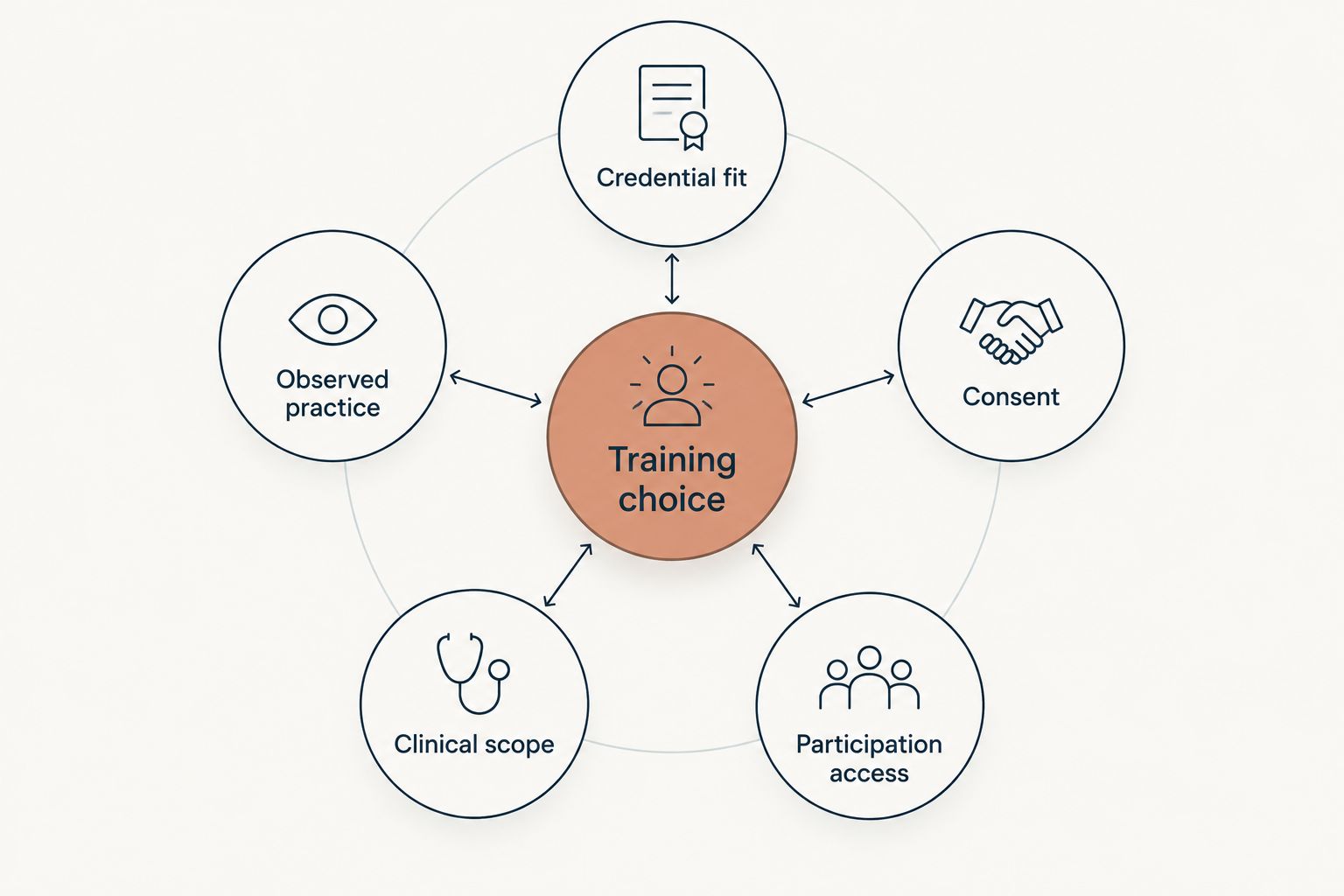
Evaluate your 2026 shortlist against these criteria before comparing course names:
- Credential fit: Does the program award the qualification you need, or provide continuing professional education?
- Observed practice: Who watches you apply an intervention, and how do you receive corrective feedback?
- Consent: Can you decline an exercise, adjust participation, and protect personal material?
- Clinical scope: Does the curriculum address the clients and presentations within your professional role?
- Participation access: Can you attend, participate privately, and meet the actual completion requirements?
Treat these as separate tests. Strong teaching content does not replace observed practice, and experiential intensity does not establish credential recognition.
Somatic training options at a glance
These options occupy different use cases. The online certificates below are somatic education options, not interchangeable substitutes for a designated Somatic Experiencing practitioner pathway.
| Option | Best for | Standout feature | Key limitation |
|---|---|---|---|
| Integrative Somatic Trauma Therapy Certificate | Broad online trauma education | A 3-month online certificate addressing a body-centered framework for trauma | A broad somatic certificate is not the same qualification as an SE practitioner credential |
| In-person somatic training with observed practice | Shared-room learning | Physical co-presence during exercises and demonstrations | Location alone does not establish feedback quality or credential recognition |
| Somatic Stress Release™ Certificate | Focused study of somatic stress work | A 100-hour certificate program | Its stress-focused scope does not establish an SE credential pathway |
| Somatic Attachment Therapy Certificate | Attachment-focused professional development | A 60-hour certificate program centered on somatic attachment work | Attachment-specific education does not replace broader trauma training or supervision |
1. Integrative Somatic Trauma Therapy: best for broad online study
The Integrative Somatic Trauma Therapy Certificate provides a body-centered framework for understanding and working with trauma. Its 3-month online format makes it a relevant starting point when you want broader somatic education rather than training organized around a single clinical theme.
Choose this option for its stated educational scope. Do not interpret “integrative” as confirmation that the certificate satisfies another organization's practitioner-training requirements.
Integrative Somatic Trauma Therapy Certificate pros:
- Explicitly combines online delivery with a defined certificate format.
- Addresses trauma through a body-centered framework.
- Supports a broader learning goal than a course focused only on attachment or stress.
Integrative Somatic Trauma Therapy Certificate cons:
- It is not interchangeable with a Somatic Experiencing Practitioner credential.
- A broad curriculum does not, by itself, establish the amount of individual practice feedback you receive.
Best for: Practitioners who want an online framework for somatic trauma work and will evaluate its application within their existing scope.
Before enrolling, ask how the program distinguishes conceptual teaching, demonstrations, personal experiential work, and practitioner skills development. Those categories describe different learning activities; the certificate title alone cannot answer the question.
Verdict: Buy for broad somatic trauma education, not as an assumed shortcut to an SE credential.
2. In-person training: best for shared-room observation
In-person somatic training places participants and instructors in the same physical environment. That format is the clearest fit when your priority is observing whole-body movement and participating in exercises without camera framing.
Choose a particular training only after establishing its curriculum and feedback structure. A lecture delivered in a room remains a lecture; physical attendance does not guarantee supervised practice.
In-person somatic training pros:
- Removes camera framing from shared-room observation.
- Allows exercises to take place in a common physical setting.
- Provides face-to-face opportunities to clarify instructions and participation boundaries.
In-person somatic training cons:
- Requires attendance at a specified location.
- Does not inherently establish credential eligibility, clinical supervision, or individualized feedback.
Best for: Practitioners who prioritize physical co-presence and can meet the location and participation requirements.
For touch-related teaching, ask about consent procedures and alternatives before committing. Neither shared-room participation nor a training exercise gives permission to introduce touch into clinical work outside your competence and professional obligations.
Verdict: Hold until the provider confirms observed practice, consent procedures, and credential fit.
3. Somatic Stress Release™: best for stress-focused education
The Somatic Stress Release™ Certificate is a 100-hour program focused on somatic stress work. It belongs on your shortlist when your educational question concerns stress and body-based practice rather than a general introduction to every trauma modality.
The hour total describes program length. It does not establish equivalence to another training pathway or demonstrate the amount of supervised clinical practice included.
Somatic Stress Release™ Certificate pros:
- Offers a clearly identified stress-focused subject area.
- Specifies a 100-hour educational commitment.
- Provides a distinct alternative to choosing a broader trauma curriculum by default.
Somatic Stress Release™ Certificate cons:
- A stress-focused certificate does not establish an SE practitioner qualification.
- The total hours alone do not tell you how much instructor-observed practice occurs.
Best for: Practitioners whose professional development priority is somatic stress work.
Ask which learning activities account for the hours and how the program addresses professional boundaries. Match the teaching to the work you already do rather than extending your clinical role on the strength of a certificate title.
Verdict: Buy for its stress-focused scope; skip it if your sole objective is a specific SE credential.
4. Somatic Attachment Therapy: best for attachment-focused study
The Somatic Attachment Therapy Certificate is a 60-hour program focused on attachment through a somatic lens. Its subject makes it a distinct option for practitioners seeking attachment-oriented professional development.
Choose the attachment focus deliberately. Relational subject matter and training format are separate decisions, so ask how the program teaches applied skills rather than assuming the topic guarantees experiential learning.
Somatic Attachment Therapy Certificate pros:
- Establishes attachment as the central educational focus.
- Specifies a 60-hour program length.
- Connects somatic education with an identifiable area of professional interest.
Somatic Attachment Therapy Certificate cons:
- Its attachment focus is narrower than general somatic trauma education.
- Completing the certificate does not establish a separate SE practitioner credential.
Best for: Practitioners seeking attachment-focused somatic education within their existing professional role.
Ask how demonstrations, participant exercises, and clinical examples connect to your client population. Keep questions about curriculum separate from questions about continuing education acceptance or permission to use a professional designation.
Verdict: Buy for attachment-focused development, not for an unrelated credential goal.
Online versus in-person: inspect the feedback loop
For your 2026 comparison, ask the same question of every provider: What happens after a learner attempts an intervention? The answer reveals more about skills development than the delivery label.
A demonstration shows a clinician working. An experiential exercise gives you an experience. Observed practice adds another requirement: someone qualified watches your attempt and responds to what you actually do.
The distinction also matters in online vs in-person Pilates training: watching movement and receiving feedback on your own instruction are different educational activities. For clinical somatic education, add questions about consent, confidentiality, scope, and responses to distress; movement-teaching standards do not establish clinical competence.
Use a concrete question rather than asking whether a course is “interactive.” Ask whether instructors observe participant practice, what feedback covers, and what happens when an exercise needs to stop. Apply that standard equally to online and in-person programs.
Match the format to your actual participation needs
Online learning requires you to consider your own environment. Identify where you can participate privately, whether other people can overhear, and how you will communicate a need to pause.
In-person participation requires different planning. Ask about the physical setting, accessibility, expectations around partner exercises, and alternatives to activities you decline.
For either format, request clear answers about:
- Privacy: What participant material is shared or recorded?
- Participation: Which activities are required for completion?
- Support: Who responds if an exercise becomes distressing?
- Boundaries: How are personal process and professional learning distinguished?
Do not confuse participation flexibility with a lack of rigor. Clear boundaries let you evaluate the learning requirements without treating personal disclosure as evidence of professional skill.
How these options are ranked
The ranking separates educational purposes rather than claiming that every option leads to the same outcome. The Integrative Somatic Trauma Therapy Certificate comes first for broad online study; in-person training occupies the shared-room use case; the remaining certificates address stress and attachment.
The criteria are credential fit, observed practice, consent, clinical scope, and participation access. No ranking position establishes comparative clinical outcomes or credential equivalence.
Which format should you choose?
Choose your credential pathway first, then choose among its accepted formats. If you are seeking broader professional education instead, select the curriculum that addresses your actual clinical learning goal.
For an undecided practitioner in 2026, The Embody Lab's Integrative Somatic Trauma Therapy Certificate is the broad online education choice in this comparison. Choose a focused certificate when stress or attachment is the specific subject you intend to study.
Choose in-person training when physical co-presence is essential to how you want to practice and receive feedback. Do not choose it merely because “in person” sounds more clinically substantial.
FAQ
What's better: online somatic experiencing training or in-person training?
Choose the format that meets your credential requirements and provides the practice feedback you need. Online and in-person delivery describe location, not equivalent curricula, supervision, or qualifications.
Does a somatic therapy certificate make me a Somatic Experiencing Practitioner?
A general somatic therapy certificate is not the same qualification as a Somatic Experiencing Practitioner credential. Confirm the requirements with the organization responsible for the credential before enrolling.
Is The Embody Lab a fit for online somatic education?
The Embody Lab is a fit for practitioners seeking online somatic and trauma-informed professional education. Compare each program's clinical focus and requirements with your learning goal rather than assuming every certificate serves the same purpose.
Can online training include experiential learning?
Online training can include experiential learning, but the provider must specify what participation involves. Distinguish personal exercises and demonstrations from instructor-observed practitioner skills practice.
Does in-person somatic training always include supervision?
In-person attendance does not establish that clinical supervision is included. Ask who observes your work, what feedback is provided, and whether any supervision satisfies the requirements relevant to your professional role.
How should I compare training hours in 2026?
Compare the activities behind the hours, not just the totals. Teaching, demonstrations, experiential exercises, and supervised practice are different forms of learning and should not be treated as interchangeable.
Will a certificate's continuing education credits count for my license?
Confirm acceptance with your licensing board and the program's current accreditation details. A certificate title or general accreditation statement does not establish acceptance for every license or jurisdiction.
One last thing
Before choosing any program, write the professional designation you expect to use after completion. Then ask the provider whether that exact designation is awarded and what additional requirements apply. This separates a meaningful educational choice from a mistaken credential assumption before you commit.