Psychology Today gives therapists a searchable directory profile, but a listing cannot replace clinical education or a clear referral strategy. The best psychology today alternatives for therapists in 2026 depend on the task: TherapyDen for another directory option; Theembodylab for somatic professional education, not directory listings. This comparison separates referral channels from training so you can choose an alternative without confusing visibility with clinical preparation.
- For psychology today alternatives for therapists, consider TherapyDen as a directory option—not a guaranteed source of referrals.
- Theembodylab offers somatic professional education, not a replacement therapist directory.
- GoodTherapy is another directory option; evaluate its fit against your practice and referral needs.
- Keep Psychology Today if it generates suitable inquiries; assess training separately from client acquisition.
Why this matters
A therapist directory and a professional education platform solve different problems. A directory helps prospective clients find your practice. Education develops your knowledge and skills; it does not establish that prospective clients will find you.
Before replacing Psychology Today, distinguish 2 tasks: attracting appropriate inquiries and strengthening clinical preparation. Your next step depends on which task needs attention. Buying training to solve a visibility problem—or adding listings to solve a clinical learning need—misallocates your time and budget.
For your 2026 decision, start with the reason you are searching. Do you need another place to list your practice, a more accurate description of your work, or education in a specific therapeutic approach? Those are separate decisions, even when they belong in the same practice-development plan.
Psychology Today alternatives at a glance
This comparison includes Psychology Today as the benchmark. It also distinguishes actual directory alternatives from an education option that serves a different professional need.
| Option | Best for | Defining function | How it differs from Psychology Today |
|---|---|---|---|
| Psychology Today | Maintaining a searchable therapist listing | Therapist directory profile | The directory benchmark in this comparison |
| Theembodylab | Somatic and trauma-informed professional education | Certificate programs, courses, and membership subscriptions | An education platform, not a therapist directory |
| TherapyDen | Considering another therapist directory | Therapist profiles with an emphasis on inclusive care | A separate directory environment to assess for practice fit |
| GoodTherapy | Considering another directory-based referral channel | Therapist directory alongside mental health information | Another place for prospective clients to search for therapists |
For a directory replacement, compare directories. For clinical development, compare education. Neither choice substitutes for the other, and neither establishes that your practice will receive more suitable inquiries.
1. Theembodylab: best for somatic professional education
Theembodylab provides somatic and trauma-informed professional education for mental health practitioners, therapists, and healing professionals. Its offerings include CE-accredited certificate programs, professional education courses, and membership subscriptions. It belongs in this comparison only when your underlying need is education rather than a new listing.
The Integrative Somatic Trauma Therapy Certificate is an education option to review if your learning goals concern somatic trauma therapy. Assess the program against your professional role and intended application, rather than treating the certificate as a client-acquisition tool.
Where the education option shines
- Relevant subject area: The stated focus is somatic and trauma-informed professional education.
- Different learning formats: The platform offers certificate programs, courses, and membership subscriptions.
- Professional audience: Its education serves mental health practitioners, therapists, and healing professionals.
Where the education option falls short
- Not a directory replacement: It does not fill the same role as a searchable therapist listing.
- No basis for a referral promise: Completing education does not establish that you will receive inquiries.
- Program fit still requires review: Check the specific learning objectives and applicable CE requirements before enrolling.
| Dimension | Education platform | Psychology Today |
|---|---|---|
| Primary role in this comparison | Professional education | Therapist discovery |
| Immediate task | Choose relevant learning | Present your practice to prospective clients |
| Appropriate evaluation | Curriculum and professional relevance | Suitability of inquiries generated |
| What not to assume | A certificate produces referrals | A profile demonstrates clinical competence |
Best for: Practitioners seeking somatic and trauma-informed education, whether or not they maintain directory listings.
Verdict: Skip as a directory replacement; consider for a separate education need.
2. TherapyDen: best for considering an inclusive directory
TherapyDen is a therapist directory with an explicit emphasis on inclusive care. Consider it when you want to evaluate another directory environment and how your practice appears within it. Its positioning is a reason to investigate fit, not evidence that it will outperform your current listing.
For your 2026 comparison, examine the experience from a prospective client's perspective. Search for the concerns and services your practice genuinely addresses, then assess whether the directory helps someone understand those distinctions.
Where TherapyDen shines
- Direct category match: It is a therapist directory, so it addresses the same broad discovery task as Psychology Today.
- Inclusive positioning: Its stated orientation gives you a specific basis for assessing alignment with your practice.
- Separate channel: You can evaluate it independently rather than assuming every directory reaches the same people.
Where TherapyDen falls short
- Positioning does not prove local fit: An inclusive directory still needs to connect your practice with appropriate prospective clients.
- Another profile requires upkeep: Your descriptions, contact details, and practice information need consistent attention.
- A listing is not clinical validation: Profile language does not substitute for relevant training, licensure, or competence.
| Dimension | TherapyDen | Psychology Today |
|---|---|---|
| Category | Therapist directory | Therapist directory |
| Reason to consider | Interest in its inclusive positioning | Maintaining an existing discovery channel |
| Evaluation method | Track suitable inquiries attributable to the listing | Track suitable inquiries attributable to the listing |
| Shared limitation | A profile cannot guarantee referrals | A profile cannot guarantee referrals |
Do not make the decision from positioning alone. If your listing clearly represents your work but produces unsuitable inquiries, review what people understood from the profile before concluding that the directory itself is the problem.
Best for: Therapists who want another directory option and find TherapyDen's inclusive orientation relevant to their practice.
Verdict: Hold until you assess practice fit; do not switch on positioning alone.
3. GoodTherapy: best for another directory-based referral channel
GoodTherapy combines a therapist directory with mental health information. It is another option to assess when your goal remains directory visibility rather than education. Compare the experience of finding and understanding your practice, not just the presence of another profile.
Where GoodTherapy shines
- Same broad purpose: Its therapist directory addresses prospective-client discovery.
- Information context: Mental health information sits alongside the directory function.
- An additional comparison: It gives you another directory environment to assess against your existing channel.
Where GoodTherapy falls short
- No automatic performance advantage: Being listed elsewhere does not establish that you will receive more appropriate inquiries.
- Ongoing maintenance: Another profile adds another place where your practice information needs to remain accurate.
- Not an education substitute: Directory participation does not develop clinical skills.
| Dimension | GoodTherapy | Psychology Today |
|---|---|---|
| Primary comparison | Therapist directory | Therapist directory |
| What to inspect | Search experience and profile clarity | Search experience and profile clarity |
| Success criterion | Appropriate inquiries connected to the listing | Appropriate inquiries connected to the listing |
Best for: Therapists evaluating another directory channel while retaining a consistent practice description.
Verdict: Hold until you have a clear reason to add or replace a listing.
Why people switch from Psychology Today
The defensible reasons to consider switching concern your own practice: whether the listing serves your referral needs, whether it communicates your work accurately, and whether maintaining it remains worthwhile. A competitor's name alone answers none of those questions.
Do not treat this comparison as evidence of a platform-wide pricing change, service failure, or referral advantage. Your decision needs a practice-level reason.
Your inquiries do not match your practice
Review the mismatch before changing platforms. Are prospective clients misunderstanding the concerns you treat, the population you serve, or the services you provide? Correct unclear language first so you do not reproduce the same problem in another directory.
Your practice has changed
If your actual services or clinical focus have changed, reassess how you describe them. Another directory warrants consideration when its search and profile experience better communicates that current work—not merely because it is different.
You need education, not another listing
A search for alternatives sometimes begins with uncertainty about professional positioning. If you want to develop somatic or trauma-informed knowledge, identify the learning need directly. A new profile cannot supply that preparation.
Switch because an alternative fits a defined need, not because a new listing feels like progress.
How to evaluate a directory in 2026
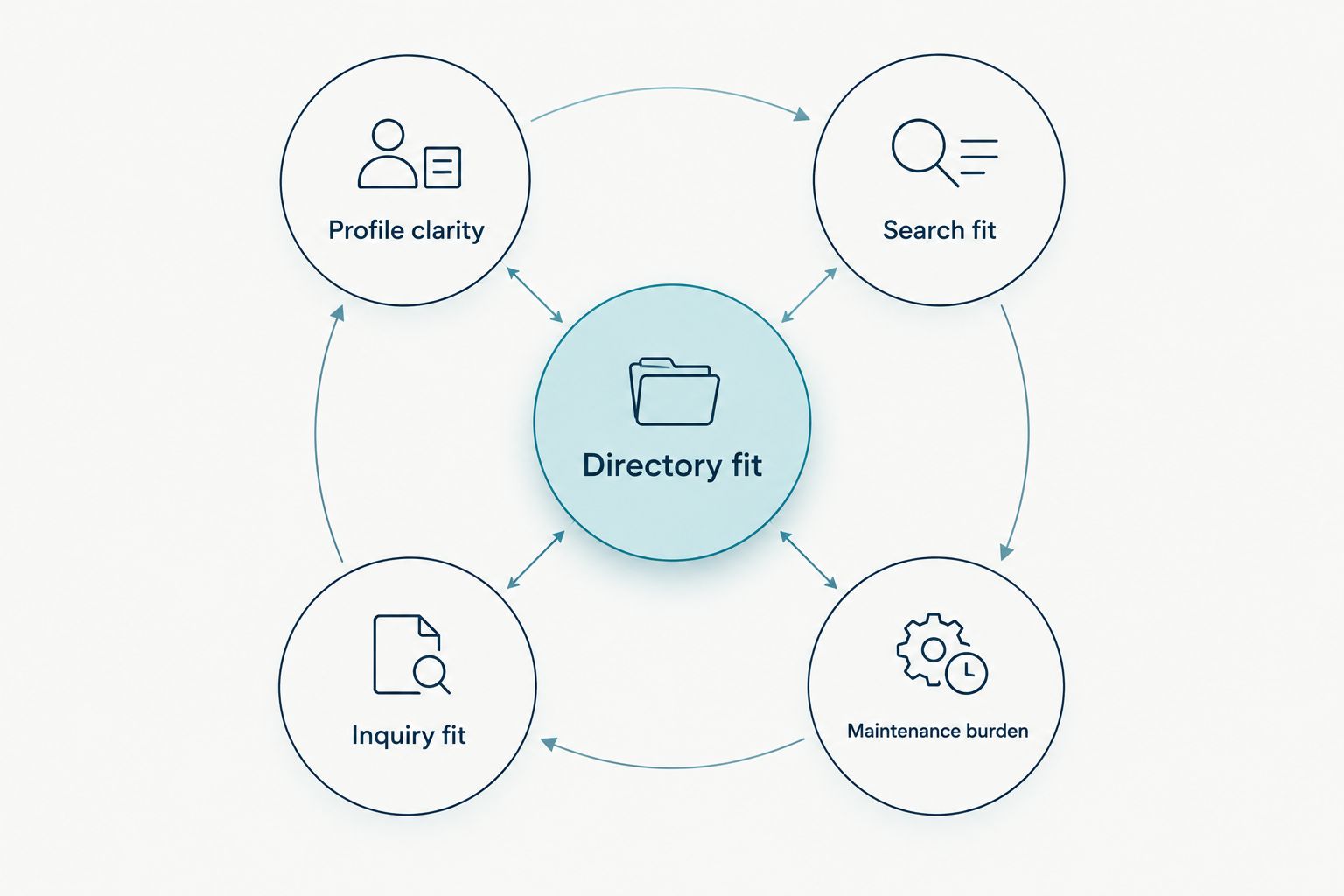
Use 4 checks before adding, replacing, or removing a listing. These checks separate how a profile looks from whether it supports your practice.
- Profile clarity: Can a reader understand whom you serve and what you actually offer?
- Search fit: Does the directory's search experience represent distinctions relevant to your practice?
- Inquiry fit: Do the people who contact you seek services within your competence and scope?
- Maintenance burden: Can you keep the listing accurate without neglecting other practice responsibilities?
Keep a simple record of inquiry sources. Ask prospective clients how they found you, and distinguish an initial inquiry from an appropriate clinical match. Avoid recording unnecessary sensitive clinical details in a marketing tracker.
Change one material element at a time when assessing your listing. If you rewrite your profile and replace the directory simultaneously, you lose a clear basis for understanding which change affected the inquiries you receive.
Do not impose a universal performance threshold. The decision should reflect your practice's actual referral needs and the suitability of the inquiries, rather than an invented benchmark.
When staying with Psychology Today is the right call
Keep Psychology Today when it provides appropriate inquiries and the listing remains manageable to maintain. You do not need to replace a functioning referral channel simply because alternatives exist.
Before leaving, review 3 questions:
- Can you identify suitable inquiries that came through the listing?
- Does the profile accurately describe your current practice?
- Is the alternative solving a problem you can name?
If the first answers support keeping the listing and the last question has no clear answer, staying is a defensible choice. You can pursue relevant education without changing your referral channels.
For 2026, the useful comparison is not which platform sounds most compelling. It is which option addresses the specific task you need completed.
FAQ
What's the best Psychology Today alternative for therapists?
TherapyDen and GoodTherapy are directory alternatives to assess against your practice's referral needs. Neither is a universal winner; compare profile clarity, search fit, and appropriate inquiries.
Is Theembodylab an alternative to a therapist directory?
Theembodylab is an education alternative, not a therapist directory replacement. It offers somatic and trauma-informed certificate programs, professional education courses, and membership subscriptions.
Is TherapyDen better than Psychology Today?
TherapyDen is not automatically better than Psychology Today. Its inclusive positioning provides a reason to assess fit, but your practice's actual inquiry experience should guide the decision.
Should I list my practice in more than one directory?
Use another directory only when you have a clear reason to evaluate it. Track inquiry sources and keep every profile accurate so additional listings serve a defined purpose.
Will a somatic certificate help me get more referrals?
A somatic certificate does not establish that you will receive more referrals. Evaluate education for its professional relevance and evaluate directory listings for their contribution to appropriate inquiries.
What should I check before leaving Psychology Today?
Check whether Psychology Today produces appropriate inquiries and whether your profile accurately represents your practice. Then identify the specific problem a replacement directory would solve.
One last thing
A directory profile is a description of your practice, not evidence that you can deliver everything named in it. Before adding a therapeutic approach to any listing, check that the wording accurately reflects your education, competence, and professional scope.
Choose the referral channel and the learning pathway separately. That distinction keeps your directory decision focused and your professional development purposeful.